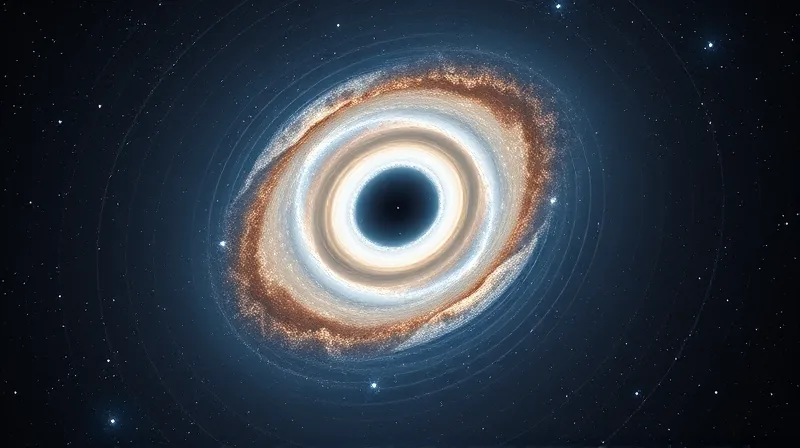
Two Roads to the Same Shadow
There are two ways to convince oneself that a black hole is real. The first is statistical: you watch the stars at the center of a galaxy, and over many years their orbits betray an enormous mass packed into a space too small to see. The second is direct: you build a lens the size of the Earth and catch the light that grazes the edge of the hole itself. These are not rival methods. They are the same claim arriving from opposite directions — one through patient bookkeeping of distant suns, the other through a single, hard-won ring of light.
The statistical road has a Nobel Prize attached to it. Astronomers tracked stars orbiting Sagittarius A, the four-million-solar-mass black hole at the center of our Milky Way, for 17 years, and from those orbits deduced that a supermassive black hole sits there. The direct road belongs to the Event Horizon Telescope, a network of radio dishes spanning the globe, which according to the account this article draws on was founded as a body in 2016 with Shep Doeleman as its founding director. [1] The same account describes him as a senior research fellow at Harvard University, assistant director of Harvard’s Black Hole Initiative, and an astrophysicist at the Smithsonian Astrophysical Observatory.
Doeleman’s route into this work was not linear. By his own account he finished high school at 15, went to college, and found himself burned out — until he saw an advertisement inviting him to Antarctica to run cosmic-ray, aerophotometry, and electromagnetic experiments. He interviewed, and, as the story goes, a 19-year-old got the post. “That’s for me,” he recalled thinking. The taste for experimental research under difficult conditions never left him. Back at MIT in 1988, he has said, he drifted through an X-ray group and a bit of neuroscience before meeting the idea that would define his career: turning the Earth itself into a telescope.
The stellar-orbit work tracked stars orbiting thousands of times the event horizon away. The Event Horizon Telescope reached right up against the edge, to roughly 1.5 times the event horizon. One method infers the monster from the motion of its distant attendants; the other photographs its shadow directly. Neither alone would close the case, and together they leave little room for doubt.
Shrinking the Wavelength, Stretching the Earth
The principle behind the whole enterprise is almost embarrassingly simple. The angular resolution of a telescope — its power to magnify small things on the sky — scales as the wavelength of light divided by the size of the telescope. To see smaller objects, one either shrinks the wavelength or grows the aperture. Astronomers have been growing apertures for centuries: the huge blocks of glass on mountaintops are big both to collect light and to resolve finer detail.
Black holes are the smallest objects predicted by Einstein’s theory of gravity, so the demand is extreme. The supermassive black hole at the Milky Way’s center, at a distance of about 27,000 light years, is described in this account as subtending about 50 microarcseconds across its lensed event horizon. Doeleman’s comparison makes the scale vivid: it is like standing in New York City and reading the date on a quarter held by a friend in Los Angeles. Or, to use a fruit comparison, spotting a tangerine — possibly a pomelo — sitting on the moon.
No single dish can do this. The trick is interferometry, and specifically very long baseline interferometry. A radio telescope in Chile records the incoming waves and time-tags them with an atomic clock, capturing every crest and trough. A telescope in Hawaii does the same. Bring the two recordings together, line up the waveforms, and they behave as though a single giant dish had received them. The Earth becomes the lens. The technical name is long, the idea is not: many small eyes, perfectly synchronized, see as one enormous eye.
The synchronization is where the engineering bites. The clocks are hydrogen masers, which in this account lose about one second every 10 million years. That stability is presented as the minimum required — if the signal jitters because the clock drifts, the waveforms from different continents will never line up. Doeleman remembers watching one of these precision timepieces winched up a helical staircase at the Large Millimeter Telescope in Mexico, at 15,000 feet, then tucked into a wooden enclosure warmed by light bulbs to hold the right temperature. At the top of a mountain, researchers get imaginative about how to swaddle an atomic clock.
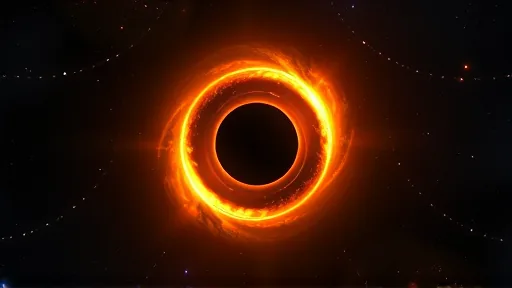
The scaling cuts both ways, and this is the part that repays attention. Push to higher frequencies — 230 gigahertz — and you see through the gas and dust that would otherwise blur the view. Push to more dishes, and the virtual lens fills in faster, because the number of pairwise connections grows as N times N minus one: add one telescope and you gain every connection to it, not just one. The same arithmetic that makes a small array powerful makes a large one transformative.
The first image did not come from the source everyone expected. Sagittarius A was the favorite — “we’re all in love with our own supermassive black hole,” Doeleman said — but it is only four million solar masses, so matter orbits it in about half an hour. During a single night of observing, the thing burbles and changes appearance from moment to moment. M87, by contrast, is described as about six billion solar masses and 55 million light years away: roughly two thousand times farther, but also about two thousand times more massive, so its angular size is about the same, while its timescales are stretched by the same factor. It sits essentially still through a night. That is why M87 came first, and why the announcement surprised astronomers who had expected the home team.
The imaging itself was run as a deliberate exercise in distrust. Four teams, geographically separated, each received the data and were forbidden to talk to one another, each using a different algorithm. The concern was groupthink — the risk that everyone in one room would agree they saw a ring because everyone else did. In July 2018, according to this account, the teams gathered in the basement of the Black Hole Initiative at Harvard and put up their images. All four were rings. “That was a moment where there was a lot of crying and screaming,” Doeleman said. [1] Then came six months of trying to make the rings go away: the algorithms were retrained on everything except rings, taught to love double sources and filled disks, and set loose on the data again. They kept coming back to the ring. Only then was the image treated as robust.
The measurement that followed is the payoff. Laid across the spacetime of the event horizon, a ruler confirmed that for their masses, both black holes are the size Einstein predicted, to within the uncertainty of the observations. That is the best evidence we have for supermassive black holes at the centers of galaxies — and, as Doeleman puts it, another test Einstein passes.
The Spin
Hidden in the Motion
A still image settles mass. It cannot settle spin, and spin is where the next chapter lives. A non-spinning black hole and a maximally spinning one produce rings of almost the same size — the difference is about 4%. The shadow barely registers rotation. But the matter orbiting the hole notices intensely: for Sagittarius A, the orbital period is given here as running from about half an hour when the hole is still to about four minutes when it spins at the maximum rate allowed. That is a clean, measurable signal, and it is the scientific reason to want movies rather than still portraits.
Spin is not a detail. It records how the black hole grew over time, and it governs frame dragging — the warping of spacetime as the hole rotates. To read it, you must watch matter move. Movies would also deliver polarized light, which traces the magnetic fields threading that warped spacetime, and that in turn would let researchers test models in which magnetic fields twist like egg beaters and fling charged particles out at near light speed along the jets seen in radio-loud galaxies.
There is a second target for the same technique: objects that are not black holes at all. Some hypothetical bodies are just large enough to sit slightly outside where an event horizon would be, with a surface of some kind, while mimicking a black hole’s gravity in every other respect. If such a surface existed, it would glow in the infrared. Combining Event Horizon Telescope observations with infrared data is now putting limits on these “black hole mimickers” — the first tests designed to rule out non-black-hole solutions rather than merely confirm the standard one.
The path to movies is concrete, and it is being built on mountains. Five sites are named as critical: Chile, Mexico, Wyoming, the Canary Islands, and a fifth on the slopes of Mount Kilimanjaro in Tanzania. The work with The Open University of Tanzania and other Tanzanian institutes began more than three years ago. His stated rule for the project is blunt: “No is an acceptable answer, full stop” — approval must come from everyone affected at every level, economic, social, educational, and cultural, before anything is built. The altitude of Kilimanjaro makes it the best site on the African continent for these measurements.
The timeline attached to this is the early 2030s, and the processing is expected to be faster than the first time. The original imaging took years because no one had ever imaged a black hole and the team proceeded with extreme caution. With the instrument now well understood and the algorithms battle-tested, techniques in development are expected to produce images within days of collecting data. The same network that once needed two decades to make one picture is being rebuilt to make many, quickly.
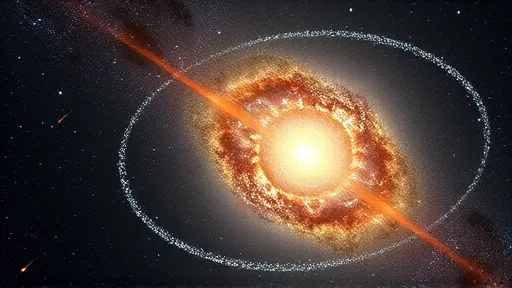
The instrument is also more democratic than its fame suggests. Researchers outside the collaboration can apply for time, and the telescope is trained on many radio-loud quasars, producing the sharpest images available of how jets are collimated and how they keep their shape far from their source. It can even catch natural radio lasers: red giant stars whose molecular envelopes are pumped by starlight, producing bright pinpoints at the stellar limb. With those molecular lines, the Event Horizon Telescope may watch stars breathe in and out.
What remains is the thing that started it all. Doeleman was 13 in 1980, in the Oregon desert, when the clouds parted during a total solar eclipse. What struck him was not just the spectacle but the coincidence: the moon’s angular diameter happens to match the sun’s, so one body can hide the other and reveal what is normally invisible — the corona. A black hole does the same thing to its own light, lensing the emission from behind it into a ring whose size is fixed by mass alone. The ingredients of that ring are nothing but fundamental constants and the mass of the hole. Anyone anywhere in the Milky Way, looking at the same object, would see the same ring.
That is the closing fact, and it needs no forecast to matter. The image is not a portrait of a distant curiosity. It is a measurement of spacetime, taken by a telescope the size of a planet, of an object that does everything in its nature not to be seen. Doeleman’s own summary of the feeling is the most precise instrument in the room: “It fills me with an intense joy.” [1]