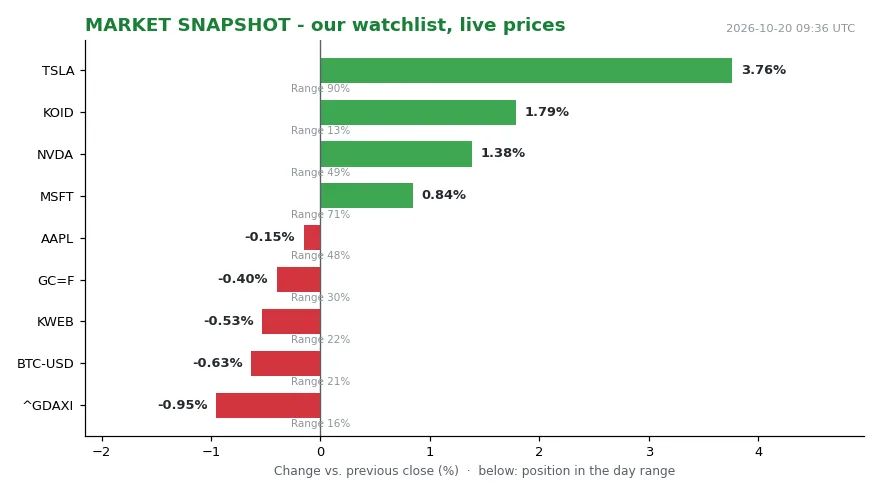
The loudest print on our screens at 09:33 UTC was TSLA at 368.06, up 3.76% and sitting 90% of the way between its daily low and high, close to the day’s high. Widen the lens and this is not a broad move into shares and other riskier assets. It is money leaving one group of stocks and moving into another. MSFT traded at 533.52, up 0.84%, 71% of the way between its session low and high. NVDA was 217.09, up 1.38%, 49% of the way between its session low and high. AAPL printed 342.94, down 0.15%, at 48% of the way between its session low and high — flat and undecided. Europe inverted the picture: ^GDAXI at 25,051.44, down 1.06% and at 1% of the way between its session low and high, effectively pinned to the day’s low. BTC-USD traded at 81,335.82, down 0.62%, at 22% of the way between its session low and high. Gold, GC=F, was 4,143.00, down 0.41%, at 29% of the way between its session low and high. KWEB stood at 24.28, down 0.53%, at 22% of the way between its session low and high. KOID showed 33.05, up 1.79% on the previous close yet at only 13% of the way between its session low and high — a gain that faded through the session.
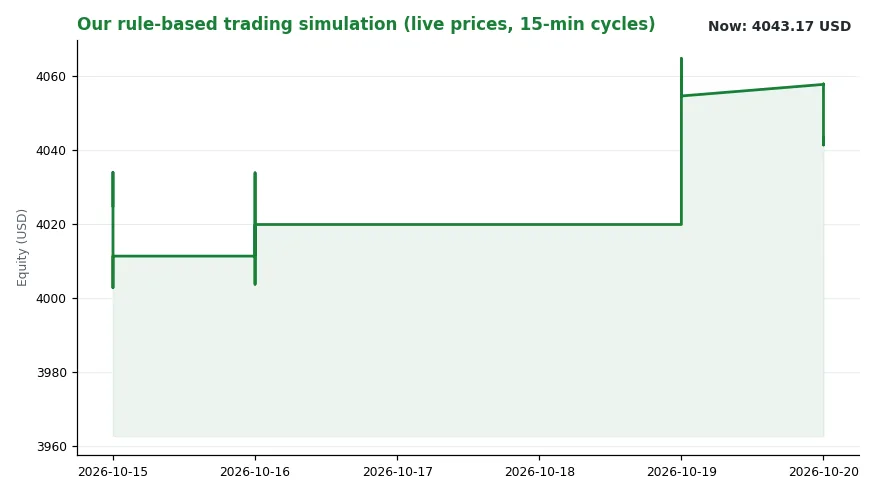
Read together, that is US mega-cap technology bid, Europe sold, crypto and gold soft, and most of the board stuck in the lower half of the distance between the day’s low and high. Our internal score for the market’s current state is falling, with a level of 3.63. The busiest theme in our count of what drove the day’s moves on 2026-10-20 was “central banks”, with 4 events. Our rule-based simulated portfolio, tracked without real money, stood at 4,043.17 USD, down 0.28% against the same time yesterday, holding 2,416.47 USD in cash, with the latest logged non-action, neither buy nor sell, on KWEB at 0.00.
That was the tape before the release. Then the release arrived, and it argued against the tape’s mood.
What the ONS actually reported
Unemployment in the UK fell to 4.7% in the three months to August, down from 4.9%, according to the Office for National Statistics. City economists had forecast a rise to 5%. The drop is the final snapshot of the jobs market before John Healey’s first budget next week. People paid through an employer’s tax payroll rose by 13,000 between August and September, to 30.3 million.
Underneath the headline, the release is less comfortable. Unfilled advertised jobs fell by 21,000 to 691,000 in the three months to September. That is the lowest since 2021, during the pandemic, and a long way from the post-pandemic peak of 1.3 million. Wage growth was mixed. Stripping out bonuses, average pay growth rose to 3.7% from 3.6%. Including bonuses, it fell to 3.7% from 3.9%, which indicates that few bonuses were paid to workers.
Sterling took the headline at face value: the pound rose about half a cent against the dollar to $1.3352.
How a vacancy count reaches the interest rate
The transmission runs through three links. First, hiring demand: unfilled advertised jobs are the forward-looking part of the release, and they are shrinking while the jobless rate falls. Those two can coexist for a while — employers stop posting roles before they stop employing people — and that is the idle-engine picture: fewer job ads, smaller pay awards, no mass layoffs yet. Second, wages: pay growth at 3.7% stays above inflation, which was 3.1% in August. Third, rates: the Bank of England is widely expected to raise interest rates at next month’s meeting of the body that sets interest rates. Rate setters worry that above-target inflation gets baked into pay awards, and that those awards then feed the consumer prices index.
Financial markets expect interest rates to rise to between 4.75% and 5% by the middle of next year, while the consultancy Capital Economics said recent improvements in the labour market were modest and the central bank would probably cap interest rates at 4.25%. That gap between market pricing and one consultancy’s view is the real uncertainty in this release — not the 0.2-point fall in unemployment.
The Work Foundation’s director, Ben Harrison, reads the same release as a drought rather than a recovery [1]: > “The UK is still amidst a jobs drought with vacancies at their lowest for over 12 years outside of the pandemic.” [1]
Suren Thiru, chief economist at the Institute of Chartered Accountants in England and Wales, described the labour market as “running on idle”, with employers limiting recruitment and pay awards “in response to surging cost pressures and pre-budget policy uncertainty” [1]. Thiru pushes the diagnosis further:.” That is a claim about cause, and it deserves to be labelled as one. The series of unfilled advertised jobs is an observation. The link to AI-driven growth and elevated employment costs is an interpretation laid over it.
Who gains, who loses, who decides
The chancellor is the immediate winner. Healey gets a pre-budget print with unemployment falling and, on the government’s own account, an employment rate that is the third highest in the group of seven large advanced economies. He is also set to reject calls to raise tax on profit from selling an asset in the budget, which removes one expected revenue line and one expected source of investor anxiety at the same time.
The Department for Work and Pensions carries the harder half of the story. The ONS estimated 715,000 unemployed young people aged 16 to 24, down by 28,000 on the quarter. Harrison argues that ministers should focus on the fact that the jobless young count remains 54,000 higher than it was 12 months ago, and that the fall in unemployment “should not make the government complacent ahead of next week’s budget”. The work and pensions secretary, Pat McFadden, concedes the point while claiming the headline: > “Today’s figures show the resilience of our labour market with unemployment falling and the UK’s employment rate now the third highest in the G7, despite a backdrop of global uncertainty.” > “That’s why we are working with industry, to bring young people back into the labour market and prevent them from drifting into the welfare system.” Employers sit on the losing side of the ledger, at least in the short term. A smaller pool of advertised roles means less bargaining power for applicants and less pricing power over wages for those already in work. Rate setters are the arbiters: they must decide whether 3.7% pay growth is a residual of past inflation or a source of the next round.
For markets, the release is a rates story before it is a growth story. A firmer pound and a falling trend reading in our own regime layer point the same way — toward discount rates, not toward earnings. That is also why our busiest signal channel was “central banks” rather than anything on the corporate side.
What we watch next
Three scheduled events dominate. September’s inflation figures land on Wednesday, with the rate expected to rise to 3.4% from 3.1%. The budget follows next week, with the capital gains tax decision already trailed. Then the monetary policy committee meets in November, where a hike is widely expected and where the size of it is not settled.
On our own screens the markers are narrower. Whether TSLA holds the top of its range at 90%, or fades the way KOID’s 1.79% gain faded to 13% of range, tells us whether the technology bid has follow-through or is a one-session rotation. Whether ^GDAXI stays pinned at 1% of range tells us whether Europe is selling the UK print or selling something else. Whether “central banks” remains the busiest channel after the inflation release tells us whether the market still reads this cycle as a rates story.
None of that is a forecast. A regime reading of trend=falling, level=3.63 describes the tape we measured at 09:33 UTC, not the tape we will measure next week. The data can turn before the reading does.
The vacancy count in the release is 691,000 and the youth unemployment count is 715,000 — two numbers from the same statistical agency on the same morning, pointing in opposite directions.