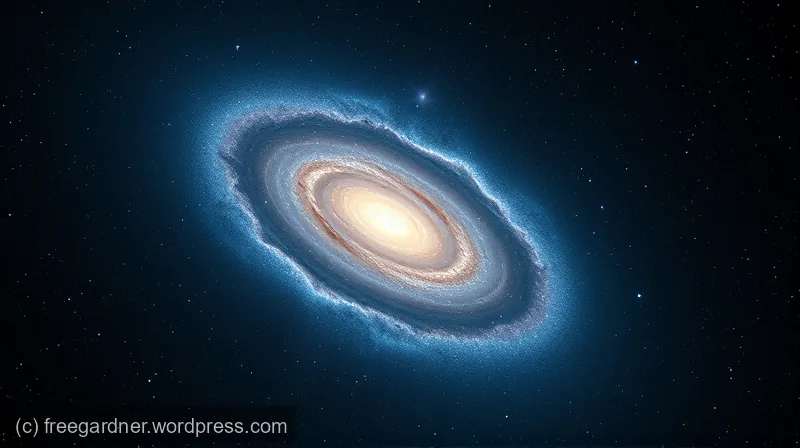
Galaxy M88 loses stars to ram pressure stripping
The gas cloud hits M88’s leading edge like a hand slapping water. It piles up. It compresses. It does not fall inward to form new suns.
Astronomers at the Space Telescope Science Institute in Baltimore watched this happen through Hubble’s Wide Field Camera 3. They saw a spiral galaxy 54 million light-years away, moving through the Virgo Cluster at hundreds of kilometers per second. The galaxy’s rotating gas disk looked shortened along one side. Dust and gas stacked up there, exactly like snow gathering in front of a moving plow [1].
This is ram pressure stripping. It is not a collision between stars. Stars are too far apart for that. It is a collision between a galaxy and the invisible medium that fills the space between galaxies.
The 100-Million-Sun Engine
At M88’s center sits a supermassive black hole weighing roughly 100 million times the mass of the Sun. That is not a guess. Astronomers calculated it from the motion of gas and stars around the core [2].
This black hole is active. It feeds. As gas and dust spiral inward, they heat up to millions of degrees. Some of that material gets flung back out in powerful outflows. Hubble’s ultraviolet images show these streams extending from the galaxy’s heart [3].
Surrounding the black hole is a dense population of older, reddish stars. These stars give M88 its warm central glow. They are ancient. They formed billions of years ago, when the universe was young.
Extending outward from this core are several tightly wrapped spiral arms. They are remarkably symmetrical. Along these arms, Hubble resolved individual bright pink and blue star clusters. The pink comes from ionized hydrogen gas, glowing because of newborn massive stars. The blue comes from young, hot stars that formed recently [4].
Dark clouds of dust thread through the arms. These clouds are the raw material for future stars. Or they would be, if M88 were not on a collision course with its own environment.
The Crowded Neighborhood
The Virgo Cluster contains more than 1,000 galaxies bound together by gravity. It is the nearest large galaxy cluster to our own Local Group. The cluster’s center lies about 63 million light-years away [5].
Galaxies inside this cluster do not sit still. They orbit the cluster’s center of mass. Their paths are determined by the cluster’s gravitational field, which is dominated by dark matter. Astronomers estimate the Virgo Cluster contains about 10^15 solar masses of dark matter, spread across a volume 8 million light-years in diameter [6].
M88 is currently about 2 million light-years from the cluster’s center. It is moving inward. Its trajectory will bring it closest to Messier 87 in roughly 200 to 300 million years [7].
M87 is the giant elliptical galaxy that dominates the Virgo Cluster. It contains a supermassive black hole that was the first ever directly imaged by the Event Horizon Telescope in 2019. That black hole weighs about 6.5 billion solar masses [8].
When M88 approaches M87, the gravitational forces will be enormous. But the real damage will come from something more subtle.
The Invisible Wind
Ram pressure stripping occurs when a galaxy moves through the hot, tenuous gas that fills a galaxy cluster. This gas is called the intracluster medium. It is thin by earthly standards — only about 0.001 particles per cubic centimeter — but it is hot, reaching temperatures of 10 to 100 million Kelvin [9].
As M88 plows through this medium, the pressure pushes against the galaxy’s own gas. The effect is like sticking your hand out of a moving car window. The wind pushes against your hand.
For M88, the wind is strong enough to sweep away its cold gas. Cold gas is the fuel for star formation. Without it, the galaxy cannot make new stars.
Astronomers have already found evidence that this is happening. M88 contains significantly less cold gas than expected for a galaxy of its size, particularly in its outer regions [10]. The gas is being stripped away, pulled out into the intracluster medium, where it will eventually mix with the cluster’s hot gas and never form stars.
This process is not unique to M88. Galaxies in dense clusters throughout the universe undergo ram pressure stripping. The Virgo Cluster is a natural laboratory for studying this phenomenon because it is close enough for Hubble to resolve individual features.
The Hubble Program
The observations of M88 were part of Hubble observing program #18103, led by Principal Investigator David Thilker of Johns Hopkins University [11]. The program aims to understand how spiral galaxies evolve in crowded cosmic environments.
Thilker’s team used Hubble’s Wide Field Camera 3, an instrument installed during the final servicing mission in 2009. This camera can resolve individual star clusters and nebulae in galaxies located tens of millions of light-years away [12].
By examining galaxies in such detail, researchers can see how ram pressure stripping affects star formation in real time. They can measure the gas content, the star formation rate, and the distribution of young and old stars.
The program also uses data from NASA’s Chandra X-ray Observatory, which detects the hot intracluster gas. Combining X-ray and optical observations gives a complete picture of the stripping process [13].
The Historical Context
The idea that galaxies could lose their gas through interactions with their environment is not new. In 1972, astronomers William Mathews and John Baker proposed that ram pressure could strip gas from galaxies moving through clusters [14].
But direct observational evidence took decades to accumulate. The first clear examples were found in the Virgo Cluster in the 1990s, using radio observations of neutral hydrogen gas. Astronomers saw long tails of gas trailing behind galaxies, like the tail of a comet [15].
Hubble’s high-resolution images have transformed this field. They show the stripping process in optical light, revealing the star clusters and dust clouds that are being torn away.
One of the most dramatic examples is IC 3418, a dwarf galaxy in the Virgo Cluster that has a long tail of young star clusters stretching behind it. Hubble images show that stars are actually forming inside this tail, in the gas that was stripped from the galaxy [16].
M88 is not yet at that stage. Its stripping is still in the early phases. But the signs are clear.
The Broader Picture
Ram pressure stripping is one of several processes that transform galaxies as they move into dense environments. Another is harassment, where high-speed gravitational encounters between galaxies disturb their structure. Another is strangulation, where the galaxy’s supply of fresh gas from the intergalactic medium is cut off [17].
Together, these processes explain why galaxies in clusters look different from galaxies in the field. Cluster galaxies tend to be redder and more elliptical, with less star formation. Field galaxies tend to be bluer and more spiral-shaped, with active star formation [18].
This transformation takes time. A spiral galaxy entering a dense cluster may take 1 to 2 billion years to become a quiescent elliptical galaxy. During that time, it passes through intermediate stages, where its spiral structure is still visible but its gas content is declining.
M88 is in one of these intermediate stages. Its spiral arms are still beautiful. Its star clusters are still forming. But the clock is ticking.
The Comparison to Other Galaxies
The Virgo Cluster contains many galaxies at different stages of this transformation. Messier 100 is a spiral galaxy with a high star formation rate and no signs of stripping. Messier 86 is an elliptical galaxy that has already lost most of its gas. NGC 4522 is a spiral galaxy that is currently being stripped, with a clear one-sided distribution of gas [19].
M88 falls somewhere in between. Its gas disk is compressed on one side, but not yet completely stripped. Its star formation rate is still significant, but declining.
Astronomers use a metric called the gas depletion time to estimate how long a galaxy can continue forming stars. For M88, the depletion time is about 1 to 2 billion years, assuming no further gas is added [20]. That is short compared to the age of the universe, which is 13.8 billion years.
The Supermassive Black Hole Connection
The black hole at M88’s center adds another layer of complexity. Active galactic nuclei can heat the surrounding gas, preventing it from cooling and forming stars. This process is called AGN feedback [21].
In some galaxies, AGN feedback is strong enough to quench star formation entirely. The black hole’s energy output heats the gas to millions of degrees, making it impossible for the gas to collapse into stars.
For M88, the black hole’s outflows may be helping to strip gas from the galaxy’s center. Combined with ram pressure stripping from the intracluster medium, the galaxy is losing gas from both the inside and the outside [22].
This double assault may accelerate M88’s transformation. It may become a red and dead galaxy faster than it would if only one process were acting.
The Timescale
200 to 300 million years from now, M88 will make its closest pass by M87. At that point, ram pressure stripping will be at its maximum. The galaxy may lose 50 to 80 percent of its remaining cold gas in a single passage [23].
After that, M88 will continue orbiting the cluster center. Each passage through the cluster’s dense core will strip more gas. Over 1 to 2 billion years, the galaxy will become gas-poor and star formation will cease.
But the stars that already exist will remain. The old, reddish stars at the galaxy’s center will continue to shine. The galaxy will become an elliptical galaxy, a fossil of its former self.
The Philosophical Statement
This is what the universe does. It takes beautiful things and it strips them down. It takes spiral galaxies and it turns them into elliptical shells. It takes gas clouds and it scatters them across intergalactic space.
But the stars remain. The light from those ancient, reddish stars will travel across the cosmos for billions of years, carrying the memory of what M88 once was.
Physics does not care about beauty. It cares about forces, pressures, and timescales. Yet within those forces, beauty emerges. The spiral arms that are being stripped today are the same arms that formed countless generations of stars. The gas that is being swept away is the same gas that will one day form new stars in other galaxies.
M88 is not dying. It is transforming. And in that transformation, it reveals the fundamental nature of cosmic evolution: nothing stays the same, nothing is permanent, but everything leaves a trace.
Sources
1. Space Telescope Science Institute
2. NASA