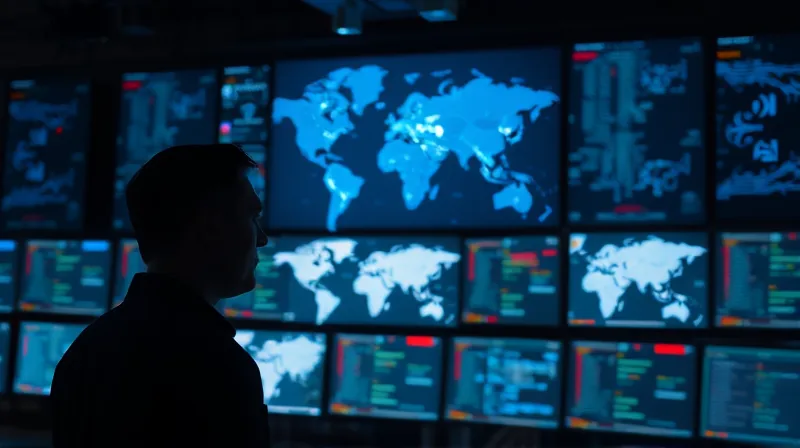
Assume the Toast, Not the Fire
Most days it is burnt toast. Occasionally it is a fire. That is the daily job of the people who watch the Internet’s pulse, and the first lesson they teach is a blunt one: assume the toast.
Doug Madory, head of Internet analysis at the network security firm Infoblox, monitors as many as a dozen network outages a day. [1] Only around “one in a thousand,” he says, turns out to have been caused by hackers. “One’s default position should be that it isn’t a cyberattack,” Madory says, “unless there is some concrete evidence to the contrary.” [1] Matthew Prince, CEO of the Internet infrastructure company Cloudflare, has lived through the reverse of that presumption often enough to distrust it. “I’ve just seen enough times where we thought maybe it’s a cyberattack and it turns out it’s not. Sometimes it will be, but typically not,” he says. [1] His read on the current stretch of failures is flatly unromantic: “Right now, most of what we’re seeing is the standard background noise. Stuff breaks, and that’s just the nature of complex systems.” The scale of what broke is what made the week feel scripted. Over four consecutive business days, a mass Microsoft exchange outage cut IT services for thousands of companies. A Federal Aviation Administration tech screw-up grounded airplanes across the country. A software problem at JPMorgan Chase caused another round of disruption. A United Airlines system glitch delayed flights again. And downtime on an NSA classified network left agency staff at Fort Meade sitting at home, waiting to be told they could return. Five failures across four business days, with rising fears of AI-enabled hacking in the background. The temptation to connect the dots is almost physical.
Yet no evidence ties any one of these failures to another, let alone to hackers. The improbable, sequential timing sent many Americans doomscrolling for signs of foul play. Analysts had to do the opposite: resist the vibes and check the plumbing.
Where the Ground Truth Actually Lives
When the elevator stalls, the alarm may shriek and the sprinklers may hiss — not because there are three emergencies, but because there is one.
João Tomé, the Internet research editor at network data company IPinfo, puts the frequency plainly. “Most big outages that look like attacks are self-inflicted,” he says. The usual suspects form a short, boring list: a bad update, a configuration change, a cable cut, a power failure. Nothing on it requires an adversary. That is why the first move in any investigation is to look at the mundane causes before the dramatic ones.
The muddle gets worse because it is genuinely hard to tell which services are down. When a foundational service like a big cloud provider fails, the failure cascades outward to every customer leaning on that infrastructure. In this week’s bank disruption, multiple banks appeared to be struggling, but they all seem to have been tied to certain inter-institutional transactions involving JPMorgan Chase. The same illusion shows up in telecom: several wireless carriers may look like they are failing, when every dropped call actually routes through one network that is down. Add false reports — accidental or anecdotal — of additional outages, and the picture turns to fog.
The fog has landmarks, though, and search engines can find them. If a major tech company’s site or service may be down, check its verified social media accounts or the “newsroom” press release section of its website. Government agencies and other institutions follow the same pattern. Then there are the “status dashboard” pages that large digital platforms publish precisely to show whether each component of a service is working or struggling. Amazon Web Services, Google Cloud Platform, and Microsoft Azure all run these landing pages. So do Meta’s business products, Google Workspace, telecom companies, and AI companies. During a major incident, companies often thread incremental restoration updates directly onto the dashboard.

When a cascading failure spreads across many services at once and the point of failure is unclear, broad-scale network monitoring becomes the next instrument. Amanda Meng, a research scientist at Georgia Tech who helps run its Internet Outage Detection and Analysis service, known as IODA, points to IODA’s own data and its social media accounts on BlueSky and Mastodon. She also names Cloudflare Radar and Watch the Net as tools worth watching. Madory posts his own outage findings on his social accounts. Together these sources turn rumor into record: a university detection service, a network-data firm, a cloud infrastructure giant, and individual analysts all publishing pieces of the same puzzle in public.
When IODA sees evidence of a disruption, “we’ll look at the timing of it, the start, the end, the network affected, anything we can find out about it, and then try and connect it with what we see from reporting,” Meng says. Scope, location, and timing narrow the field. A single network hit by a buggy update looks different from a region severed by damage to a fiber optic cable. Rarer still: a cyberattack, or a government deliberately cutting off Internet access to its citizens to stifle protests. Even with those clues, Meng sends investigators back to the operators. “Usually the operators have the most information about what’s actually going on,” she says.
Confessions, Claims, and the Clock
Here is the tell that separates accident from attack more reliably than any dashboard: who is talking, and what they are saying. When a company or agency admits a mistake, the mea culpa usually confirms a tech mishap. When downtime is the work of hackers, the hackers themselves often cannot resist the microphone.
Ransomware gangs, perhaps the most common source of serious malicious Internet disruption, advertise their breaches on dark web pages that list targets for extortion. Some pages carry countdown timers, pressure applied in public to force payment before stolen information leaks. Two of the worst cyberattacks in history, the NotPetya and WannaCry worms, left self-perpetuating code behind that planted ransom messages on infected machines; those messages raced across social media as the attacks unfolded. Ideological “hacktivist” groups — or state-sponsored hackers posing as hacktivists — often take credit on X, Telegram, or their own websites, from where the claims spread into news reports within hours.
None of that testimony is trustworthy on its face. Hacker groups exaggerate, misdirect, or lie when it serves their purposes. And some of the most significant mass hacking incidents have produced no public message at all. The Mirai attack on the Internet infrastructure company Dyn in 2016 took down thousands of websites, and the hackers responsible said nothing. Silence, in other words, settles nothing either way.
When neither the perpetrator nor the target confirms an attack, confirmation can arrive first from a government agency such as the Cybersecurity and Infrastructure Security Agency, or from threat intelligence researchers at private cybersecurity firms. Investigators sometimes post findings to their websites or share them with media. But confirmed conclusions often take days, weeks, or even months. That delay is part of the method, not a failure of it.
If nothing else settles the question, patience does. “It’s going to get a little conclusive at some point,” Madory says. “Sometimes you just have to just sit and wait.” A faulty update, a power outage, or a cascading bug can often be fixed quickly. “A rollback takes minutes or hours,” Tomé says, describing the fix for a bad update that introduced a bug. “Ransomware takes days or sometimes even weeks.” Determined hackers who have maximized damage, who shift tactics to outsmart defenders, or who remain inside a breached network can keep an outage running far longer. “For better or worse, modern society is completely mediated through Internet-based services. They have outages from time to time. And that’s a reality I don’t think we’ll ever completely eliminate,” Madory says. What stays open is the verdict on any single incident — and the habit of mind that keeps it open. “If you’re immersed in that world of looking at outages for years on end, then they don’t really surprise you,” he adds. “You just try to understand what’s different about each one. And maybe what we can learn from it.”
Sources
- Ars Technica — Quote source (original article) — Original: [](https://www.wired.com/story/how-to-tell-if-its-a-cyberattack-or-just-an-outage/)
Mentioned organisations (context, not sources)
- Infoblox — Organisation (homepage)
- Cloudflare — Organisation (homepage)
- Microsoft — Organisation (homepage)
- Federal Aviation Administration — Organisation (homepage)
- JPMorgan Chase — Organisation (homepage)
- NSA — Organisation (homepage)
- IPinfo — Organisation (homepage)
- Amazon Web Services — Organisation (homepage)
- Google Cloud Platform — Organisation (homepage)
- Meta — Organisation (homepage)