The Year That Had No Sunrise
An experiment designed to measure how four people hold up under a year of isolation has just ended in Houston, and its most striking instrument was not a sensor. It was four people who could not step outside.
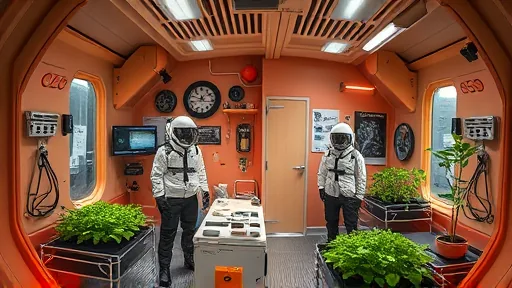
Ross Elder, Ellen Ellis, James Spicer, and Matthew Montgomery left NASA’s Mars Dune Alpha habitat on Oct. 31, completing the agency’s second yearlong Mars surface simulation. [2] They had entered the roughly 1,700-square-foot, 3D-printed structure at Johnson Space Center on Oct. 19, 2025, as the crew of CHAPEA Mission 2 — Crew Health and Performance Exploration Analog. That is 378 days without windows. No sounds of the outside world. No real-time calls with family or friends.
The habitat is the size of a modest apartment, and it stood in for a planet. Inside it, the four ran simulated Marswalks, robotic operations, habitat maintenance, exercise, and crop cultivation. They also lived with a communication delay of up to 22 minutes each way — the time a radio signal needs to cross the gap between Earth and Mars. Conversations had to be scheduled like shipments.
The numbers alone do not capture the oddity of the arrangement. Four adults volunteered to live in captivity, and one of them said so plainly. “It’s been a hell of a year, analog astronauts living in captivity of our own free will,” Ellen Ellis told Reuters after emerging. [2] The phrase is precise: captivity, chosen.
A Year Measured Against Other Years
While the four were sealed inside, the world outside kept producing milestones that gave their isolation a scale to measure against.
NASA astronaut Jack Hathaway completed a 237-day mission aboard the International Space Station and returned to Earth during the crew’s confinement. NASA also marked 25 years of continuous human presence aboard the space station on Nov. 2, 2025. [1] Hathaway put the crew’s year in perspective directly: “The reality of what you guys did here required immense physiological and psychological strength, teamwork, and human grit,” he said.” And the rehearsal has a predecessor. The first CHAPEA mission concluded on July 6, 2024, after its own four-person crew spent 378 days in isolation between 2023 and 2024. Two missions, identical duration, different crews — and the second one now feeding data into the same program.
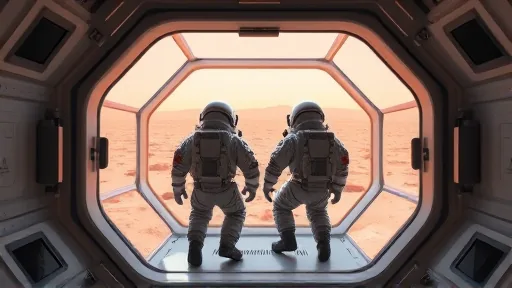
The habitat’s demands were not abstract. Elder, who brought a U.S. Air Force experimental test pilot’s approach to commanding the crew, found the simulated Marswalks and robotic exploration “uncannily similar” to operating as part of a flight. From inside the habitat, the crew remotely operated a drone and a rover to survey terrain and identify or collect rock samples. Preparing suits, completing airlock procedures, and making long traverses consumed time and stamina. Elder emphasized nutrition, exercise, and rest as essential to sustaining that pace — a finding about the body that arrived through the schedule rather than through a sensor.
Spicer, who brought experience in satellite communications and spacecraft development to the habitat’s maintenance work, compared the year to living aboard a submarine or a boat, where limited supplies and space shape daily decisions. The crew tracked consumables from dish soap to respirator filters and carefully managed food and water. He was surprised by how little he missed constant news and social media updates; the break from distraction helped him focus. Inside the habitat, stories and jokes around the kitchen table brought laughter to demanding days. He told his crewmates they had made the year “not a chore, but a joy.”
The Ground Team Nobody Was Watching
Ellis, a U.S. Space Force officer with experience at the National Reconnaissance Office, served as medical officer and helped organize biological sample collections and prepare supplies for the crew’s health research. She described the discipline required to follow every procedure carefully as routines became familiar, and she found “a kind of tactical creativity” in solving problems with the tools at hand. Her most salient lesson was not about the crew at all: “When I look back on the mission, the most salient point I’ve learned is that a future Mars crew requires a highly integrated ground team.” She credited exercise, behavioral health, nutrition, and medical specialists for their coordinated support throughout the mission.
Montgomery, described at egress as the “Swiss Army knife of crewmates,” brought hardware engineering, robotics, technology startups, and independent film experience. He helped identify rock samples collected during simulated Marswalks, set up the habitat’s 3D printing capabilities, and carried his indoor agriculture background into a seed-germination experiment using a control and simulated Martian soil. He learned to investigate anything that gave him pause — speaking up helped surface concerns with equipment, safety, and data quality — and to give himself more grace when an outcome fell short. “It’s really the people that make exploration possible,” he said.
The data now has a destination. Two weeks of post-mission evaluations and debriefs will help researchers interpret the crew’s readings alongside their experiences. Grace Douglas, CHAPEA’s principal investigator, said the research will help NASA weigh human health and performance risks against resources including crew time, communication capacity, and food and water system designs — and she noted that many resource challenges facing space explorers mirror problems on Earth. Sara Whiting, CHAPEA project scientist, said the data arrives as NASA plans how astronauts will live and work at the Moon Base, humanity’s first lunar outpost near the Moon’s South Pole. “This is really the now moment for this kind of data,” she said.
A habitat in Houston, sealed for 378 days, produces knowledge meant to be spent at the lunar South Pole first and on Mars later. The door opened in October. The measurements are only beginning.
Sources