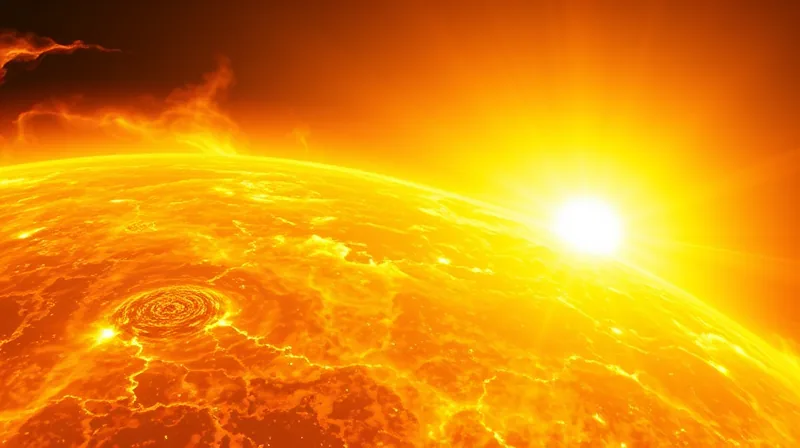
First Direct Images of Solar Whirlpools
First Direct Images of Solar Whirlpools
As of 2026, the Daniel K. Inouye Solar Telescope has produced the most detailed images of the sun to date.
The new pictures show characteristic swirls of magnetized plasma across a 19-kilometer-wide patch of the sun’s surface. [1] For the first time, those swirls have been directly observed on the sun’s surface. No direct observation of them existed before.
The telescope sits near the summit of Haleakalā volcano in Maui, Hawaii. It is the largest solar observatory in the world. Its mirror measures 4 meters in diameter. That mirror gives the telescope a higher resolution on the sun’s surface than any earlier instrument.
Earth’s turbulent atmosphere would otherwise blur the view. Engineers built an adaptive system to correct that blurring. Leon Ofman, an astrophysicist at the Catholic University of America in Washington, D.C., was not involved in the study. He says this correction was crucial. It fixed distortions that would have destroyed such fine-resolution images.
A Familiar Instability on an Unseen Stage
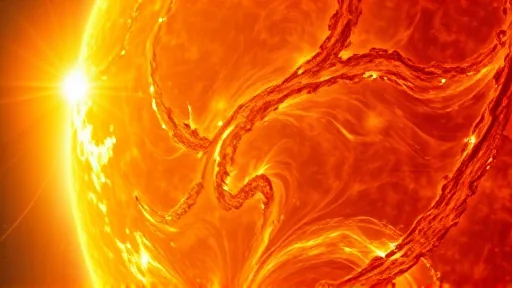
The swirls are a signature of the Kelvin-Helmholtz instability. That instability occurs when two fluid layers move next to each other at different speeds. A small disruption in the balance between the layers causes curling motions. Those curls roll up and grow into waves.
Scientists have seen this instability in some ocean waves. They have seen it in clouds. They have seen it in Jupiter’s atmosphere. They have even seen it in the sun’s outer atmosphere. On the sun’s surface, they had never seen it directly. The Inouye telescope has now made that possible.
The sun’s surface holds millions of solar magnetic elements. These are regions of highly magnetized plasma. Plasma is an electrically charged gas. Energy from that plasma can be transferred, stabilized, and transformed by swirling motions. David Kuridze, an astrophysicist at the National Solar Observatory headquartered in Boulder, Colo., says the instability occurs everywhere. [1] It happens, he says, at the boundaries of solar magnetic elements.
Why was this so hard to see? Kuridze explains that detecting these structures requires resolving details down to the 20-kilometer scale. That level of detail was simply invisible until now. The physics was not new. Only the direct view was missing.
Where Solar Explosions May Begin
The new images do more than record the sun’s surface. They provide evidence for a type of fluid instability that might explain the sun’s outbursts, such as solar flares and eruptions. On the sun’s magnetized surface, the instability can convert swirling plasma into tension. The plasma acts as a fluid in this process. The tension twists the magnetic field. That twisting creates energy. That energy can cause a solar explosion.
The observations were reported in the journal Nature on August 5; an independent parallel research effort from a separate organization has also studied Kelvin-Helmholtz instability on the sun’s surface. Understanding how magnetic structures on the sun’s surface transfer energy in fluidlike motion could provide insights into how solar activity develops. Ofman says we are just beginning to understand that process. We need to study it, he says, to understand all the stages of energy transfer from the sun’s interior to the surface. From there, it can affect Earth and beyond.