Kilaueas Fountain Era Explains Episodic Eruptions
A Summit Crater That Changed Its Behavior
In December 2024, the ground above a summit crater on the Big Island of Hawaii began to swell and tilt. [2] Instruments registered the deformation. What followed over the next twenty-one months was something volcanologists had documented only three times since 1823 — and never at this pace.
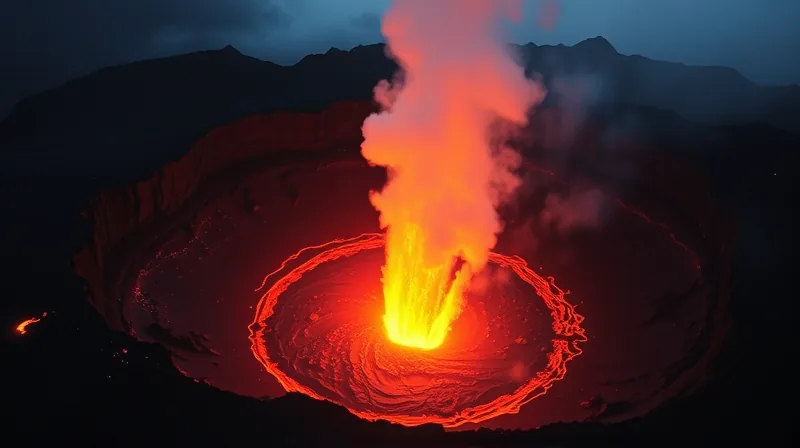
Kilauea, Hawaii’s most active volcano, entered what researchers now call its fountain era. The opening act came at dawn on December 23, 2024, with an eruption inside Halema’uma’u, the bowl-shaped depression at the volcano’s summit. From that moment forward, the volcano did not settle into the long, continuous lava flows that defined its previous two centuries of near-constant activity. Instead, it began firing discrete, episodic bursts of molten rock into the sky, one after another, separated by gaps of minutes to weeks.
By September 2026, the count had reached 54 separate fountaining episodes. [2] Each episode lasted typically for hours, then stopped. Then, days or weeks later, another one began.
The distinction matters. During a volcanic eruption, which can persist for hours, months, or even years, an occasional lava fountain is not unusual. What is rare is repetition — distinct, separated bursts within a single eruption. Before December 2024, Kilauea had produced such clustered spurts only three times in over two hundred years.
The Piston Beneath the Rock
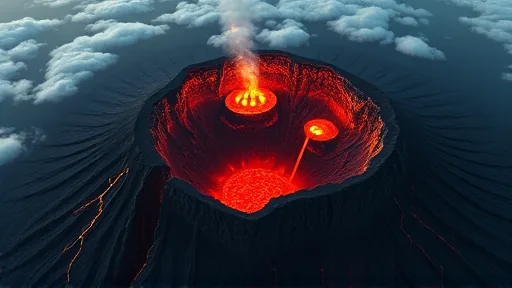
To understand what drives these fountains, researchers needed to answer a fundamental question: what initiates, sustains, and ends an episodic burst? Two competing ideas had circulated for years. The first held that water dissolved in magma — the underground, molten mix of rock and gas — rising from deep inside the volcano suddenly escapes as the pressure changes, leading to a burst of pyrotechnics. The second proposed that a carbon dioxide-rich foam atop the trapped magma, like the pressurized froth over a shaken bottle of soda, suddenly and violently expands.
Kilauea offered a rare chance to test both. The volcano is instrumented with an array of sensors that continuously record seismic activity, temperature, low-frequency acoustics, ground swelling and deflation, and the gases that escape from the summit. Ashton Flinders, a research geophysicist at the U.S. Geological Survey’s Hawaiian Volcano Observatory in Hilo, and his colleagues sifted through more than a year of this multiparameter record. [1] A pattern emerged. Before each fountain, the floor of Halema’uma’u would inflate and tilt, suggesting magma was gathering beneath. The deformation was systematic, not random. By tracking it, the team could forecast when the next episode would begin.
As the eruption matured and the fountains continued, a pattern emerged, first appearing before the fourteenth fountain. Just before that eruption, the instruments detected a repetitive sequence: minutes-long bursts of seismic energy paired with low-frequency acoustic waves. The researchers interpret these signals as the buildup and release of trapped gases in the magma, causing it to rise and fall through narrow vents in the rock — much like a piston moving up and down inside a car engine. [1] The gases act as the driving force, pushing magma upward until the pressure overcomes the resistance, then letting it fall back as the eruption drains the conduit.
The gas composition told its own story. The volcano released some sulfur dioxide during the episodes, but relatively little carbon dioxide. [1] That absence undercuts the foam hypothesis. If a CO2-rich froth were driving the fountains, carbon dioxide would be a major component of the emissions. It was not. The data point instead to water dissolved in magma escaping as pressure changes, and to the piston-like rise and fall of gas-charged magma through narrow vents.
Flinders and his colleagues call this a preliminary glimpse. Many questions remain about how magma reservoir pressure, conduit permeability, and the exsolution of dissolved volatiles interact to control the onset of fountaining. The current eruption has already provided something no previous episode could: a continuous, multiparameter record of episodic fountaining from start to finish, repeated 54 times.
Where Volcanology Meets the Physics of Fluids
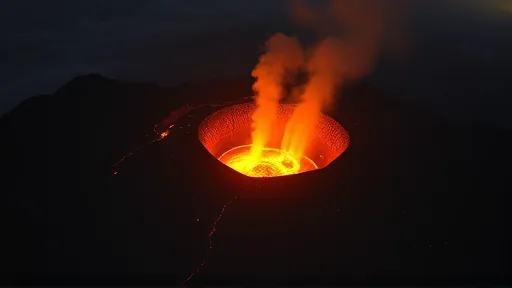
The Kilauea record does more than explain one volcano. The same physical process — gas bubbles forming, growing, and escaping from a liquid — also governs how fluids move through porous media in geothermal systems and how dissolved gases behave in industrial foams.
What makes Kilauea exceptional is that researchers can watch the process in real time, with instruments that measure the ground moving, the gases escaping, and the seismic waves generated by the magma itself. The 54 episodes have given scientists a library of repeated natural experiments, each one a test of the same underlying physics. The next step, as Flinders and his team describe it, is to use this eruption to constrain the timing, evolution, and processes driving episodic fountaining globally.