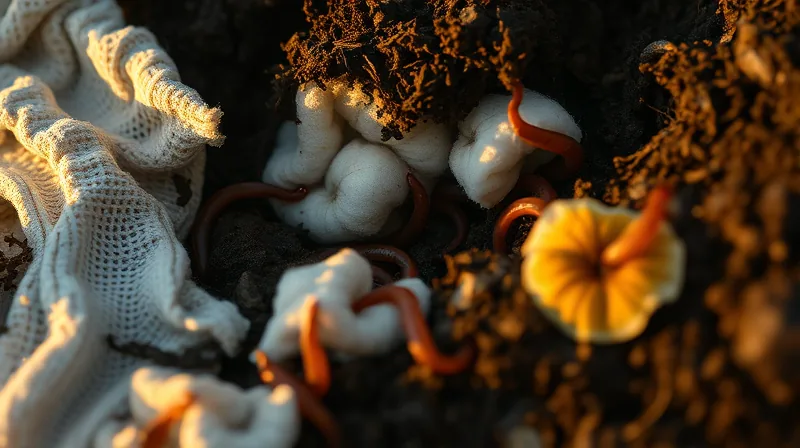
Citizen scientists bury underpants to test global soil health
A Playful Test With Serious Soil Science
The experiment sounds like a prank: bury a pair of cotton underpants in the ground, wait two months, dig them up, and see what is left. But for a team of agroecologists, this was a serious research method. The underpants served as bait for soil organisms - worms, mites, fungi, and bacteria - that break down organic material.
Cotton is pure cellulose, a complex organic compound that decomposes at a measurable rate. When soil is healthy and full of microbial life, the cotton degrades quickly. When soil is depleted, the fabric stays largely intact. This makes underwear a simple, low-cost tool for assessing biological activity beneath the surface.
The project, called “Proof by Underpants,” involved around 1,000 volunteers across 25 countries. Participants buried their cotton underwear in their gardens, fields, or forests, then documented the condition of the fabric after eight weeks. The results were compiled and published in the journal Plants, People, Planet.
Marcel van der Heijden, an agroecologist at Agroscope and the University of Zurich and co-author of the study, said the findings were striking. “Our results show that how soil is managed can significantly affect both soil life and soil quality,” he stated. “Healthy, biologically active soil is crucial for fertility, nutrient cycling and many other ecosystem services
Why a Teabag Was Not Enough
Soil scientists have long used a method called the “teabag index” to measure decomposition rates, a technique developed by researchers at the University of Utrecht. Commercially available teabags are buried, retrieved, and weighed to determine how much organic matter has broken down. The method works, but it has limitations.
The teabag index requires careful handling and specialized equipment, such as a fine-scale balance. This makes it difficult to run large-scale studies across many locations. Van der Heijden and his colleagues wanted a method that anyone could use without technical training.
Earlier research had shown that cotton strips could serve as decomposition indicators. The team realized that cotton underpants offered the same advantage, but with a lower barrier to participation. Volunteers did not need lab equipment - they just needed a shovel, a patch of soil, and a willingness to part with a piece of clothing.
The citizen science approach allowed the researchers to gather data from 25 countries simultaneously, a scale that would have been impossible with traditional methods. Participants photographed the remains of their buried garments and sent the images to the research team. This crowdsourced data provided a global snapshot of soil health that no laboratory study could match.
The Limits of a Decaying Fabric
The study confirms that land use matters. Soils under different management regimes - tilled farmland, permanent grassland, forest, or urban gardens - showed different decomposition rates. The researchers found that human activity at a site significantly influences the biological diversity of the soil beneath it.
This finding aligns with smaller studies that previously documented the link between land use and soil microbial communities, such as the global soil biodiversity survey led by the German Centre for Integrative Biodiversity Research. But the underpants project adds a new layer: scale. The sheer number of sampling points across national borders strengthens the case that soil management is a global concern, not just a local one.
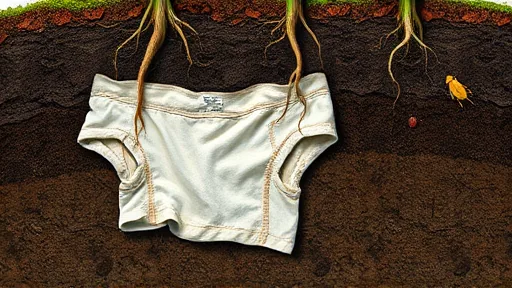
However, the method has boundaries. Cotton decomposition measures one aspect of soil health - the activity of decomposer organisms. It does not reveal nutrient levels, pH, heavy metal contamination, or the presence of specific pathogens. A pair of intact underpants tells you that decomposition is slow, but not why.
The authors acknowledge that the teabag index and cotton strip methods each capture only part of the picture, and they point to ongoing work by the Soil Biodiversity Observation Network as a complementary effort to standardize soil health metrics worldwide. The new study does not replace those tools; it complements them. The playful approach succeeds as a public engagement tool, bringing soil science to a wider audience, but it remains a screening method rather than a diagnostic one.
Soil health has been declining worldwide, according to the authors. Agriculture depends on fertile, biologically active soil for food security, and the global ecosystem relies on nutrient cycling that soil organisms perform. The underpants experiment offers a glimpse into that hidden world - but it cannot yet explain every factor that shapes it.
Sources
1. Agroscope