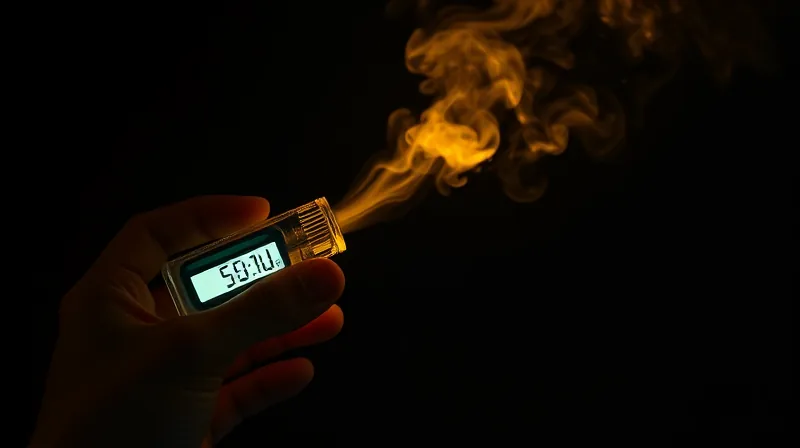
Handheld Breathalyzer Detects Fat Burning in Real Time
The Science That Could Change Weight-Loss Tracking
For decades, the only reliable way to know whether the body had switched from burning carbohydrates to stored fat required a needle, a clinic visit, or an MRI machine. That assumption now has to be revised. A new handheld breathalyzer can detect the moment the body enters ketosis — the metabolic state when free fatty acids become the primary fuel — simply by analyzing a single exhalation.
The device works by measuring acetone, a volatile compound released in the breath when fatty acids break down in the liver. Acetone is produced during periods of fasting, low-carbohydrate diets, or high-intensity exercise. The molecule travels from the liver through the bloodstream to the lungs, where it escapes in the air we exhale.
What sets this device apart from existing consumer breath testers is a two-step improvement. First, a smartphone application guides the user’s exhalation — controlling flow rate and volume to standardize the sample. Second, inside the device, acetone is physically separated from the rest of the breath before measurement. That separation matters because the humidity of exhalation, along with the temperature and moisture of the surrounding environment, frequently corrupts the readings of earlier devices.
The team that built the prototype is led by Andreas Güntner, a researcher in molecular sensing at the Swiss Federal Institute of Technology (ETH) in Zurich. [2] Two of the authors, including Güntner, hold shares in a university spin-off company called Alivion, which has commercialized the device under the name Nutrion. ETH Zurich holds the patent for the underlying technology. [2] The device is designed for home use — no clinic, no technician, no blood.
Strong Agreement With a Lab-Gold Standard in Small Tests
The current generation of consumer breath-testing devices for ketones has been widely available but poorly documented. Many have not undergone rigorous scientific validation. Others rely on direct measurement of ketones from the exhaled breath and cannot correct for the interference of water vapor or humidity. Those shortcomings have been noted repeatedly in the scientific literature.
The research team recruited twelve healthy volunteers.
The handheld device showed strong agreement with the PTR-MS measurements across the entire range of interventions.
The human body does not always stay in ketosis. It may enter that state for an hour after a difficult run, or for days during a prolonged fast. Until now, the only way to confirm that shift in real time was a blood test or an expensive body-composition scan in a clinic. The breathalyzer closes that gap by delivering a number within seconds.
The Question That Remains About Accuracy in the Real World
The sample size is too small to know how the device will perform across a wide range of ages, body compositions, health conditions, and breathing patterns.
The researchers state explicitly that the device should be tested in more people to confirm its accuracy. That call for larger trials is the open question left by the findings. A dozen volunteers can show that a technique works in principle, but they cannot reveal how often it fails in practice.
Other teams have also been working on breath-based methods to track fat metabolism. In 2025, a group including Marfatia, Ni, Preda, and Nasiri published a review of biosensors for acetone detection in the journal Biosensors. Two years earlier, in 2021, Alkedeh and Priefer published another overview of breath-testing technologies in that same journal. Both articles point to the same barrier: until recently, no handheld device could adequately separate acetone from the mix of water vapor and other molecules in the breath of a person who has just exercised or eaten.
The device from ETH Zurich adds the smartphone guidance and the internal separation step that earlier devices lacked. Those two features appear to solve the humidity interference that had made earlier consumer devices unreliable. But whether those solutions hold in a larger, more diverse population is not yet known.
For now, a person using the device can know within seconds whether their body is burning fat. The question is how often that reading will be correct when the user is elderly, has a chronic lung condition, or lives in a very humid climate. The answer will come only from studies with hundreds, not dozens, of participants.
Sources
1. DOI: 10.1038/d41586-026-02295-w
2. ETH Zurich
3. Alivion