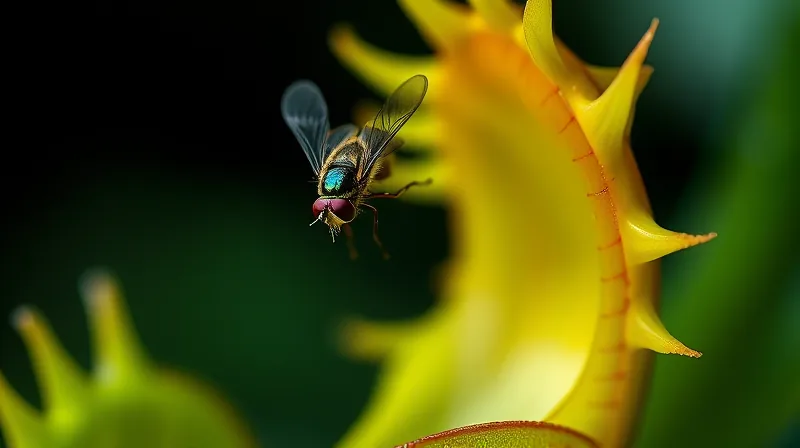
The Trap That Thinks Like a Muscle
The Venus flytrap has baffled science for over a century: a plant that moves faster than a blink. A fly lands on a leaf. The leaf is a mouth. The mouth snaps shut. The fly is gone.
For a long time, we thought we knew how this worked. The old idea was simple and it made sense. Water, like a hydraulic fluid, would pump from one side of the trap to the other. One side would shrink. The other side would swell. The leaf would bend. It was the same principle that makes a garden hose stiffen when you turn on the tap. Charles Darwin called it one of the most wonderful plants in the world, but he never understood the snap.
That old water-pump theory was the thesis. It was the story we told ourselves for decades. But a new study, published in the journal Science, has turned that story on its head. Yoel Forterre, a physicist at Aix-Marseille University in France, decided to test the old theory with a simple question: How fast can water actually move through a Venus flytrap? [1]
The answer was slow. Very slow.
Forterre and his team measured the time it took for water to travel through the trap tissue, both through individual cells and through the whole leaf. It took between 30 and 60 seconds for water to move from one side to the other. But a Venus flytrap closes in less than one second. An insect does not wait for a minute. The math did not add up. The water pump was too slow to be the engine of the trap.
The old theory was not wrong because it was impossible. It was wrong because it was too slow.
So the team looked closer. They noticed something strange. After the trap was triggered, the surface of the leaf became bumpy. Not smooth like before, but wrinkled and uneven. That kind of change, they realized, could only happen if the cell walls had suddenly become softer. A stiff wall holds its shape. A soft wall buckles.

They used tiny probes to measure the mechanical forces inside the outer layer of cells. What they found was a surprise. When the trigger hairs are touched twice in quick succession, an electric signal shoots across the leaf. It is the plant’s version of a nerve impulse. A wave of calcium ions follows. This signal tells the outer cells to do something remarkable: they soften.
“The cell walls of the outer epidermal layer rapidly soften,” Forterre said. This is the key. The outer surface of the trap loses its stiffness. It becomes mechanically less rigid. Meanwhile, the inner cells remain pressurized, like a balloon under tension. When the outer wall loosens, the inner cells expand outward on that side. The outer edge lengthens. The inner surface stays stiff. The whole trap bends and snaps shut.
The old idea was about pumping water. The new idea is about releasing tension. The trap is not a hydraulic pump. It is a spring that has been held in place by a stiff wall. When the wall softens, the spring snaps.
The team does not yet know what molecules trigger this rapid softening. “We understand the beginning of the chain of events, touch sensing, and the end, trap motion, but the molecular link connecting the two remains largely unknown,” Forterre said. There is a gap in the middle. A missing piece.
Not everyone is convinced. Sergey Shabala, a plant biologist at the University of Western Australia in Perth, has doubts. [2] He argues that the team assumed water moves through cells one by one, but it could move simultaneously. He also thinks that changes in cell wall stiffness cannot happen as fast as the team claims. “It would take at least several minutes,” he said. He believes the water-pump theory is still alive.
Forterre pushes back. He says the team directly measured how long it takes for pieces of trap tissue to swell. Those measurements show that water transport is far too slow. On the other hand, the loss of stiffness in the cell wall was measured and found to be surprisingly rapid.
One team proposes a new mechanism. Another team questions it. The truth lies somewhere in the middle, or beyond.
Other researchers are also working on this puzzle. At the University of Cambridge, a group is studying how the Venus flytrap uses electrical signals to communicate with its own cells. [3] At the Max Planck Institute in Germany, scientists are looking at the role of calcium waves in plant movement. The Venus flytrap is not an isolated oddity. It is part of a larger story about how plants sense and respond to the world.
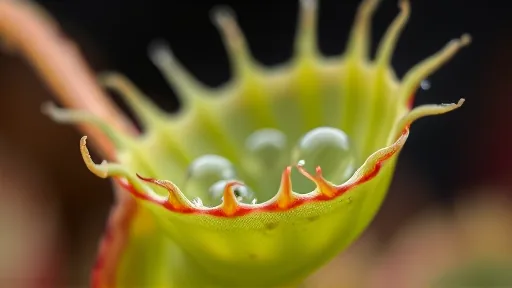
The Venus flytrap has been a mystery since Darwin. Now we have a new clue. The trap does not pump water. It softens its walls. It releases tension. It snaps.
If a plant can change the stiffness of its cell walls in less than a second, what else can it do? Can other plants use the same trick to move, to defend, to hunt? The next question is not just how the flytrap closes, but whether this mechanism is hiding in plain sight, in the leaves of ordinary plants we walk past every day.
The trap snaps. The fly is caught. And a new question is born: what other secrets do plants hide in their silent, green world?.