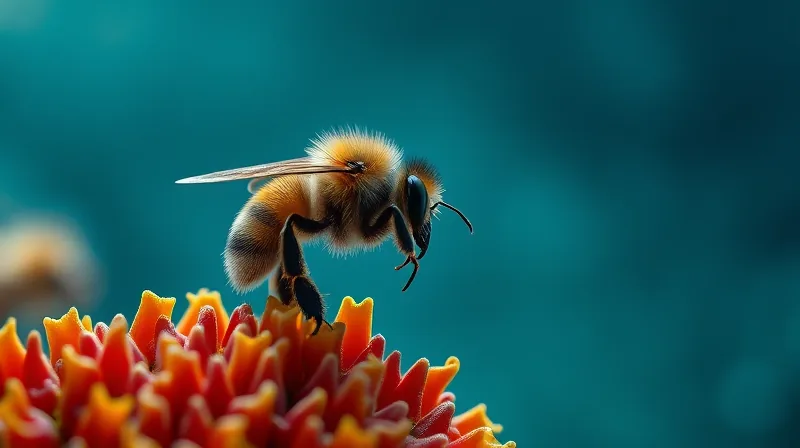
Bumblebees Solve Problems Without Any Training – A First for Insects
Imagine a tiny creature with a brain the size of a poppy seed. Now imagine that creature figuring out a puzzle it has never seen before. That is exactly what bumblebees have just done, and it changes how we think about intelligence in the animal world.
For a long time, scientists believed that only big-brained animals like chimpanzees, dolphins, or parrots could solve new problems on their own. These animals would look at a challenge, think about it, and then find a solution without anyone showing them how. Insects were not thought to have this ability. They were seen as creatures that mostly followed simple rules or learned by copying others.
But a new study published in the journal Science shows that bumblebees can spontaneously solve a novel problem without prior training, as reported by lead researcher Olli Loukola of the University of Oulu. This is the first time that any insect has been proven to solve a problem without any prior training or experience with that specific task.
The experiment was simple but clever. Scientists placed a fake flower with sugar water above a small hole in the floor. The flower was too high for a bee to hover and drink from it. The only way to reach the sweet reward was to roll a small ball into the hole, climb on top of it, and then drink. This is like the classic “box-and-banana” problem where an animal must move an object to reach something out of reach.
The bees had never been trained to roll balls. They had only learned two things before: that balls can be moved, and that a blue ring means food. When the bees were placed in the arena, more than 70 percent of them figured out the trick on their own. They moved the ball, climbed up, and got the sugar. They did not stumble into the solution by accident. In later tests, scientists made the puzzle harder by adding walls. The bees still found the ball, remembered where the flower was, and brought the ball to the right spot. This shows that the bees had a goal in their mind and understood the nature of the task.
This discovery builds on earlier work by Loukola, who in 2024 demonstrated that bumblebees can cooperate to solve challenges, such as pushing a Lego block or opening a door together They learned to push a Lego block or open a door together to get a reward. That was already impressive. But now we see that bees can do more than learn from each other. They can think for themselves.
What does this mean? It means that the line between “simple” and “complex” animals is not so clear. Intelligence might not need a big brain. It might be about how the brain is wired, not how big it is. Bumblebees have tiny brains, but they can still plan, remember, and solve new problems. This is a huge step forward in understanding how animals think.

Other researchers are also exploring this idea. Studies on birds, like parrots and crows, show that they can solve puzzles too. But those birds are often kept in captivity and have lots of experience with puzzles. The bees in this study had no such experience. They were wild bees, tested for the first time.
The next step for the researchers is to observe bees with slow-motion cameras to detect potential ‘aha moments’—sudden behavioral changes indicating insight, such as grooming or pauses after solving the puzzle “aha moment” – a moment of sudden understanding, like when a human figures out a tricky problem. They will look for small changes in behavior, like grooming or pauses, that might show the bee has just had a breakthrough.
This study underscores that brain size does not determine problem-solving ability; even insects with tiny brains can exhibit flexible cognition. It challenges assumptions about intelligence and highlights the need to study diverse species to understand cognitive evolution.