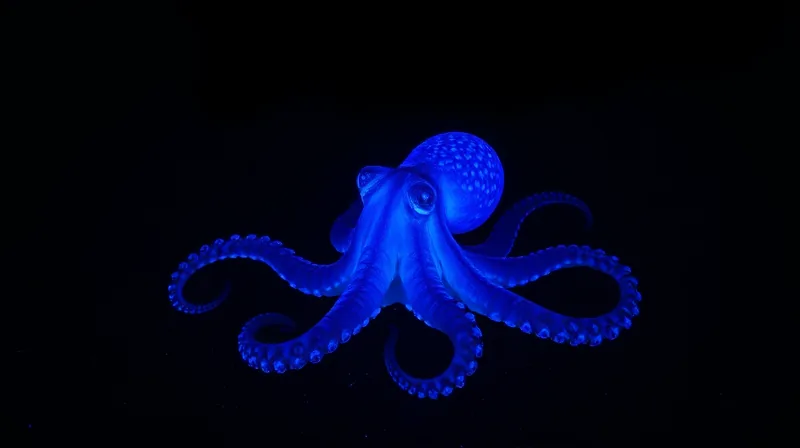
Blue Octopus Found in Galápagos Deep
Imagine a world where every time a creature eats, its meal glows. The predator bites down, and light erupts from its mouth like a silent scream. In the darkness nearly two kilometers below the Pacific surface, this is not science fiction. This is dinner.
If the tiny blue octopus succeeds at its scale, the deep sea floor becomes a place where small bodies and dark webbing are the keys to survival. If it fails, its lineage vanishes into the abyss, leaving only sediment and silence. Either way, the ocean floor holds secrets we have barely touched.
Pull back to the present. It is 2015. A remotely operated vehicle inches along the slope of a seamount near the Galápagos Islands. The camera feed shows bare rock, then sediment, then something impossible — a tiny octopus, dark blue, perched like a forgotten toy. No human has ever seen this animal before.
The Mystery of the Unseen
For centuries, the deep ocean was a blank map. Explorers drew coastlines, then continents, then nothing. Below a certain depth, they assumed, life could not exist. No light. No plants. No warmth. No hope.
Then the Challenger expedition of the 1870s hauled up creatures from abyssal plains. Jellyfish. Sea cucumbers. Strange fish with teeth like needles. The blank map gained dots. But the dots were sparse.
Fast forward to the 21st century. We have mapped the surface of Mars in higher resolution than we have mapped our own ocean floor. Every time a submersible descends, it enters a world where most species remain unnamed. The Pacific Ocean alone covers more area than all the land on Earth combined. If you took every continent and pieced them together like a jigsaw, they would not fill the Pacific’s blue expanse.
Yet we keep finding new things. In 2015, a team from the Monterey Bay Aquarium Research Institute set out on a ten-day expedition. They did not expect to rewrite the family tree of octopuses. They were just looking.
The First Glimpse
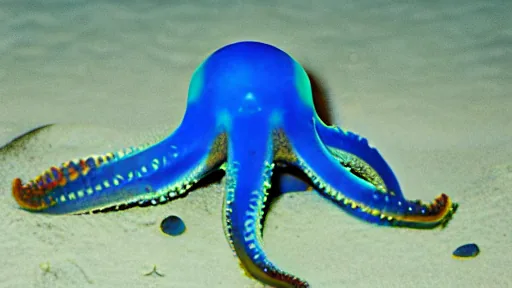
The submersible crept along the slope of a seamount nearly 1,800 meters down. The camera operator saw movement. A shape. Small enough to fit in a human palm. Blue. So blue it seemed to glow against the gray sediment.
“He’s tiny! It’s blue!” one scientist shouted in the dive recording. The excitement was raw, unguarded. They had found something that did not match any known species.
The octopus sat still. Its arms were short and stubby. Its suckers ran in a single row — unusual for most octopuses, which have two rows. Its body was smooth on the back, not rough like many deep-sea relatives. And it was fully grown.
That last detail mattered. The animal measured roughly ten centimeters in total length. That is the size of a juvenile in most octopus species. But this one had a complete set of arm suckers. Its ovaries contained developing oocytes. It was an adult. A tiny adult.
The researchers named it Microeledone galapagensis. [1] ‘Micro’ refers to its small size; ‘galapagensis’ honors the Galápagos Islands near the discovery site.
The Lonely Specimen
The team spotted four individuals that looked like this species during their expedition. But they captured only one. That single specimen became the key to everything.
It was shipped to the Field Museum in Chicago. There, curator Janet Voight waited. She had seen photos during the dive. Now she held the actual animal in her hands.
“When it arrived, I was like ‘Oh! My goodness! It’s beautiful,’” Voight said. [1]
But there was a problem. Normally, to describe a new octopus species, scientists must dissect it. They cut open the body to examine the mouth, the beak, the teeth, the internal organs. These structures tell them how the animal relates to others. Without dissection, identification is guesswork.
Voight had only one specimen. She did not want to take it apart. “We only had the one specimen, so I didn’t want to take it apart,” she said.
So the team tried something new. They used micro-computed tomography — a CT scanner powerful enough to see internal details at microscopic scale. They took thousands of X-ray images. Then they compiled them into a 3D model of the octopus, revealing its insides without cutting a single piece of tissue.
Stephanie Smith, head of the Field Museum’s X-ray lab, described the experience: “There’s nothing like spending the day looking at something no other human has ever seen.”
This was the first octopus species ever described using CT scanning alone. The method let researchers confirm the new species without dissection. It preserved the only known specimen intact for future study.
Why So Small?
The small size of Microeledone galapagensis is not a coincidence. It is likely an adaptation.
In the deep sea, food is scarce. Predators are everywhere. Growing large takes time and energy. A smaller body matures faster. It reaches reproductive age sooner. It produces eggs earlier. The generation time shrinks.
Voight explained: A juvenile-sized body “could increase the rate of reproduction” by shortening the time from hatching to first eggs.
Think about that. If a typical octopus takes years to mature, it faces years of risk. Predators can eat it. Disease can strike. The environment can change. But if an octopus matures in months, it can reproduce before those risks catch up.
Being small also helps escape predators. A tiny octopus can hide in crevices that larger hunters cannot reach. It can burrow into sediment. It can disappear into spaces that seem too small for any animal.
But there is a trade-off. Small bodies produce fewer eggs. Each reproductive event yields less offspring. The species must reproduce more often to compensate. That is the gamble: speed over quantity.
The Blue and the Dark
The color of Microeledone galapagensis is striking. Its back is light blue — one of the rarest colors in nature. Its underside is deep purple, almost black.
Voight believes this pattern serves a specific purpose. The octopus has short, stubby arms that might be built for digging. When it digs in the sediment for prey, it may disturb animals that produce light. Many deep-sea creatures bioluminesce — they glow when touched or threatened.
“When the octopus is digging in the sediment for prey, she may stimulate those prey items to bioluminescence,” Voight said.
That light could attract predators. A glowing octopus is a visible octopus. But Microeledone galapagensis has dark webbing between its arms. When it captures prey, it can spread that webbing like a blanket. The dark tissue blocks the light. The predator sees nothing. The octopus eats in safety.
After swallowing, pigment cells inside the body could block any glow from within. The meal’s light never escapes. The octopus remains invisible.
This is not just camouflage. It is active light management. The octopus uses darkness to shield itself from the consequences of its own hunting.
A Family of Runt
Microeledone galapagensis belongs to the family Megaleledonidae. Most members of this family are large. They live in the Southern Ocean surrounding Antarctica. They are built for cold, deep waters. They are not small.
This new species is the runt of the family. Its stubby arms and single row of suckers set it apart from most octopuses we know. Even among other species with short arms and single sucker rows, its coloration and smooth skin on the back surface separate it.
Only one other species in the genus Microeledone is known. That species was found in waters off New Caledonia in the South Pacific — thousands of kilometers from the Galápagos. The distance between the two locations suggests that other species might live in the waters between them. The Pacific is vast. The dots on the map are few.
The Broader Picture
The discovery of Microeledone galapagensis is not an isolated event. It fits into a larger pattern.
In 2016, researchers described a new species of octopus from the deep waters off Hawaii. In 2018, another new species emerged from the Indian Ocean. In 2020, a team found a ghostly white octopus near the Aleutian Trench. Every year, the list grows.
These discoveries happen because the deep sea remains unexplored. The ocean floor is a patchwork of known and unknown. We have sampled only a tiny fraction of it. Every time a submersible descends, it enters territory that no human has ever seen.
The Charles Darwin Foundation, which supported the 2015 expedition, focuses on conservation and research in the Galápagos region. [2] But the Galápagos is just one small area. The Pacific Ocean stretches from the Americas to Asia, from the Arctic to Antarctica. Every part of it contains animal life from the surface to the seafloor.
“It’s like those little plushies that kids put on their backpacks,” one researcher said during the dive. The comparison was playful, but it captured something real. This octopus was small, cute, unexpected. It was a reminder that the ocean holds wonders we have not yet imagined.
What This Reveals
The story of Microeledone galapagensis is not just about one tiny blue octopus. It is about what we do not know.
Every new species is a question mark. How does it live? What does it eat? Who eats it? How does it reproduce? How many are there? Where else might they be? These questions multiply faster than answers.
The CT scanning method that preserved the specimen is itself a breakthrough. It shows that we can study rare animals without destroying them. In a world where many deep-sea species are known from only a handful of individuals, that matters. We can learn without losing.
But the deeper lesson is about scale. The Pacific Ocean is unimaginably immense. Every part of it contains animal life from the surface to the seafloor. This specimen highlights that unknown diversity.
We live on a planet where most species remain unnamed. We map the stars but not the depths. We search for life on Mars while ignoring the life beneath our ships.
The tiny blue octopus from the Galápagos seamount is a messenger. It tells us that the ocean is not empty. It is full. We just have not looked closely enough.
The Philosophical End
What does this research reveal about the nature of biology? About life itself?
It reveals that life adapts to extremes. Darkness. Pressure. Cold. Scarcity. These are not barriers. They are opportunities. Evolution finds a way.
The small body of Microeledone galapagensis is not a weakness. It is a strategy. Speed over size. Reproduction over growth. Invisibility over strength.
The dark webbing is not just camouflage. It is a tool. Active light management. The octopus uses darkness to control its environment.
This is the nature of life on Earth: it does not wait for perfect conditions. It makes do. It adapts. It finds niches where none seem to exist.
The deep sea floor, two kilometers down, is not a barren wasteland. It is a living world. Every grain of sediment holds a story. Every creature carries a solution to a problem we did not know existed.
The tiny blue octopus reminds us that the unknown is not empty—it is full of life we have yet to discover.
And maybe that is the most humbling truth of all: the universe we have not seen is larger than the one we have.