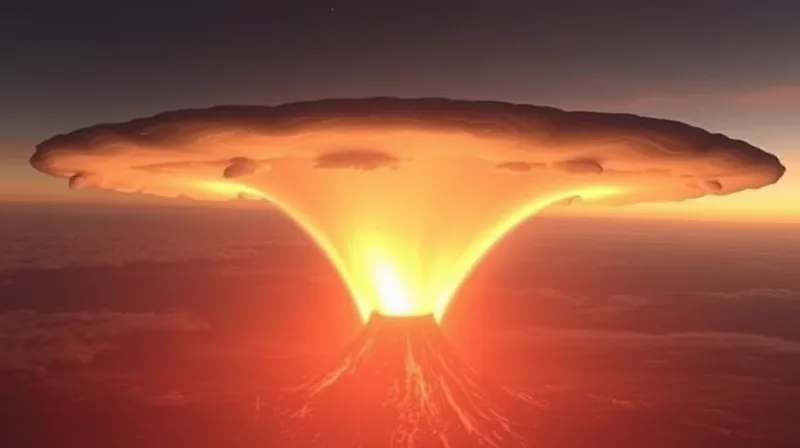
A Cloud That Defies the Textbook
Every morning during the Martian spring and summer, a white streak appears above a volcano and then stretches itself across the sky until it is more than 1,000 miles long — roughly the distance from New York to Kansas City in a straight line — before thinning out and vanishing. [1] The cycle repeats the next day, and the day after that, for months. The streak is water ice, and it sits near Arsia Mons, a Martian mountain that soars 11 miles high. Its formal name is the Arsia Mons Elongated Cloud, or AMEC.
What makes the AMEC strange is not its size alone but the fact that, until now, no simulation could build it. Conventional cloud physics failed. The breakthrough came only when the team added a process that most atmospheric scientists treat as a textbook curiosity rather than a real-world mechanism. Jorge Hernández-Bernal, a planetary scientist at Sorbonne Université in Paris and the lead author of the work, put the surprise plainly: “Once we included this physics in our simulations, the AMEC emerged just as we hoped.” [1] That process is homogeneous ice nucleation. On Earth, cloud droplets and ice crystals almost always need a seed — a speck of dust, salt, pollen, or some other airborne particle — to condense or freeze around. This is called heterogeneous nucleation, and it is the default assumption for water ice clouds. Homogeneous nucleation skips the seed entirely: water vapor freezes straight into ice, with nothing to cling to. Hernández-Bernal offered an image that makes the oddity concrete: “It’s akin to droplets of condensation appearing in the middle of a room, rather than on a window.” [1] The finding, published in Nature Geoscience, does not merely explain one Martian cloud. It challenges a working assumption that has guided cloud modeling across the solar system. If ice can form from vapor alone in the Martian atmosphere, then the same shortcut may be available elsewhere — and the standard picture of how clouds are born may be incomplete on more than one world.
Decades of a Streak Nobody Could Explain
The AMEC is not a new discovery. When Hernández-Bernal looked through archival Mars images, he found the cloud as far back as NASA’s Viking 2 mission in the 1970s. It had largely escaped notice because of its schedule: it forms at sunrise around the summit of Arsia Mons and is gone within about three hours. Many spacecraft cameras cannot photograph that region until the afternoon, because their orbits are timed to the Sun. The cloud was, in effect, hiding in the one window of the day when most instruments were not looking.
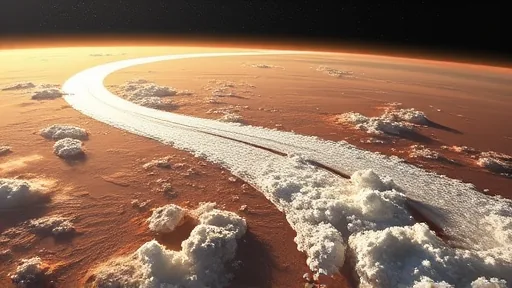
The European Space Agency’s Mars Express satellite, which reached the Red Planet in 2003, changed that. In 2018, its Visual Monitoring Camera — informally the Mars webcam — caught the formation in an otherwise clear sky. Tracking it over time revealed the pattern: during spring and summer in Mars’ Southern Hemisphere, the cloud appears each morning, grows, and fades, usually reaching about 1,118 miles (1,800 kilometers) in length. It is an orographic cloud, the same family as the clouds on Earth that form when wind is forced up and over a mountain or volcano.
For years the explanation stalled there. The cloud was orographic in shape but impossible to reproduce in full. The Arsia Mons volcano, long dormant, is not venting steam; the water is atmospheric, not volcanic. What the mountain does provide is a ramp. When wind hits the roughly 65,000-foot-tall peak, it launches a powerful wave that lifts moist air high into the atmosphere within minutes. That lift sets up the conditions the new model needs: a sharp temperature drop of 30 degrees Celsius within 10 minutes, combined with high relative humidity.
The humidity requirement is the part that strains belief. Homogeneous nucleation demands supersaturation more than 100,000 times greater than any value measured on Earth. Before this modeling work, it was not even known that such humidity levels existed on Mars. “We don’t have nearly as much information about Mars’ atmosphere as we do about Earth’s, so reproducing the AMEC to this degree is a big success,” Hernández-Bernal said, adding that “the result is remarkable.” The idea itself is not new. Homogeneous ice nucleation from water vapor had been discussed as a theoretical possibility, including in connection with mesospheric clouds, but it had never been observed in nature on any planet, and it was not typically considered viable under real atmospheric conditions, precisely because it requires such extreme supersaturation. Mars, it turns out, may be the place where the textbook case actually happens.
Where the Same Physics Might Hide
The result carries a challenge that reaches back to Earth. The paper argues that the finding “strongly suggests” homogeneous ice nucleation from water vapor occurs on Mars, and that it challenges some current assumptions about how certain clouds form on Earth and potentially on other planets. The logic is a mirror: if a process dismissed as impractical on Earth is running daily above a Martian volcano, then the dismissal deserves a second look wherever the required conditions might arise.
That is the next step the work implies rather than performs. The model reproduces the AMEC; the question now is whether the same mechanism can be confirmed elsewhere — in mesospheric clouds where theory already allows it, or in other planetary atmospheres where the humidity and temperature swings might line up. The team behind the study — Hernández-Bernal, A. Määttänen, A. Spiga, and F. Forget — built its result on a meteorological model of Mars combined with a treatment of homogeneous ice nucleation, run until the cloud appeared. Whether the same ingredients exist on another world is the open question.
The cloud was caught only because the right instrument was looking at the right hour. For decades the AMEC was a streak that simulations could not produce. Now it is evidence that the atmosphere of Mars can do something no atmosphere has been directly observed doing before.