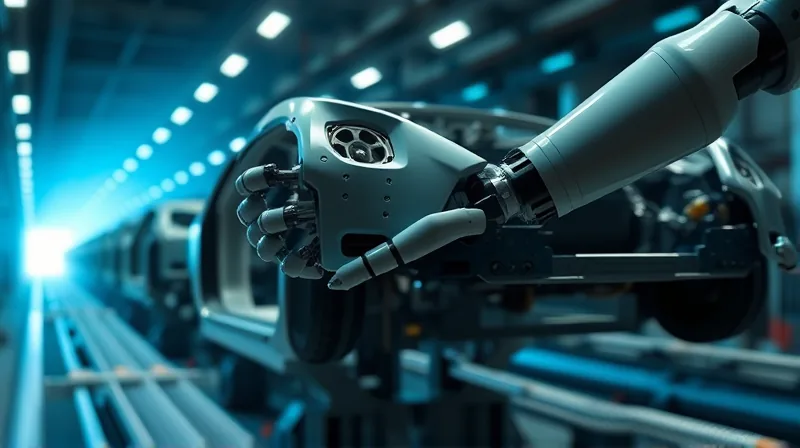
China EV Makers Recast Themselves as Robot Companies
China’s largest electric vehicle makers are repositioning themselves as robotics companies, a pivot driven by collapsing profit margins and intensifying competition. The strategic shift is visible in capital raises, production timelines, and investor reactions across the sector.
The shift from electric vehicles to humanoid robots marks a strategic pivot for China’s largest automakers, driven by thinning profit margins and intensifying competition in the EV market.
China’s EV sales are headed for their worst year since 2021. Xpeng shares have tumbled more than 45% this year, the worst performance among major EV players. BYD is down more than 13%. Chinese automakers account for more than half of the nearly 20 car companies worldwide that have entered the humanoid robotics sector through in-house development, investment or incubation as of August, according to Counterpoint Research. [9] The venture arm of EV maker Nio has invested in humanoid startups such as LimX Dynamics and Acorn Robot. Xiaomi, Li Auto and Geely are also making moves, although their strategies differ. Kevin Li of Counterpoint calls it a bid to reshape ‘capital valuation narratives’ and says the automakers want to be perceived as tech companies while establishing a second growth curve. [9]
Why would a car company need a second curve? Profitability. The average profit margin in China’s vehicle manufacturing sector stood at just 1.5% in the first half of 2026, according to the China Association of Automobile Manufacturers, cited by Counterpoint. [10] A margin of 1.5% leaves almost no room for error. Jing Yang of Fitch Ratings describes diversification into robotics as a natural strategic move, given slowing growth and weakening profitability in the EV market, particularly at home. It allows companies to pursue alternative growth drivers, to achieve economies of scale for shared advanced technologies, and potentially to improve profitability over the medium term. There is also a capital channel at work. Xpeng raised 900 million USD for its robotics business last month, the largest single round in China’s “embodied” AI industry, according to the company. [3] Embodied AI, in the industry’s vocabulary, means artificial intelligence connected to hardware. The raise valued Xpeng’s robotics unit at more than 6.3 billion USD, on par with the 6.5 billion USD that Citi estimates for Xpeng’s EV business. A business line that has not yet reached mass production is worth about the same as an entire car company. Investors, however, are not yet buying the story: Xpeng shares fell after it raised the money.
There are real mechanisms underneath the narrative, according to Xiaoyi Lei of Jefferies Hong Kong. Lei notes that Chinese automakers can reuse a significant portion of their supply chain, including motors, chips and software. Xpeng, for example, says it can use 85% of its motors, chips and smart-driving software for humanoids. [3] Robots can then be deployed immediately in the automaker’s own stores and factories, rather than waiting for consumers to buy them. In-house deployment makes data collection easier and cheaper, and data collection is critical for humanoid commercialization. Chinese automakers also know how to build things at scale. Producing thousands of robots that are reliable and serviceable is what they already do every day. “Chinese players are the ones actually pushing it into daily use,” Lei says.
That deployment channel gives Chinese EV makers a potential advantage over Tesla and its Optimus humanoid. Tesla must persuade consumers to buy a robot; Chinese firms can first put the robot to work on floors they already own. Xpeng said Tuesday it plans to begin mass production of its robots by the end of this year, starting in its own stores and business venues. [3] Next year, it plans to launch the robots to the broader market in China and overseas. Xiaomi, which only launched its first electric car in 2024, started testing humanoid robots at its factory this year. BYD can also deploy robots in its factories. Counterpoint’s Li argues that over the medium-to-long term, Geely and Xpeng could better capture the benefits of diversifying beyond cars, pointing to Xpeng’s greater emphasis on its physical AI strategy. [9] Lei also names the core technical uncertainty: making the algorithm and software stack that worked for smart driving viable in the humanoid scenario, which is more difficult and more challenging.
The list of open questions is long. Jefferies has yet to see firm external orders from the automakers it covers, or clear guidance on external customers and robotics revenue for next year. Unitree, the leading humanoid company, saw its shares rocket at its Shanghai debut last month, then decline in 12 of the 16 sessions since its listing. Founder Wang Xingxing has cautioned that commercialization could still take years, and that a “ChatGPT moment” for humanoids may be a decade away. External demand, in other words, is unproven. Even internal demand depends on whether the robots actually work in stores.
The concrete milestones to watch include Xpeng’s mass production timeline, the performance of robots in showroom deployments, and whether external orders materialize. Until those metrics become visible, the gap between robotics valuations and proven revenue will remain the central question for the sector.