A Mirror, A Drag, And A Deadline
In 1990, a telescope the size of a school bus rode into orbit aboard a space shuttle and promptly embarrassed its builders. The primary mirror had been ground to the wrong shape — a flaw traced to a measuring instrument that had itself been misaligned. Three years later, astronauts installed corrective optics, and the instrument began returning the images that made it famous. More than 23,000 peer-reviewed scientific papers have since grown out of those pictures, a number that reads like trivia and is not: it is the ledger of an entire era of astronomy.
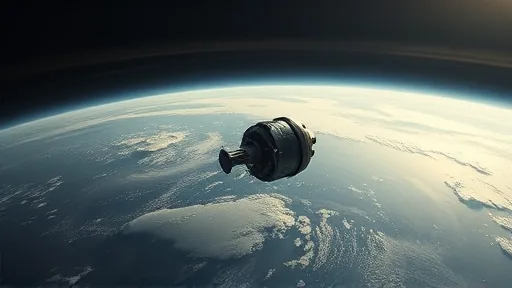
That era now has an expiry date written into the physics of low Earth orbit. At Hubble’s altitude, the atmosphere is not absent — it is thin, persistent, and patient. Every pass through those wisps of gas costs the telescope a sliver of height, and Hubble carries no engine to buy it back. It maneuvers with gyroscopes, but has no propulsion of its own. The observatory can aim anywhere and travel nowhere.
The last time anyone lifted it was 2002, when the space shuttle Columbia visited during one of five servicing missions. That fleet is gone. NASA now estimates a 10 percent chance that Hubble re-enters the atmosphere by September 2032, and a 50 percent chance by December 2033. [1] A satellite is like a stone skipped across a pond that never quite touches water again — except this stone has dense components that would likely survive the fall and strike the ocean rather than burn away. Hubble itself is 13 meters long and weighs more than 12,000 kilograms, which is what makes grappling it so hard.
The Companies Asked To Catch A Falling Icon
NASA has responded not by building a rescue ship but by opening a competition. A call for ideas went out to the commercial sector, with submissions due by 30 November, asking for plans to either raise Hubble to at least 600 kilometers or steer it down safely. A private bidder would have to supply everything: the launch vehicle, the spacecraft, and any crew. This is not the agency’s first attempt at such an invitation. A similar request in 2022 drew eight reported submissions and produced no mission; NASA did study a SpaceX proposal.
The template exists, and it is imperfect. Earlier this year, a NASA-funded mission flown by the commercial firm Katalyst Space set out to boost the orbit of the Neil Gehrels Swift Observatory, which was decaying much as Hubble is. The attempt failed on a steering problem. A tow truck that stalls on its first call still proves tow trucks can reach the highway.
Alise Fisher at NASA says the agency is open to ideas from inside or outside the organisation and is taking nothing off the table. \"It wouldn’t be appropriate for the agency to speculate about specific potential responses, so we don’t inadvertently limit them,\” she says.
The Decade That Ultraviolet Light Would Go Dark
The scientific case rests on a capability no other instrument currently matches. Hubble performs high-resolution ultraviolet imaging better than anything flying. The Ultraviolet Explorer, planned for 2030, will observe the same part of the spectrum at one-tenth the resolution. The Habitable Worlds Observatory may match Hubble’s sharpness, but not until the 2040s. Let Hubble burn in 2032 and the gap runs a decade or longer; cancel the later observatory and the gap becomes effectively permanent. This is the difference between a library closing for renovations and a library burning down.
Stephen Wilkins at the University of Sussex says Hubble has unique abilities unmatched by any other instrument — including the James Webb Space Telescope, the Nancy Grace Roman Space Telescope and the European Space Agency’s Euclid telescope. He also names a second dividend that does not appear on any balance sheet: attempting a repair keeps alive skills that future space exploration will need. Repairing Hubble is harder now that the shuttle is retired, but the attempt itself sustains skills that future space exploration will need.
Thomas Haworth at Queen Mary University of London sits on a panel advising NASA on Hubble’s direction and calls it “the greatest telescope of all time.” [1] He expected the discussion to center on squeezing the most science from the telescope before its end. Instead, re-boosting sat higher on the agenda. “It’s within the realms of possibility,” he says, and the panel’s still-unsubmitted document will try to make that recommendation strongly. Time is the binding constraint: a boost mission takes years to plan, so the decision cannot wait. “You need to decide now.” Mark Norris at the University of Lancashire, once funded by the Hubble budget to hunt ultra-compact dwarf galaxies in archived images, describes a career built on a by-chance find in data collected for other purposes. Hubble was designed to be serviced, he notes, and is fitted with grapple points for robotic arms. But a raised orbit is a reprieve, not a cure. “The instruments are gradually degrading through exposure to the space environment,” he says. [1] “It’s a bit of a miracle it’s still going.” Saving Hubble makes sense only if the cost is bearable and only if something else is not cut to pay for it. He offers a hypothetical: if the space-based gravitational wave detector LISA were sacrificed for the sake of an old instrument, he would call that a shame. The question NASA faces is not whether Hubble is worth saving. It is what a saved Hubble would be worth more than.
Sources