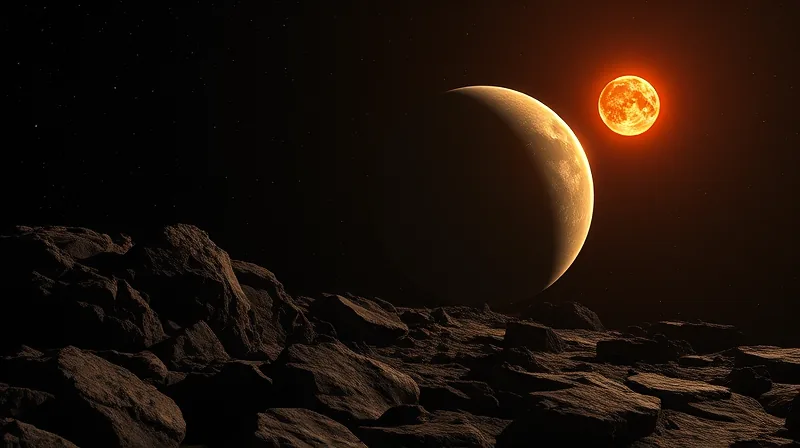
First rocky atmosphere found in habitable zone
An Atmosphere That Should Not Exist
For years, astronomers believed that small red dwarf stars were hostile to planetary atmospheres. These stars, the most common type in the galaxy, release powerful ionizing radiation and frequent flares that strip away the gaseous envelopes from their orbiting planets. The assumption was straightforward: rocky planets in the habitable zones of red dwarfs would end up airless or with only the thinnest atmospheric remnants. This made the search for potentially habitable worlds around these stars seem nearly hopeless.
Then came LHS 1140b. Located 49 light-years away in the constellation Cetus, this planet orbits a quiet red dwarf that produces few flares. In 2024, researchers led by Dr. Collin Cherubim, then at Harvard University, used the Magellan Clay telescope in Chile to observe the planet as it passed in front of its star. [1] The infrared spectrograph detected something unexpected: helium escaping from the planet into space. This was not just any detection — it marked the first observationally confirmed atmosphere on a rocky planet in the habitable zone outside our solar system.
The finding challenges a foundational assumption. If red dwarfs strip atmospheres away, how does LHS 1140b still have one? The planet’s star is unusually calm, but the detection itself proves that atmospheres can survive under the right conditions. The helium signal was clear and the team ruled out contamination from Earth’s atmosphere and every other false positive they could imagine. The atmosphere is real.
What Earlier Studies Missed About This World

LHS 1140b was discovered in 2017. At that time, researchers knew it had a mass 5.6 times that of Earth and a radius 70% larger. It sits squarely in the habitable zone, where liquid water could exist on the surface. But without an atmosphere, any water would boil away or freeze. The planet appeared similar to Earth in overall composition and temperature, yet differed in critical ways: it is tidally locked, meaning one side always faces its star, and it may hold far more water than Earth.
Earlier studies had found atmospheres around gas giants and sub-Neptunes — planets much larger than Earth. There were also hints of atmospheric envelopes around rocky exoplanets outside the habitable zone. But LHS 1140b is different. Cherubim’s team achieved the first direct identification of an atmospheric species — helium — for any rocky exoplanet, whether inside or outside the habitable zone. This puts the planet at the forefront of astrobiology research.
The planet has a rocky surface, temperatures that could support liquid water, and an atmosphere that may prevent water from escaping while shielding the surface from radiation Notably, the team found no atmosphere around LHS 1140c, another rocky planet orbiting the same star. This contrast deepens the mystery — why does one planet retain its atmosphere while its neighbor does not?
The Next Measurement to Be Certain
The detection was not consistent. Observations of LHS 1140b in 2025 showed no helium signal. This shocked Cherubim and his colleagues, forcing them to re-analyze their initial findings. They returned to the 2024 data and tested every possible explanation for the signal. Every false positive they could think of was ruled out. The helium was real in 2024, but why did it vanish a year later?
Dr. Jayne Birkby, a professor of astrophysics at the University of Oxford, noted that the varying signal reveals how the planet’s atmosphere reacts to the extreme ultraviolet radiation from its host star. [2] The atmosphere may expand or contract depending on stellar activity, changing the amount of escaping gas. This variability could even tell researchers how surface conditions shift over time. This variability could even tell researchers how surface conditions shift over time, though the observations focus on the upper atmosphere, not the surface environment where life would exist
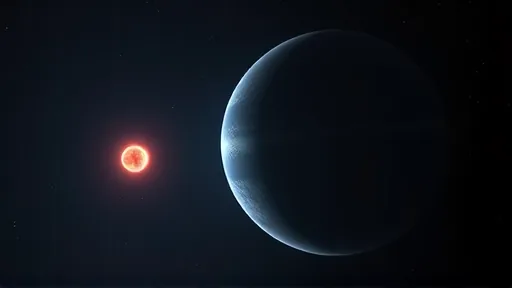
Dr. Yamila Miguel of Leiden Observatory pointed out that the observations focus on gas escaping from the planet’s upper atmosphere, not the lower atmosphere near the surface where life would evolve. She cautioned that these results have no direct implications for detecting life. But the upper atmosphere detection is a critical first step. To be certain about habitability, researchers need to probe the lower atmosphere — to find molecules like water vapor, carbon dioxide, or methane. The next measurement must look deeper, closer to the surface. LHS 1140b is the best laboratory for that search, and the tools to do it exist. The James Webb Space Telescope and the upcoming Extremely Large Telescope are capable of performing these deeper observations, and planning for such measurements is already underway