A Twenty-Year Dossier That Refuses to Close
For two decades, cosmologists told themselves a story that fit. The universe, they said, is roughly 30 percent matter — most of it a slow, invisible kind called cold dark matter — and roughly 70 percent something else, a repellent energy woven into the vacuum of space itself. That energy had a name, lambda, and a convenient property: it never changed. The bigger space grew, the more of this vacuum energy there was, and the faster the cosmos expanded. This was the standard model of cosmology, Lambda-CDM, and it survived every test thrown at it for twenty years. Think of it as a well-worn key that opened lock after lock.
The key no longer turns cleanly. In May 2026, the Dark Energy Survey released findings from its full six-year dataset, and the numbers do not sit comfortably inside Lambda-CDM. [2] The collaboration combined type Ia supernovas, baryon acoustic oscillations, weak gravitational lensing and galaxy clustering into a single fit for a dark energy that is allowed to change over time. The result showed a three-sigma preference for evolving dark energy over a cosmological constant — the tightest constraint ever extracted from a single survey, and still short of the 5-sigma bar physics demands before anyone claims a discovery. [2] The word “sigma” here is not decoration. It is a measure of how surprising a result would be if the boring explanation were true. Three sigma is significant enough to make people pay attention. Five sigma is the threshold where a field stops hedging and starts rewriting textbooks. The Dark Energy Survey lands on the eyebrow-raising side of that ladder, not the textbook side.
What makes the tension harder to dismiss is its shape. If one dataset were simply wrong, you could throw it out and watch everything snap back into place. That does not happen. Assume Lambda-CDM is correct, and the early-universe snapshot of the cosmic microwave background no longer quite matches the maps of how matter clumps; the clumping maps no longer quite match the supernovas; the supernovas no longer quite match the microwave background. There is no single item you can remove from the file to make the rest agree.
Simone Ferraro, a cosmologist at Lawrence Berkeley National Laboratory, put the situation plainly: “There appear to be cracks in that model. There’s something that doesn’t fit.” [2] He added that the field’s return to confusion after twenty years of stability is “certainly enough to make you either uncomfortable or excited.” Both reactions are, at this stage, defensible.
The Tug-of-War Written Into Every Pair of Galaxies
To understand what the survey actually measured, picture a cosmic arm-wrestle that has been running for billions of years. Gravity pulls matter together; dark energy pushes it apart. Whoever is winning at a given moment determines how much matter has managed to clump into galaxies by that era. Measure the clumping at many different epochs, and you have a history of the match.
The Dark Energy Survey assessed this clumping three ways, as Sujeong Lee, a physicist at Ohio University, explained. First, it measured how tightly visible galaxies cluster, which reveals how much dark matter surrounds them. Second, it mapped foreground visible matter by watching how it bends light from galaxies behind it. Third, it mapped foreground dark matter the same way. Each method means comparing pair after pair among hundreds of millions of galaxies, hunting for distortions so small they would vanish in any ordinary photograph. Seven years of that labor produced the final results published in early 2026.
The scale of the instrument behind this is worth pausing on. The 570-megapixel Dark Energy Camera, the most powerful digital camera of its era, was mounted on the 4-meter Victor M. Blanco Telescope in the Chilean Andes and ran for 758 nights between 2013 and 2019. It was meant to stop in 2018; clouds from a strong El Niño season forced an extension. By the end, the survey had pushed the count of recorded galaxies into the hundreds of millions, and the collaboration had grown past 400 scientists across seven countries.
Alongside the clumping maps, the team reprocessed a catalog of 1,600 recently observed supernovas, producing the sharpest view yet of the modern universe. “I trust the DES-reanalyzed supernova data much more than I trust any other supernova dataset,” said Seshadri Nadathur, a Dark Energy Spectroscopic Instrument cosmologist. Ferraro, who is not part of the survey, called the analysis “a real tour de force” that “pushed the analysis to a new level.”
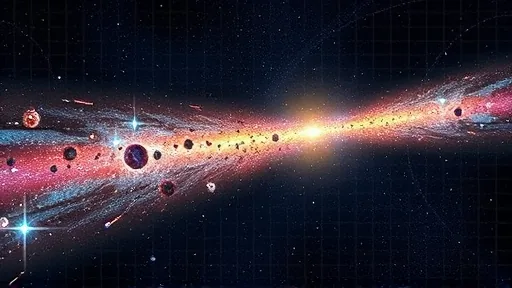
The decisive test came from merging everything into one file: the clumping map, the supernova catalog, galaxy-shell distances from the Dark Energy Spectroscopic Instrument, and a microwave background image. Against that full dossier, the changing-dark-energy theory fit better than the constant one — a three-sigma preference, as the collaboration reported. [2] It is not enough to declare the old model dead.
A Faint Glow That Could Break Every Chain at Once
If the cracks are real, the next question is whether they come from the universe or from our instruments. One candidate suspect is a single number that almost every cosmological analysis quietly borrows: the optical depth to reionization, written tau. It describes how much the first starlight ionized the hydrogen fog of the early universe, and it is measured through the faint large-scale polarization of the microwave background — a signal brutally hard to separate from instrumental effects and foregrounds.
Ferraro, working with collaborators, examined what happens if the timing of reionization differs from the standard assumption. Their 2025 analysis found that shifting the reionization history — Lambda-CDM puts this event at roughly 700 million years after the Big Bang, but if it happened roughly 200 million years earlier — reduces the preference for evolving dark energy. In other words, a slightly different fog-clearing history could dissolve a good part of the anomaly. The catch is that this number is “extremely hard to measure,” as Ferraro said, and “crucial.” The anomaly is stubborn. It does not live in any one drawer of the filing cabinet.
The Next Camera Already Pointing at the Sky
The observational answer is not subtle: keep fattening the dossier. The Dark Energy Spectroscopic Instrument will keep collecting data until at least 2028. And on the summit of Cerro Pachón in Chile, about six miles from the Blanco telescope that hosted the survey, the Vera C. Rubin Observatory began its survey operations in 2026. Rubin is the survey’s spiritual successor and now holds the title of world’s largest digital camera, with an eye expected to spot roughly 10 billion galaxies — with a “b.” The comparison to the field’s origin is stark. In the late 1990s, the accelerating expansion of the universe became apparent from the motions of just a few dozen supernovas. Rubin should find millions more. Veterans of the Dark Energy Survey are already moving to the Rubin collaboration to analyze those galaxies pair by pair, the same painstaking method applied to a far larger dataset. Where the old survey had to fight clouds for 758 nights, the new one will have a catalog deep enough to test whether the cracks are a passing artifact of limited data or the first visible seam in the standard model.
Meanwhile, theorists are probing the implications from other directions. Some are asking whether a changing dark energy could shift in tandem with the mass of dark matter, tying two of the universe’s great unknowns into a single knot. Others are deeply skeptical that dark energy can change at all, because they already struggle to explain why the vacuum carries the tiny, almost imperceptible energy it seems to have; confirming that this energy is also evaporating at a mysteriously slow rate would stack a second impossible question on top of the first. The field is split not on the data but on what kind of universe could produce it.
What remains undisputed is the size of the question. A model that accounted for two decades of observations now fits the fullest dataset ever assembled only somewhat worse than a rival that nobody expected to need. The next few years of sky will decide whether that “somewhat” hardens into a discovery or fades into noise. Either way, the era of comfortable certainty is over, and the cameras are already running.
Sources
Mentioned organisations (context, not sources)
- Lawrence Berkeley National Laboratory — Organisation (homepage)
- Ohio University — Organisation (homepage)
- Dark Energy Spectroscopic Instrument — Organisation (homepage)
- Vera C. Rubin Observatory — Organisation (homepage)
- WMAP — Organisation (homepage)
- Atacama Cosmology Telescope — Organisation (homepage)
- South Pole Telescope — Organisation (homepage)