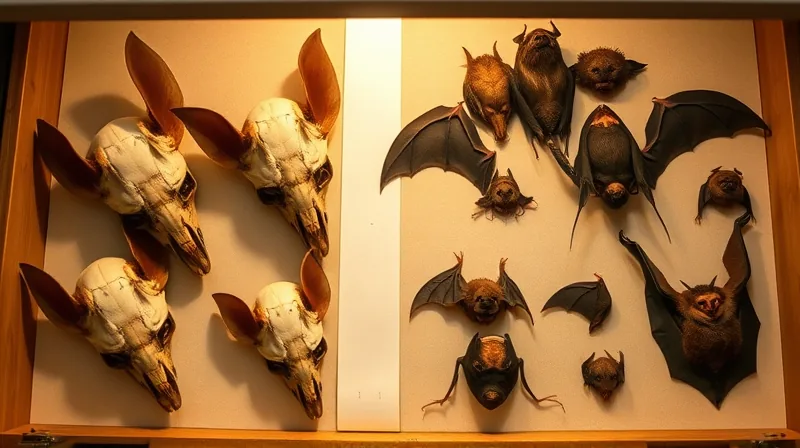
The Shrinking Bats in the Museum Drawer
That is close to what happened to Malagasy flying foxes, the fruit bats known as Pteropus rufus, whose preserved skulls in museum drawers now read like a diary of their own decline. The animals are large by bat standards — leathery wings stretching up to a meter and a half across — and they belong to a group that includes the biggest bats on Earth. They are not shrinking in myth or metaphor. They are shrinking in millimeters.
The first hint came not from a forest but from a cabinet. [3] Researchers at the Field Museum in Chicago, among them flying vertebrate ecologist Emily Cornelius Ruhs and conservation biologist Steven Goodman, noticed that the preserved specimens of Malagasy flying foxes looked conspicuously larger than the animals field scientists had been catching in Madagascar in recent years. The archive and the wild were telling two different stories about the same species. Ruhs put the puzzle plainly: the specimens in the collections seemed a lot larger than the ones being caught in recent fieldwork. [3] What followed was a measurement campaign rather than a single dramatic discovery. The team logged twelve different features of the skull and teeth across 121 specimens held in nine museums, animals collected over more than 150 years and continuing to the present day. That is a long baseline by the standards of most field biology — longer than any single researcher’s career, longer than most institutions survive. It is the kind of record you can only build by keeping things that seem ordinary when they arrive.
The result was a step down, not a slow drift. Bats collected before the 1980s had skulls averaging 3.6 millimeters longer than those collected after — roughly 6 percent longer. The study, published in the Journal of Mammalogy, describes directional reductions across multiple cranial measurements in adults after commercial hunting began. [1] The researchers did not simply assume hunting was the cause. Climate change and habitat loss were both live candidates, and the timing of the shrinkage lined up uncomfortably well with the commercialization of flying fox hunting. What made hunting the leading suspect was the shape of the change, not just its timing. The decline was concentrated at the median of the adult size distribution, the middle of the bell curve, consistent with sustained removal of adults under hunting pressure.
Goodman, who has lived and worked in Madagascar for nearly forty years, supplied the historical eye. After examining late eighteenth and nineteenth century museum specimens, he noticed many were what he called “monster size” compared to animals handled in the wild today. [3] From that observation the working idea formed: the bats have diminished in body size as a result of recent heavy hunting pressure, and they are not living as long as they did in decades past.
Why the Biggest Bats Disappear First
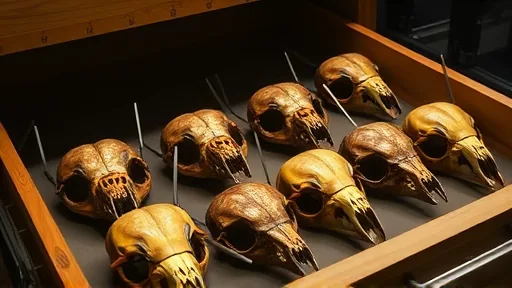
Dental traits showed mixed responses — most declining, one increasing — which the authors describe as nonuniform change across the teeth. Multivariate analyses revealed significant temporal divergence in both cranial and dental shape, independent of age structure, meaning the change is not merely a matter of younger animals replacing older ones. Something about the form of adult bats themselves has shifted.
The age structure matters because this is a slow-reproducing species. Larger values in older individuals is the expected pattern, and the study confirmed it. But if the biggest bats are also the oldest, and the oldest are the ones of breeding age, then a hunter removing the largest animal is not just taking meat — he is taking a mature breeder out of a population that does not replace breeders quickly. Ruhs framed the hunter’s logic without flinching: if you are the biggest bat in the sky, you might be the easiest target, and you also provide a hunter with the most meat. The phrase she used for the economics of it was the most bang for your buck. That is not a metaphor about conservation. It is a description of a market.
What they can say is that large-scale exploitation is actively reshaping the morphology of Pteropus rufus, and that the downward shift in adult body size, combined with low reproductive output and ongoing habitat loss and hunting, raises serious concern for long-term population viability.
What a Six Percent Skull Means for the Species
For anyone who tracks conservation biology, the number that should stop the eye is not the 6 percent itself but the population figure sitting beside it. There were an estimated 300,000 Malagasy flying foxes in Madagascar in the early 2000s. [1] Researchers estimate the number has dropped two-thirds since then. [1] A species that has lost two-thirds of its individuals in roughly two decades, while its adults have measurably shrunk, is not experiencing two separate problems.
Emma Stone, a conservation biologist at the University of Bath in England, supplied the reason the shrinkage may matter beyond aesthetics. [2] Species are specifically adapted to their environments, she noted, and adaptation takes place over thousands of years. [2] Changes in physical traits or adaptations caused by human pressures might leave the bats less able to respond to environmental, climate, or disease stresses. [2] The context that makes this more than a single-species story is how the bats reach the table. Bats are eaten in Madagascar in certain villages and cultures, and up until the 1980s the animals were mostly hunted on a very small scale, to feed a family or a small community. Around that time, people began selling more bats at markets and restaurants. The shift from subsistence to commerce is the hinge on which the whole finding turns.
Ruhs’s own next steps stay close to the animals. Future work on the bats’ genetics could tell researchers how modern populations are faring — whether the shrinkage has left a signature in the gene pool, or whether the population still carries the diversity to recover. And because other fruit bat species are also hunted and eaten in Madagascar, checking whether they show similar shrinkage is the obvious parallel test. If the same pattern appears in species hunted the same way, the case for hunting as the driver gets stronger without a single new experiment.

The question Ruhs leaves open is the one that will outlast the paper. These are important food sources for people, she said, and there is something to be said for understanding how to manage their harvesting a little bit more. Then the harder version: if this population is not doing so well, how do we overcome the needs of the people who live there while also protecting species? That is not a question a skull measurement can answer. But the skull measurement is what makes the question unavoidable — a 6 percent difference, sitting in nine museums, waiting for someone to open the drawer.
Sources
- DOI: 10.1093/jmammal/gyag092
- DOI: 10.1093/jmammal/gyag092/9002374
- Sciencenews — Quote source (original article)