FBI Warned of Tradwife Dating Profiles to Dox ICE Agents
A Tradwife
Profile as an Enforcement Alarm
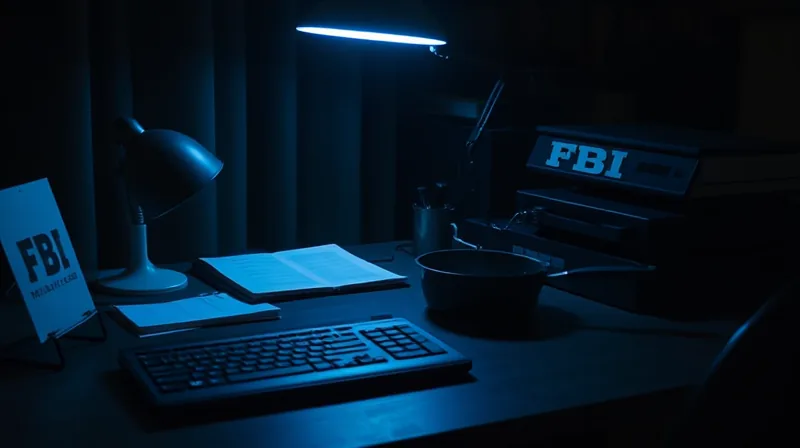
A single frame holds an entire winter: a desk in a Chicago field office, a forwarded email chain, a printout of a dating profile showing a woman with a cast-iron pan, and a routing slip carrying the page to police agencies in every state. That frame is, in miniature, the whole of a brief internal memo the FBI in Chicago disseminated to law enforcement officials across the United States in February 2026. Its subject was not a crime already committed but a tactic the bureau believed might be tried.
The memo warned that, as of late January 2026, a small group of women were allegedly creating fictitious online dating profiles to attract and then dox law enforcement officers participating in immigration enforcement. [1] Doxing, in plain terms, means publishing someone’s private information online without that person’s consent. The bureau described a specific aesthetic at work: profiles “incorporating imagery of a ‘traditional wife’ aesthetic” and listing particular interests intended to appeal to people in law enforcement. The word “tradwife” refers to a trend popularized in recent years by influencers who promote traditional gender roles and romanticize domesticity. The stated objective was to lure affiliated law enforcement personnel into an online or in-person interaction “under the guise of a date”, after which the individuals would be publicly exposed and doxed. In the bureau’s words, the tactic “is intended to generate public embarrassment and deter immigration enforcement activity”.
The memo called itself a “situational information report” — a low-level FBI product that circulates unverified threat information — and said it aimed to raise awareness about a doxing technique rather than presenting a finished assessment. It carried its own caveat: the report was “not finally evaluated intelligence”, meaning the bureau had not verified it to conclusion. A spokesperson added by email that the FBI “regularly shares information with our law enforcement partners to assist in protecting the communities they serve as well as protecting those who serve and protect communities” and is “committed to ensuring that law enforcement officers are safe from threats or violence while performing their duties”. [1] After publication, the Department of Homeland Security, which oversees Immigration and Customs Enforcement, said its officers are “under constant threat from violent agitators” and that “publicizing their identities puts their lives and the lives of their families at serious risk”. [2]
When the Echo Chamber Files the Brief
The shape is familiar inside any large organization: a warning about a hypothetical phishing campaign, sent to every employee, ending in a password reset for an attack that may never have arrived. The visible record around this memo has something of that quality. The briefing was sent weeks after the New York Post, a conservative outlet, ran a story saying that left-wing TikTok users were orchestrating groups of women to pursue ICE agents in a scheme to dox them. [4] That story cited Libs of TikTok, a right-wing account that had posted a screenshot of someone claiming to be part of a Facebook group dedicated to going on dates with agents in order to expose them. The article listed a handful of posts and videos from users discussing the tactic.
In the administration’s looser usage, doxing has been stretched to include posting videos of officers at work — a definition considerably wider than the traditional one.
Property of the People, a government-transparency non-profit, obtained the document through a public records request. It is one of many internal records the group has collected that reveal law enforcement’s internal concerns about activists organizing against Immigration and Customs Enforcement. Ryan Shapiro, the group’s executive director, said in a statement that it is “absurd the FBI issued a thinly-sourced security alert about ICE agents’ online dating troubles”. [8] He called it equally ludicrous that the bureau is spending taxpayer dollars to protect agents from possible embarrassment at the hands of a supposed small group of women who might name and ridicule them online. [8]

Mike German, a former FBI agent and longtime civil liberties advocate, reviewed the document and said it was odd that the briefing carried no footnotes or citations. “. German’s assessment: “The right-wing echo chamber creates threats and the government’s intelligence apparatus just repeats those threats without any context, more detail or any instruction of how agents or officers should respond.” He argued it seemed likely the briefing was inspired by the New York Post story. “They must have run out of other threats,” he said. The document, he added, “reinforces the paranoid ‘us versus them’ mentality within law enforcement”.
Alerts Pile Up, Names Carry a Price
The Chicago memo is not an isolated artifact. More than a dozen internal law enforcement reports obtained through records requests by Property of the People carry similar warnings about doxing. [8] An October 2025 report from the US Army said there was “credible intelligence” that cartels had offered to pay gang members and others in the United States to dox, assault or kidnap immigration officers. [9] That report cited charges against a man accused of a murder-for-hire plot targeting a top border patrol leader. The man was found not guilty months later — a reminder that an allegation inside a briefing is not a conviction.
In a November 2025 report, the FBI warned that AI, facial-recognition and automated data-scraping tools had “increased the scale and accuracy of doxxing attacks” targeting ICE officers. [1] The alert said people had published officers’ names, photos, license plates, locations and family details, citing various crowdsourced efforts by activists to report ICE sightings. A January 2026 New York Police Department “terrorism brief” warned of “violent rhetoric” and “extremist messaging” on social media after the killing of Renee Good, including “calls to ‘hunt down’, ‘dox’, and kill ICE personnel. [10] That report cited a small number of online posts that appeared to call for violence. A May 2026 alert from Customs and Border Protection, a branch of the Department of Homeland Security, warned that smart glasses — eyewear with built-in cameras — could be used to surveil, record and potentially dox CBP personnel. [2] A CBP spokesperson did not comment directly on the document but said by email that smart glasses “pose unique security and intelligence risks because of their ability to discreetly capture audio and video”, and that the agency continues to monitor technology trends. [2]
Other agencies that have raised concerns about ICE agents being doxed in internal records include the FBI in Los Angeles, the Amtrak police department, an Idaho law enforcement consortium, a Florida fusion center of local and federal agencies, and the Federal Protective Service, which is also part of the Department of Homeland Security. A fusion center is a shared office where agencies at different levels of government pool intelligence. The safety stakes can be concrete when an agent’s home address or family details are exposed. Two activists were convicted of “stalking” in California after prosecutors said they followed an agent home and publicly disclosed the location.
German argues that law enforcement’s claims about doxing are misguided. ICE officers, in his account, are public servants rather than “secret agents” whose identities must be shielded. “These are agents working on the public dime,” he said. “The public has a right to know who they are and what their qualifications and training are.”
Read together, these documents describe not an event so much as an attention span — a long exposure in which a screenshot, a caption and a forwarded rumor accumulate across months until they acquire the weight of a pattern. What the file preserves is rarely what occurred; it is what someone was already prepared to believe could.
Sources
1. FBI — Organisation (homepage)
2. Department of Homeland Security — Organisation (homepage)
3. Immigration and Customs Enforcement — Organisation (homepage)
4. New York Post — Organisation (homepage)
5. TikTok — Organisation (homepage)
6. Libs of TikTok — Organisation (homepage)
7. Facebook — Organisation (homepage)
8. Property of the People — Organisation (homepage)
9. US Army — Organisation (homepage)