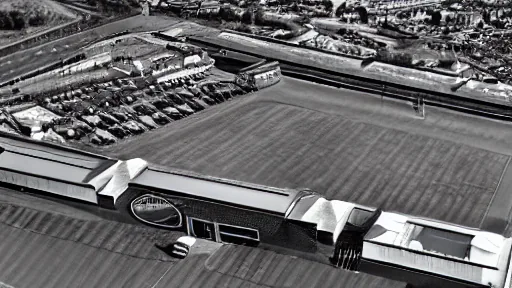
The British town centre was emptied in units of out-of-town retail parks. Dates carry this argument better than adjectives do. Britain had one out-of-town retail park in 1981. By 1996 it had 385. That is 384 new parks in fifteen years. The count is what 40 years of planning policy looks like in built form.
Parkgate opened in 1987. MPs warned at the time that it would disembowel towns and villages. [1] The word was theirs, and the outcome matched it. Rotherham town centre is now 24% vacant. Retail parks nationally sit at 4.8% vacant. The gap between the two is the measure of what planning policy did.
Andy Burnham’s £210m for high streets is welcome. It is also a one-off. Forty years of built form do not reverse in a single budget line. The money is real. The mismatch is real too.
Sammy Gecsoyler’s report from Rotherham, published on 4 November, asked the plain question: can anything save the British high street? [2] Rotherham’s high street is a parade of vape shops, nail shops and charity shops. A high street can be mourned, or it can be costed.
The Pound Is Not the Point
Home delivery is now cheaper than a trip to a retail park. The volume is the evidence. Up to 3bn parcels a year land on British doorsteps. Not one of them passes through a town centre. Up to three billion arrivals that never reach a shop front, a market stall or a car park.
That flow is the tax base in a proposal now in front of a Commons committee. The housing, communities and local government committee is inquiring into revitalising high streets. [1] Dan Johnson, co-founder of Crafty Vintage in Whalley, Lancashire, submitted the proposal as written evidence. His rate is £1. It falls on every parcel delivered to a residential address. It falls on nothing collected from a shop, a locker or a pickup point in a town.
The money would be ringfenced by law. It would return to the council area where the parcel landed. Sixty per cent would go to transport. Forty per cent would go to markets and high streets. The revenue follows the doorstep back to the place that generated it. The ringfence is written in law.
The rate is deliberately small, and the design explains why: “The pound is not the point; the exemption is.” [1] The cheapest way to receive a parcel would become the route that involves walking into a town centre.
Retail Cannot Be Its Primary Purpose
The government’s strategy is called Hope on the High Street. It includes community-led schemes of the kind the Architectural Heritage Fund has supported. Matthew Mckeague, CEO of the Architectural Heritage Fund, names two of them. High Street West in Sunderland took derelict shops and delivered a cafe, a music venue and workspaces under one mixed-use approach. Valley Heritage’s development in Bacup, Lancashire, split a Grade II former bank into co-working space and affordable housing. Both keep the building and change the use. The fund’s emphasis falls on the communities themselves, on the grounds that they are passionate about their environment. [2]. Many town centres remain difficult, and a growing number offer a more positive future that could be replicated elsewhere. [2].
Helen Roberts, Sheffield, takes the argument into built form. Councils should acquire vacant or persistently underused sites. Where appropriate, poor-quality empty buildings should be replaced with well-insulated, low-rise homes for renters and young professionals. New developments should be designed from the outset so that extra floors or modular homes can be added later as demand grows. That would cost more initially and could reduce the expense of future expansion. Housing alone will not make a thriving neighbourhood. It has to be interspersed with services people genuinely need. The list is specific: walk-in health and mental health support, childcare, community and arts spaces, local amenities. Green space belongs in the mix as well, with trees, planting and small parks. The same planting answers climate change and air pollution at once. Planning and licensing powers should then be used carefully. Their job is a balanced mix of businesses, and the avoidance of concentrations that undermine the health and character of an area.
The commercial layer is being rebuilt from below in Hastings. Barry Ashley runs the Grumpy Cook, a community-focused cafe in Hastings. My Local First, the loyalty and rewards platform he launched, brings independent businesses together. Customers earn rewards for spending locally. They discover other independent businesses. They get a reason to return. A business participates for £10 a month. The platform takes no commission on its sales. Work is also under way on connecting affordable food and discreet community support. Barry Ashley states the reasoning plainly: high streets cannot thrive if the people living around them cannot afford to participate in their local economy. [2] No council and no grant can regenerate a town centre alone. [2]. No individual business can take on a multinational on its own. Ten pounds a month, and no commission on a sale.
Sources
- Housing, Communities and Local Government Committee — Quote source (original article)
- Guardian — Quote source (original article)