Why does one night of fireworks change the air above a city of 30 million people — and why does that change refuse to leave? It sits in monitor readings taken days before the firecrackers were lit, and in a court order that tried to limit them.
On Monday morning, the Air Quality Index in several parts of the Indian capital exceeded 350. [1] The index converts measured pollutant concentrations into a single number, and a higher reading means worse air. Readings above 350 are categorised as “severe” against the World Health Organization’s recommended exposure thresholds, and the level carries significant health risks for the more than 30 million people who breathe it. New Delhi persistently ranks among the most polluted capital cities in the world, which makes Monday’s reading less an anomaly than the latest entry in a long series.
The timing is what makes this year’s sequence instructive. On Wednesday, days before Diwali, monitors already showed toxic air pollution in New Delhi at more than 30 times the WHO’s recommended daily limit. [1] The festival had not yet begun. Whatever the firecrackers added was added to air that was already far outside the range the WHO considers safe for a single day of exposure.
And it does not clear quickly. The outcome is a dense haze that can sit over the capital and its surroundings for days at a time. That is the core of the political and economic problem: the costs of Sunday evening are not settled on Sunday evening. They are paid on Monday, Tuesday and after, by people who lit nothing at all.
The Ledger of What Burns and Rolls
Before the fireworks, there was a rule. Last month India’s Supreme Court put restrictions in place to limit Diwali pollution, allowing only approved “green firecrackers”, under specified conditions, inside three-hour windows on Saturday and Sunday. The design is a familiar regulatory compromise: ban the worst category, license a better one, and confine it in time. The approved crackers produce fewer emissions, but they are not pollution-free.
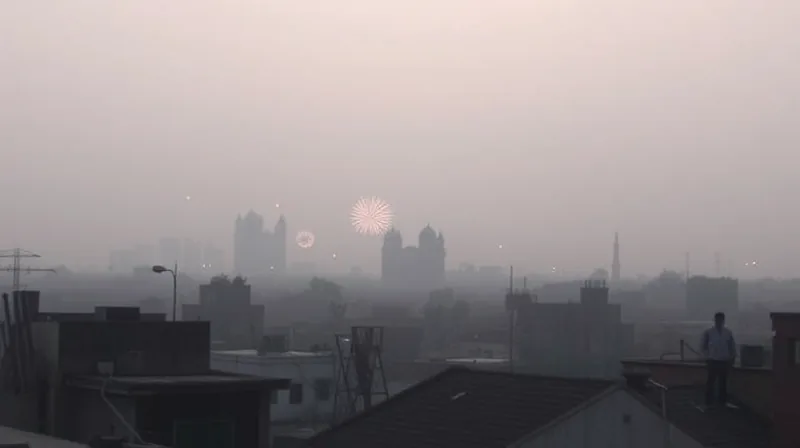
The compromise did not hold the evening. Despite the restrictions, residents of New Delhi celebrated the festival of lights with firecrackers throughout Sunday evening, putting smoke and fine particulate matter (airborne particles small enough to be drawn deep into the lungs) into the air above the city. Diwali was celebrated across India on Sunday. So the sequence ran: a court order, a licensed product, a three-hour window — and then a night of smoke.
The second half of the ledger has nothing to do with festivals. India’s Ministry of Environment, Forest and Climate Change attributes 23 percent of New Delhi’s winter pollution to vehicles. [1] Biomass burning — the burning of organic material such as crop residue, wood or dung — including farm stubble fires (stubble is the crop residue left in fields after harvest), contributes 20 percent. Neither of those two sources needs a holiday to operate; they run on ordinary days, in ordinary weather, at ordinary volumes.
The political arithmetic behind those two numbers is harder to see. A rule aimed at firecrackers is cheap to announce and visible to voters, and it fits inside a single evening. A rule aimed at the transport share touches fuel, freight and the daily commute, and a rule aimed at stubble touches the incomes of farmers in neighbouring states. The other two sources are spread across neighbouring states and city agencies, which makes them a matter of negotiation rather than a single order.
When the Air Simply Stops Moving
The question is why, if the sources are known and quantified, the same crisis arrives on schedule each winter. Part of the answer is that winter does something to the atmosphere that no short-term policy can offset. Cooler temperatures, weak winds and a stagnant atmosphere keep pollutants from dispersing. The capital is not only producing emissions; it is producing them under a lid.
That is why the crisis is seasonal rather than constant. In winter, the same mass of particles has nowhere to go. The index does not measure intent or effort; it measures what is hanging in a given column of air at a given hour, and in winter that column holds far more.