A Tenth Edition That Will Not Open
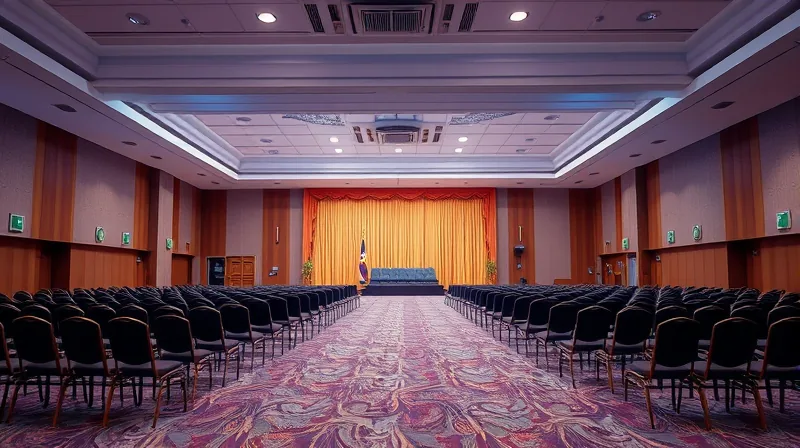
For most of the past decade, the last week of October in Riyadh belonged to a fixed ritual. Ballrooms filled along the capital’s main arteries. A stage went up. Money managers from three continents flew in, suits pressed, to hear how the kingdom intended to spend its oil revenue on something other than oil. The occasion is the Future Investment Initiative, launched in 2017 and quickly nicknamed “Davos in the Desert” after the World Economic Forum’s annual meeting in Switzerland. It is state-backed, it is annual, and it is the closest thing the Gulf has to a tour in which issuers pitch investments to investors with a geopolitical purpose. The first edition ran in 2017, the year the kingdom put its diversification plan in front of foreign investors and asked them to fund it. Nine editions later, the format had become routine enough that its postponement is itself the news. Its tenth edition was scheduled to open on October 26 and run through October 29.
This year the stage stays dark. A statement published on the event’s official website announced that the conference has been postponed until 2027, with a new date to be announced “very soon”. [2] The institute’s chief executive, Dr Maha Bint Mishari Al Saud, described the decision as coming “from a deep commitment to our partners, members, speakers and delegates”. [2] She added: “Because this is our landmark tenth edition, we want to ensure it delivers the full scale, extraordinary quality, and unforgettable impact that our community has come to expect and truly deserves.” [2] The postponement lands in the middle of an escalating exchange of fire between Saudi Arabia and the Iran-backed Houthis, and a year’s delay is not a neutral act for an event whose entire function is to be held on schedule. The distinction between postponed and cancelled matters to the organisers; to this year’s calendar it makes little difference. The decision also follows the cancellation or delay of several other high-profile gatherings in the kingdom, among them the second European Union-Gulf Cooperation Council summit, the format that links the European Union with the Gulf Cooperation Council. In the writer’s reading, when a government starts moving its own calendar, the calendar has become a security document.
What is being postponed matters as much as the postponement. The FII is the annual shop window for a plan: to pull in the billions of dollars the kingdom needs to shift its economy away from oil and gas and towards tourism, sport and technology. Crown Prince Mohammed bin Salman has built that transformation into the centre of his programme, and the conference has served since 2017 as its most visible platform for foreign capital. The audience is narrow and decisive — the people who decide where other people’s savings go. Presence is the product: the panel is filmed, but the corridor conversation is what is being sold. In the writer’s reading, a postponement does not so much move a meeting as remove, for a year, the room in which the pitch is made in person.
The Office Calendar Becomes a Security Map
The Houthis, also known as Ansar Allah and aligned with Iran, have struck military, energy and civilian infrastructure across the kingdom in recent weeks. One of the targets was Riyadh’s international airport. The campaign has killed at least 18 people and injured hundreds more. Several countries have issued travel warnings for the kingdom in response. For a conference economy, the relevant geography is small: one city, one airport, one hotel corridor. When that route is the target, the calculation changes.
The capital’s working life adjusted within days. Government agencies in Riyadh told employees to work from home, according to one worker and two consultants speaking to AFP. One employee received a message on Sunday that read: “It has been decided to implement remote work from Monday to Thursday this week”, followed by the line “We ask everyone to continue their activities as normal”. The instruction covered one week, not the season, which is what a temporary measure looks like when it is issued in a hurry. The Kingdom Centre, a 99-storey tower in downtown Riyadh that houses the International Monetary Fund’s regional office, asked its workers to stay away until further notice. Companies based in the King Abdullah Financial District, where major United States firms keep offices, issued similar instructions. The orders were administrative, and they were also a public statement about distance.
The addresses are the story. That judgment becomes legible to outsiders precisely because of who sits in those buildings. The tower with the fund’s regional office and the district with the American banks are the coordinates at which foreign capital keeps a physical presence in the kingdom. Buildings are the part of a market that can be photographed.

The fighting has a second ledger, and it is heavier. At least 53 people were killed and more than 200 injured on Monday when Houthi missiles that follow a high arcing flight path struck a military training facility in Shabwa province, in south-eastern Yemen. Several missiles hit the Ahmed al-Sulaimani Training Center inside the Al-Alam military base in Jardan district, near the provincial capital Ataq. Newly recruited internal security personnel were undergoing training at the site. The Houthis claimed responsibility; their al-Masirah television cited a military source saying the group had targeted gatherings of what it called “Saudi-backed forces” at the base. Al-Alam is a major facility used by forces aligned with Yemen’s internationally recognised government — the administration the Saudi-led coalition has backed since 2015.
The Money That Was Meant to Arrive
The speaker list shows what a postponement costs. Alphabet and Google’s president and chief information officer Ruth Porat, Goldman Sachs chairman and chief executive David Solomon, and BlackRock chairman and chief executive Laurence Fink were listed on the event’s website. JPMorgan Chase chief executive Jamie Dimon and Citigroup chief executive Jane Fraser were also named as speakers. Each of those firms allocates capital that governments compete to attract. These are the names that make a conference a venue rather than an event: their presence tells smaller investors that the diligence has already been done. A stage without them is a stage with a different meaning. The FII’s value has always run through that chain — a chief executive flies in, a sovereign fund manager takes the meeting, a mid-sized institution reads the photograph and books a ticket.
Before the in-person gathering was called off, organisers had reportedly considered allowing participants to attend virtually while keeping a physical component. Some Wall Street leaders were weighing whether to travel at all. The compromise was on the table because presence is precisely what cannot be substituted. A virtual edition would keep the panels and lose the dinners, and the dinners are where mandates are discussed. That is the specific loss a postponed conference imposes: not information, which travels cheaply, but proximity, which does not.
Underneath the calendar sits a longer history, and a body of research that has already counted a cost. A 2023 study in the field of Islamic history and civilisation applied a thematic analysis to the conflict — a method that groups evidence into recurring themes rather than ranking causes by size, which is why its conclusions arrive as a list rather than a hierarchy. It examines the war across three scopes at once: political, social and economic. It treats the conflict as a process with a before and an after rather than a single event. The study argues that the Saudi-led intervention launched in 2015 is the biggest threat to the stability of Yemen. [1] It traces the sequence that preceded it — the rise of the Houthi group, and the coup against the Yemeni government during the 2011 uprising — then describes what followed: attacks on many regions under Houthi influence and the destruction of the group’s military assets. It records the outcome no side disputes: despite the campaign, millions of Yemenis became victims. [1] Two ledgers, one war. In Shabwa and Sanaa, the cost is counted in the dead, the wounded and an economy the study classifies as recessionary. In Riyadh, it is counted in an airport struck, a financial district sent home, a summit postponed and a tenth edition that will be read about rather than attended. The study’s author sets the key result down in three parts, to be read aloud for the first time in a seminar room rather than a boardroom: political instability, recession and social backwardness. [1] Spoken slowly, the list does what a prospectus cannot — it names what a war costs the country it is fought over. The tenth edition of the FII will be given a date, and the announcement will say “very soon”. The three nouns do not come with a date.
Sources
Mentioned organisations (context, not sources)
- Future Investment Initiative — Organisation (homepage)
- World Economic Forum — Organisation (homepage)
- European Union — Organisation (homepage)
- Gulf Cooperation Council — Organisation (homepage)
- AFP — Organisation (homepage)
- International Monetary Fund — Organisation (homepage)
- Alphabet — Organisation (homepage)
- Google — Organisation (homepage)
- BlackRock — Organisation (homepage)