
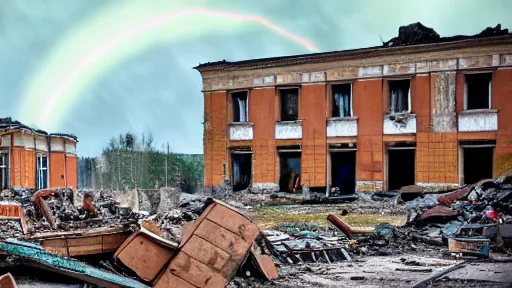
Komyshuvakha, a village in the southern Zaporizhzhia region, tested that assumption on Monday. The regional head, Mykhailo Semikin, counted at least nine bombs dropped from aircraft, each weighing 3,000kg. President Volodymyr Zelensky put the number of guided bombs at 10 and described an area that included a school building used to distribute humanitarian aid and a nearby shelter. The aid arrived every week, on Mondays. The people who had stayed in the village were the ones collecting it. Zelensky posted video of the crater the strike left and of rescue teams searching the rubble. The first official death toll was 18. By his evening address on Monday it was 26. In between, Ukraine’s state emergencies service, the DSNS, confirmed 24 dead, among them two rescuers and four police officers. Five people were injured. Twenty-seven were initially reported missing; local officials later put the number still unaccounted for at about 20. Zelensky’s phrase for the attack was “utterly horrific”. [1] The sequence of the strikes carries more weight than the tonnage. He described a first strike on the school, which he said was “used for humanitarian needs”, then a second on the place where people had taken shelter. In his account, the first explosion pushed survivors toward one address and the second landed on it. The timing could not have been a mystery, he argued: the Russians “could not have been unaware that the local residents who remained in Komyshuvakha received humanitarian aid there every week”. His conclusion was political rather than tactical: “This is yet another proof that Russia does not want any de-escalation.” Video of a crater indicates the size of the explosion; it does not establish the intent behind it.
Rescue work was interrupted as well as carried out. Russian drone attacks in the area forced teams to halt their operation a number of times, even as they kept working the scene. Semikin described the attack as a “terrible tragedy” and confirmed that “people are still under the rubble”, which explains why the count is provisional. [1] As night fell, responders searched the collapsed buildings by flashlight, in photos and video posted by local officials. A day of mourning was declared for Tuesday across the whole Zaporizhzhia region. Ukrainian authorities also reported multiple Russian drone attacks elsewhere that injured at least 17 people. The expectation that the toll will rise rests on a plain physical fact: people remain under the rubble.
What a Ceasefire Buys, What It Costs
On the same day the bombs fell, a limited ceasefire expired in Kherson, a different region of the south. That arrangement had allowed humanitarian aid and evacuation missions into frontline areas of Russian-occupied territory. Fighting has since returned to the Kherson region, after the longest ceasefire of the war. The Kherson arrangement lapsed on the same day the aid point in Komyshuvakha was due its weekly delivery.
Zelensky offered a working counter-example from the same war. During a temporary ceasefire brokered by US First Lady Melania Trump, teams from both sides ran a joint operation to evacuate civilians from the Russian-occupied southern city of Oleshky. Evacuees from that city have since been reunited with family after years trapped under occupation. In his account, the operation produced “a moment when the next steps could show that peace is possible”. Then came the strike on the aid centre. “With such killings, Russia is sending the exact opposite signal - Russia is counting on further killings.” The logic Zelensky sets out is one of demonstration, not capability. A humanitarian operation proves that a channel exists; an attack on a humanitarian site suggests that the channel will not be widened.

The diplomacy runs on a separate clock. Talks among Ukraine, Russia and the United States are due to resume in Abu Dhabi next week, a date that comes from a post on X by US President Donald Trump’s special envoy, Steve Witkoff. The talks have been suspended since February. Witkoff listed the agenda as “post-war security arrangements, de-escalation, humanitarian efforts, and next steps toward peace”. [1] The same post said US negotiators would meet European and NATO officials in Brussels this week. No major breakthrough is expected.
What has changed since February is the military balance underneath the table. Moscow has stepped up attacks while Kyiv has virtually run out of Western-supplied interceptors to defend against missiles. In an address to the nation, Zelensky said Ukraine expected Russia to escalate its attacks at a time when the country faces a shortage of missiles needed to defend itself. That is the trade-off that shapes what a session in Abu Dhabi can deliver.
When the Siren Speaks Three Languages
In the same window, the government emergency alert apps of both countries were hacked. Ukrainians received phony notifications warning of an imminent nuclear threat. The messages also made false claims of high radiation levels, a chemical threat and public disturbances in Kyiv. They arrived in English, Russian and Ukrainian. The English versions carried spelling and grammatical errors. One Russian-language message read: “Hi! There will be a nuclear threat across Ukraine. Do not worry, the Oreshnik is incoming,” a reference to a Russian missile that flies a high arc and then falls on its target, and is difficult to intercept. Users in Russia received fake alerts too. Whether the two breaches were connected was not clear.
A Russian Telegram channel with links to the country’s security services said a hacking group called Hitcore had claimed responsibility for the Ukrainian breach; the claim was not independently verified. Residents rely on that app to find safety during missile and drone attacks. It was suspended and then restored; Russian authorities said work to repair theirs was ongoing. Ukraine’s air raid alert channel posted that “unauthorised parties” had interfered and warned users not to click on links in “suspicious notifications”.
There was little indication that the fake alerts caused panic in Ukraine. Instead came a flood of humorous posts, with users sharing photographs of pets relaxing and apocalypse-themed images generated by artificial intelligence. A picture of Kyiv mayor Vitali Klitschko, a former international boxing champion, circulated with the line: “It’s a good thing we have a boxer for a mayor.” What the breach puts at risk is the one asset an alert system cannot rebuild once spent: the habit of believing it.
The number still moving is the death toll. It went from 18 to 24 to 26 inside a single day, and officials say about 20 people remain unaccounted for. A number that stops moving is information too.