One Number, Two Directions: What a 5% Treasury Yield Does to a Down Payment
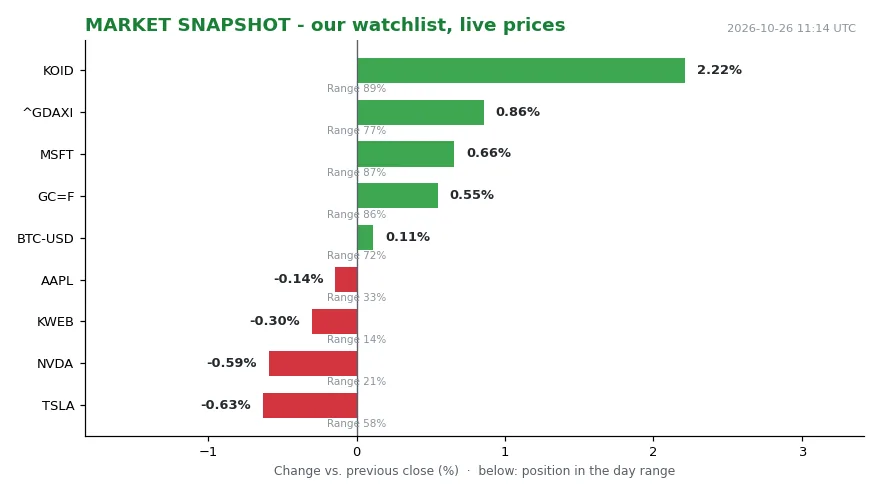
At 11:10 UTC our watchlist read like a market that is re-sorting itself rather than retreating. Microsoft traded at 524.51, up 0.66% and holding 87% of its intraday range; gold futures sat at 4,028.80, up 0.52% and near the top of the day at 84% of range; Nvidia quoted 210.96, down 0.59% and pressed into the bottom fifth of its range at 21%. The China internet ETF KWEB changed hands at 23.14, off 0.30% and stuck at 14% of range, while crude for December delivery dropped 2.27% to 100.93 and the VIX added 0.72% to 19.59. The 10-year yield on our feed stood at 4.9880, up 0.71% on the day — just beneath the 5% line the housing market has spent October arguing about. Our regime reading printed a falling trend at level 3.63, and the busiest signal channel of the session was central banks. That is not a picture of panic. It is a picture of money being moved from one pocket to another: quality software and bullion bid, semis and China exposure offered, energy softening.Which brings us to the question people ask at open houses only in their heads: not whether mortgage rates will fall, but where the down payment is supposed to live while a buyer waits for them to.
The news: a pause after seven weeks of pain
The number that matters for anyone shopping for a loan is 7.32%. That is the average rate on a 30-year fixed mortgage for the week ending Oct. 22, down from 7.40% the week before, according to Freddie Mac data reported by Realtor.com (1). [2] The decline is small, but it is the first in two months, and it follows seven consecutive weekly increases that pushed borrowing costs to three-year highs (1). Earlier in October, mortgage rates crossed into the 7% range for the first time in 2026.
The move tracks the bond market almost mechanically. The 10-year Treasury yield slipped from 5.24% to roughly 5.13% last week, largely because investors are playing defense, watching the conflict in Iran unfold and waiting on fresh unemployment claims before making their next move (1). Fears that mortgages could reach 8% have receded. They have not been replaced by comfort — persistent inflation continues to press on the market — but by something more useful to a saver: a plateau.
A plateau, though, is a statement about direction, not about level. Our own feed puts the 10-year just beneath the 5% line, which is to say the yield is hovering at the threshold rather than resting comfortably below it. A week-old reading and today’s reading can differ by several basis points and still tell the same story: the market is not resolving, it is waiting.
The mechanism: one yield, two opposite jobs
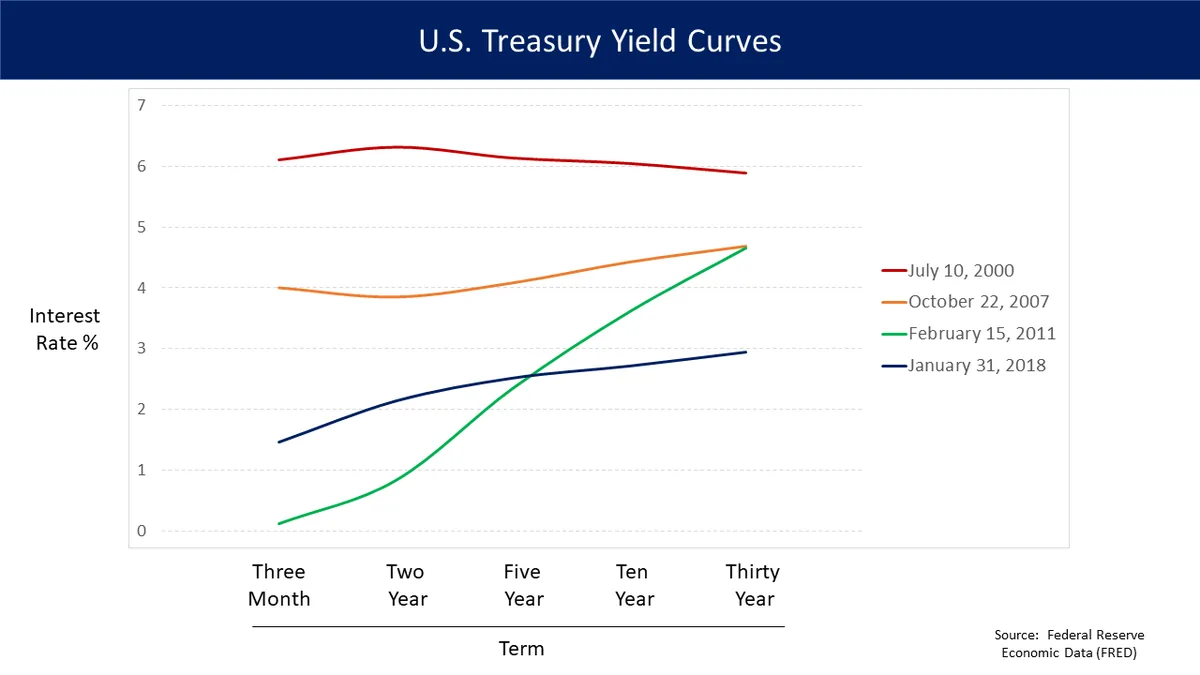
Here is the piece of plumbing that makes this moment interesting. Mortgage rates take their cues from the 10-year Treasury yield, which reflects what investors collectively expect about inflation, labor-market health and monetary policy. When that yield rises, lenders price home loans higher. The Federal Reserve does not set mortgage rates directly; it sets a policy rate, and cheaper borrowing costs only trickle down to housing gradually (2).
The same yield, however, is what a saver can earn. That symmetry is easy to state and hard to feel, because for most of the past several years the two sides of it pointed the same way: cheap money made loans cheap and deposits worthless. Now the arithmetic runs in both directions at once. Banks are offering between 3.5% and 5% on high-yield savings and money market accounts (1). A down payment parked in cash is no longer idle in any meaningful sense. > “High rates make mortgages more expensive, and it’s going to be painful to see such high mortgage rates for a lot of homebuyers, especially those who saw extremely low rates just a couple of years ago.” (1) [2] > > “It’s going to be difficult for them to understand that this might be the new normal in this economy.” (1)
> “But that same environment makes cash more productive. Those looking to buy houses who have built up a down payment no longer have to look at the stock market for a return. They can hold that down payment in cash, in a money market, or in a high-yield savings account, and keep looking around at houses without worrying about their purchasing power decreasing.” (1) Buying a T-bill is the second option, and it costs money if the timing is wrong. Treasury bills are direct government obligations, typically issued in three-, six- and 12-month maturities. A saver buys a $10,000 three-month bill and three months later gets the $10,000 back plus interest. The catch is the calendar. > “You should see it as locking your money away for the duration you decide, so flexibility isn’t something you tend to get with T-bills, even though they’re shorter duration.” (1) > “If you need the money sooner than the duration you signed up for, you have to go into the secondary market and sell it, which can be pretty volatile depending on where interest rates are at that time.” (1) > “They’re high credit quality, they have a defined maturity, and they’re fairly predictable.” (1) > “You’re not nervous about credit risk, because a T-bill is backed by the full faith of the U.S. government, which is almost as sure a thing as you can get.” (1) That is the trade in its purest form: certainty of repayment purchased with uncertainty of access. A 5% yield is generous compensation for giving up the option to buy the house that lists next week at a reduced price.
The actors: who pays, who earns, who decides
The distributional picture is unusually clean. Borrowers lose purchasing power when yields climb. Savers win, but only the ones who actually move the money — a down payment left in a checking account earns nothing while the same balance in a money market account earns a real return. Banks sit in the middle and price deposit rates against their own funding needs, which is why the 3.5% to 5% range is a range and not a number.
The Treasury is the other party in the room, and higher yields have driven investors to recent Treasury auctions in droves (1). On the housing side, supply remains partly frozen by an older decision: households that locked in low rates in 2021 and 2022 are reluctant to trade a cheap mortgage for a market in the mid-sixes, an effect that keeps inventory tight in metros such as Dallas-Fort Worth even as national listings and contract signings improve (3).
Then comes the question that decides everything for an individual saver, which is not “what is the highest yield” but “when do I need the money back.” The answer splits the market in two. > “Treasurys and CDs are for when you know exactly when you’ll need the money. If you have a set expense in the next six months, a T-bill that matures in six months would be fantastic.” (1) > “But if you have a down payment for a house, you’re actively looking, and you don’t know exactly when you’ll need the money, a high-yield savings account could be a fantastic place to park it for the time being.” (1)
The outlook: what we watch, and what we do not know
Three observable things come next. The weekly mortgage survey will show whether the dip to 7.32% extends or reverses. And weekly unemployment claims, the data point investors are waiting on, may reprice the whole curve in one direction or the other (1).
Around that sit the harder-to-model inputs: the conflict in Iran, the crude move on our screen, and the inflation pressure that has not gone away. Our regime reading — falling trend, level 3.63, central banks as the busiest signal channel — is a description of the present, and we treat it as one. Nothing in our measurement tells us where the 10-year sits in December.
That leaves one ordinary object. A calendar entry — three months out, six months out, twelve — the date you write down when you commit money to a maturity. For years that date was administrative housekeeping, a note about when a form would clear. Now it is the decision itself: every date a buyer chooses is a bet on whether that buyer will still be house-hunting when it arrives.
Sources: (1) Dina Sartore-Bodo, “Treasury Yields Rest Above 5%: How Homeowners — and Buyers — Can Take Advantage of the Moment,” Realtor.com via Yahoo Finance, Oct. 26, 2026. (2) Katherine Watt, “Mortgage Rates End the Week Slightly Lower,” CNET Money via Yahoo Finance, on the 10-year yield as the reference rate and the Fed’s indirect role. (3) Neal Franklin, “4 data trends buyers and sellers should know heading into D-FW’s summer housing market,” Yahoo Finance, on the lock-in effect. (4) Own watchlist measurements, 2026-10-26, 11:10 UTC; quotes fetched one minute prior to publication. This article is educational and contains no investment recommendation.