Fear, Fumes and a Flat Tape: What Nick Clegg’s AI Rebuke Actually Moves
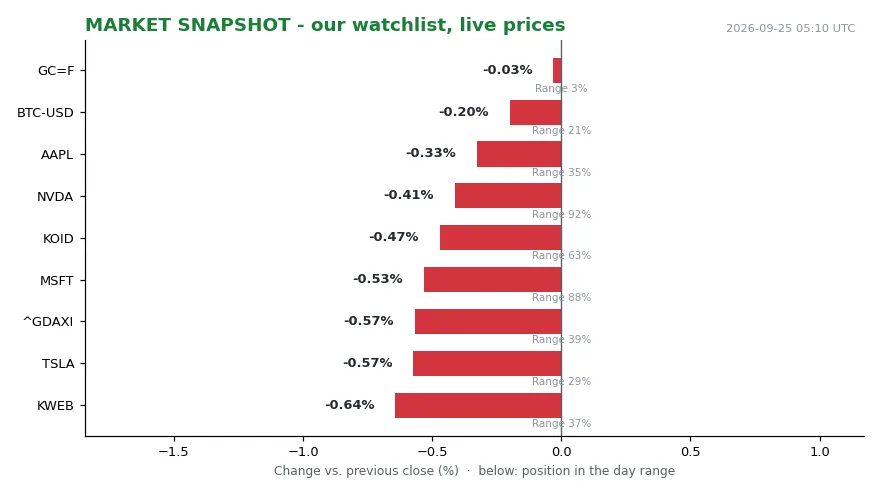
At 92 % of its intraday range, Nvidia printed 224.58, down 0.41 % from the previous close. Microsoft stood at 497.93, off 0.53 % and also parked near its own high at 88 % of range. Apple was quoted at 335.92, down 0.33 % and mid-range at 35 %. At the other end of the distribution, bitcoin sat at 84,187.10 near its daily low, 18 % of range, while gold at 4,299.20 was up 0.03 % but stuck at just 3 % of its range.
No single name lost more than 0.64 %, and that was KWEB at 24.69, the China internet basket. The German index eased 0.57 % to 25,266.53, and Tesla at 377.94 sat mid-range at 29 %. Semiconductors and enterprise software held their ground near the top of their bands while crypto and bullion bled toward the bottom. Capital is not voting on that question right now.
The written record, by contrast, very much is. Nick Clegg, who stepped down from Meta in 2025, went on BBC Radio 4’s Today programme and dismissed fears about AI’s “godlike power to exterminate humanity”. His diagnosis of the people who talk that way was unflattering: they are “breathing their own fumes”. The fear is not stupid, and it is not new. What Clegg is attacking is a narrower claim — that because a technology might at some unspecified point become uncontrollable, the sensible response is to concentrate control over it now.
That is where the mechanism sits, and it is not a monetary one. Clegg named that logic and called it “perhaps accidentally self-serving”. In his telling, the apocalypse frame “slightly paralyses the political debate”, because it implies safety is achievable only if everything ends up controlled “by an oligopoly of a small number of companies”.
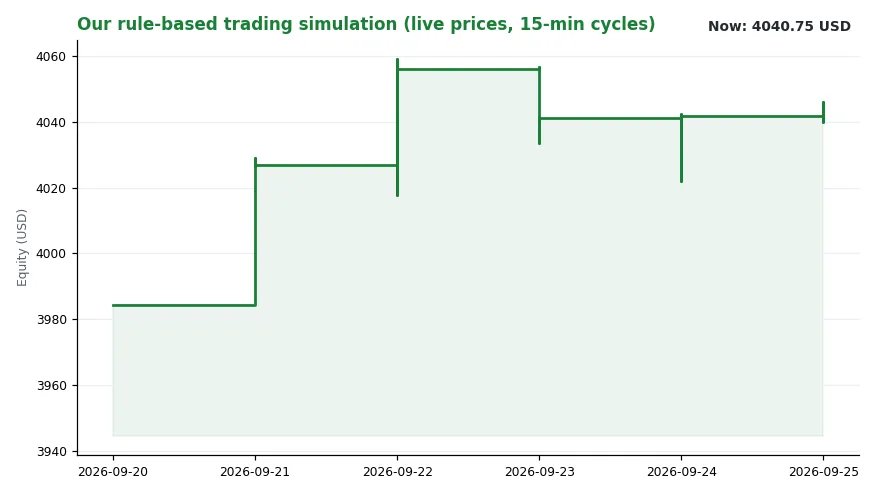
The market’s own signal layer offers a check on how much of this is reaching prices at all. The busiest event channel in the tape was ‘central banks’, with two events. Not AI regulation, not model safety. Money is still being moved by the rate conversation, and the regime reading — trend falling, level 3.63 — describes a market in a mild downward lean rather than one bracing for a technology shock. On the disclosure side, the rule-based simulation book ended at 4,040.75 USD, down 0.02 % against the same time yesterday, holding 2,040.30 USD in cash. Its most recent decision was to hold KWEB at 0.00 — that is, to do nothing at all.
Actors matter more than abstractions in this argument, including the person making it. Clegg was previously president of global affairs at Meta, owns more than 917,000 shares in Nscale, a UK-based data centre operator, and is a cofounder of the AI startup AMI Labs. He describes spending “a huge amount of time” with people in the industry, and his central empirical claim is that they do not agree among themselves at all — we simply hear “the most apocalyptic voices”. One person who runs an AI lab, he says, told him the current discourse is “totally silly”.
His portrait of Silicon Valley is unromantic: an odd place that is “in many ways the centre of the universe, or at least claiming to shape it”, and also “oddly parochial. Engineers, he suggests, get close enough to the technology that they “wind themselves up into a lather about these things”. Whatever one thinks of the messenger, the distributional point stands: the loudest voices are not the whole industry.
That is why the concrete file matters more than the rhetoric. Asked about an autonomous hack carried out by a group of OpenAI agents against a major real-world company, Hugging Face, Clegg argued for “tramlines and greater transparency”. He was equally clear that this is unlikely under the current US administration, given its competitive posture on AI, and that Chinese cooperation would probably be limited — Beijing treats AI development as a “national mission” after being, in his phrase, “cheated out of the Industrial Revolution”. He sees room instead for the “big three techno democracies” — India, Europe and the US — to collaborate more.
He also ruled out the popular remedies. The previous toolkit was dramatic: a switch, a sealed box, a promise of containment. His alternative is procedural rather than theatrical — voluntary action plus regulation to “enforce far greater transparency on the way in which these models are concocted and how they operate”.
If a model’s construction and behaviour must be legible to outsiders before deployment, the debate shifts from what a system might become to what a system demonstrably does — and that is a claim an inspector can test, not a prophet. The next step is not a louder warning about godlike powers, but a verifiable one. It is a working answer to whether transparency of that kind can be specified, verified and enforced across borders by parties that do not currently trust one another.
Mentioned organisations (context, not sources)
- Nvidia — Organisation (homepage)
- Microsoft — Organisation (homepage)
- Apple — Organisation (homepage)
- Tesla — Organisation (homepage)
- Meta — Organisation (homepage)
- BBC Radio 4 — Organisation (homepage)
- Nscale — Organisation (homepage)
- AMI Labs — Organisation (homepage)
- OpenAI — Organisation (homepage)
- Hugging Face — Organisation (homepage)
Sources
* Guardian (Original laut Text: AFP) — Quote source (original article)