Three Votes and a Ticker: Anthropic’s Listing Walks Into a Falling Tape
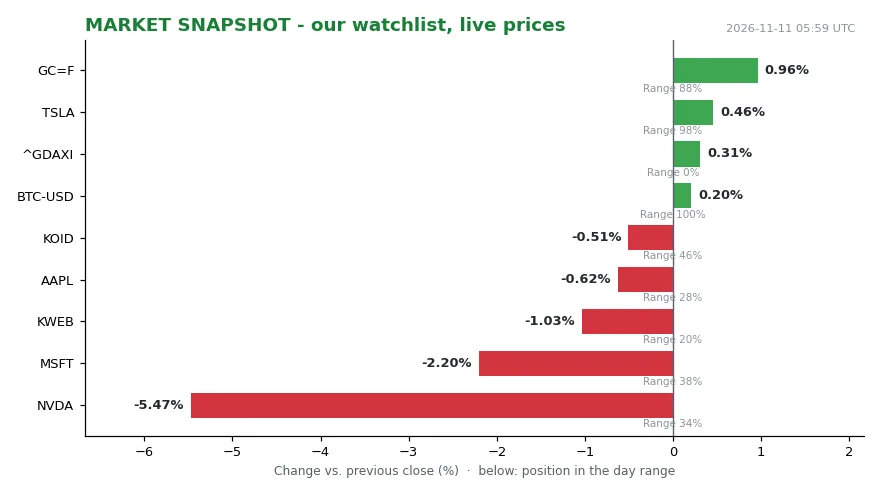
Our screens opened the week with a split tape, and the split carries more information than any single headline. Nvidia printed 168.89, down 5.47 % against the previous close and parked mid-range at 34 % of its daily band. Microsoft traded at 533.16, off 2.20 % and also mid-range at 38 %. Tesla went the other way, printing 379.78, up 0.46 % and pinned at 98 % of its range, near the day high. Gold at 4,068.20 added 0.94 % and sat at 86 % of range. Bitcoin at 73,810.64 was 0.14 % higher and at 97 % of range. Apple slipped 0.62 % to 348.51, mid-range at 28 %. The DAX at 26,347.45 gained 0.31 % and still finished near its day low at 0 % of range. Read together, the print looks like rotation rather than liquidation: the compute complex leaks while hard assets and non-AI cyclicals catch. Our regime line agrees, with trend falling and level at 3.63. The busiest channel in our signal layer on 10 November was central banks, with a single event. That is the tape Anthropic’s bankers are pricing into.
Go back to June
To see why the timing is awkward, rewind five months. Elon Musk’s SpaceX raised $86 billion in its listing at a valuation of $1.77 trillion, the largest IPO on record. Now the maker of the Claude models has filed with the US Securities and Exchange Commission to sell 825 million shares at $70 to $78 apiece, or EUR 62.44 to EUR 69.58. [1] The ticker will be “ANT.” The company had been expected to raise as much as $100 billion, which would have made it the largest IPO on record. Even at the top of its range, it will not get there. SpaceX’s $86 billion remains the bar. That shortfall is the first hard number in the story.
The anchor buyer
The second number is the anchor demand. Seven technology companies, among them Google, Nvidia, AMD and Microsoft, have agreed to buy $26 billion of non-voting shares at the IPO price in a separate private placement. The filing notes that these firms are investors in Anthropic or major suppliers of its computing power. That is not a crowd of strangers bidding. It is the supply chain buying in at the same price as the public, in a class of stock that carries no vote.
The mechanism
A listing by one of the leading AI model developers works as a gauge of how long the AI spending boom lifting the US economy can last. That frame is the useful one. An IPO converts a private estimate into a public price, and a public price has to be defended every session. When the tape is falling, the discount rate does the arguing.
The company’s own figures give that argument its material. Revenue reached $17 billion in the third quarter, up from $1.4 billion a year earlier. [1] Annualized run-rate revenue was about $81 billion, or EUR 72.3 billion, as of 31 October. Anthropic puts that figure $10 billion above where it stood at the end of September. Those numbers are what justify a range at all. Estimates in recent months had put the valuation as high as $2 trillion. They have slipped along with AI stocks on Wall Street.
The cost side is where the mechanism bites hardest. Anthropic has committed hundreds of billions of dollars to computing capacity. It warns that it must make many of those payments even if demand falls short. Fixed commitments plus equity funding equal an obligation that does not flex with the cycle. That is the channel through which one listing reaches the wider market: not sentiment alone, but contracted spend.
Regulation adds a second channel. The filing devotes extensive space to the technology’s risks, including the concern that advanced AI systems “could pose catastrophic or existential risks to society if not developed and deployed responsibly.” Anthropic also warns that its public positions on AI regulation and safety could expose it to “political backlash, or disproportionate regulatory action.” The context is not abstract. The Pentagon has labeled the company a national security risk after it refused to lift restrictions on military use of its technology.
Politics pushes from the other side as well. Wall Street is digesting US midterm results in which the Democrats, more wary of AI, won control of both chambers of Congress. They have vowed to put the brakes on President Donald Trump’s agenda.
Who holds the votes
Follow the votes and the ownership becomes clearer. Under the governance structure laid out in the filings, the seven co-founders will keep just over half of shareholder votes after the listing. The group is led by chief executive Dario Amodei and his sister, president Daniela Amodei. Outside investors cannot outvote them. The $26 billion placement is explicitly non-voting. The public buyer therefore receives economic exposure without a vote to match it.
Who gains from this arrangement? The strategic buyers gain a fixed price and a commercial relationship inside the ecosystem they supply. The founders gain capital without surrendering control. The underwriters gain a fee on 825 million shares. Who carries the risk? The public shareholder who funds the compute commitments and cannot outvote anybody.
The competitive read sits in one quotation. “Just another chapter” is how Art Hogan, chief market strategist at B. Riley Wealth Management, places the listing within investors’ worries over the cost of the AI buildout and how it gets financed. [1] “But at the end of the day, I think there are three massive companies that investors have wanted to be part of for the last three years and that’s SpaceX for sure, Anthropic is next, and perhaps next year OpenAI,” he said.” Nvidia, the AI chip-maker, is in focus after chief executive Jensen Huang was caught up in a spy scandal. Its shares were the heaviest weight on our tape, at minus 5.47 % against the previous close. When the leading supplier of AI compute is the weak spot, an IPO range is set against a moving reference.
What we watch next
Three things to watch, and one honest limit. First, whether the deal clears at the top of the $70 to $78 band or has to be walked down. A range that holds says something about demand; a range that narrows says something about the tape. Second, the first trade on 19 November and the sessions after it, because the filing’s own risk language gives public buyers reasons to be slow. [1]. Third, whether the $26 billion placement is confirmed on the terms disclosed. Behind all three sits the run-rate, the only operating number in the document that compounds.
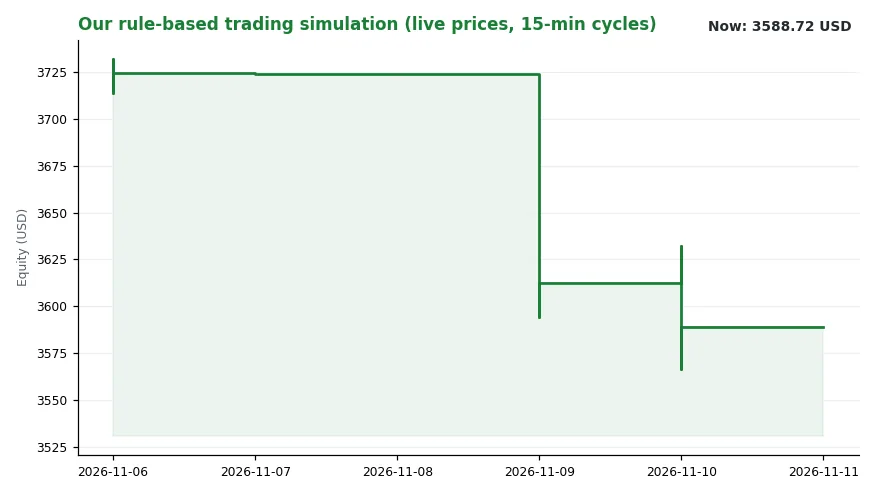
The limits deserve equal space. The $2 trillion valuation figures were estimates, and they have already slipped along with AI stocks on Wall Street. Nothing in the filing guarantees the range holds. Our own simulated book is flat on the day at 3,588.72 USD, with 1,806.93 in cash. Its most recent rule-based decision was to watch KWEB, which is to say the model is not positioned for a verdict either.
So the question to carry into the listing week is the one the filing keeps circling. Which vote is actually being priced: the founders’ just-over-half, the $26 billion of non-voting stock, or the one cast in the midterms? The tape will answer it before the prospectus does?
Sources
Mentioned organisations (context, not sources)
- Nvidia — Organisation (homepage)
- Tesla — Organisation (homepage)
- Apple — Organisation (homepage)
- Anthropic — Organisation (homepage)
- SpaceX — Organisation (homepage)
- US Securities and Exchange Commission — Organisation (homepage)
- Google — Organisation (homepage)
- AMD — Organisation (homepage)
- Pentagon — Organisation (homepage)
- Congress — Organisation (homepage)