The $20 Billion Question: How a Revenue Headline, Not a Revenue Miss, Rattled
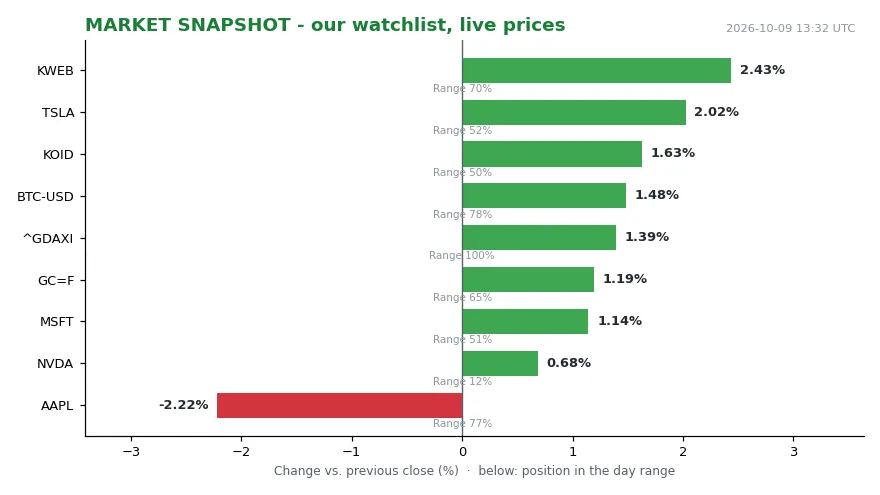
the AI Trade Our own tape, pulled two minutes before this was written, shows rotation rather than retreat. Nvidia trades at 230.48, down 2.94% against the previous close and sitting near its day lows — just 9% of its daily range. Microsoft is at 522.61, off 1.35% and mid-range at 26%. Apple is doing the opposite: 340.42, up 1.11%, pressed near the top of its band at 80% of range. Tesla is 0.74% lower yet parked at 88% of its range, which is where weakness hides when the headline number is red. Bitcoin is at 82,936.50, up 1.53%, near its highs at 81%. Gold at 4,205.70, up 1.17%. The DAX at 25,117.31, up 1.25%, near its highs at 83%.
Read together, the lines show a pattern. American AI hardware is being sold. European equities, bullion, bitcoin and Apple are being bought. KOID, our AI-exposure proxy, is the tell: 34.96, down 3.35%, stuck mid-range at 27% — neither a rout nor a bounce, just stalled. That is the shape of a rotation inside a risk-on market, not of a market heading for the exit.
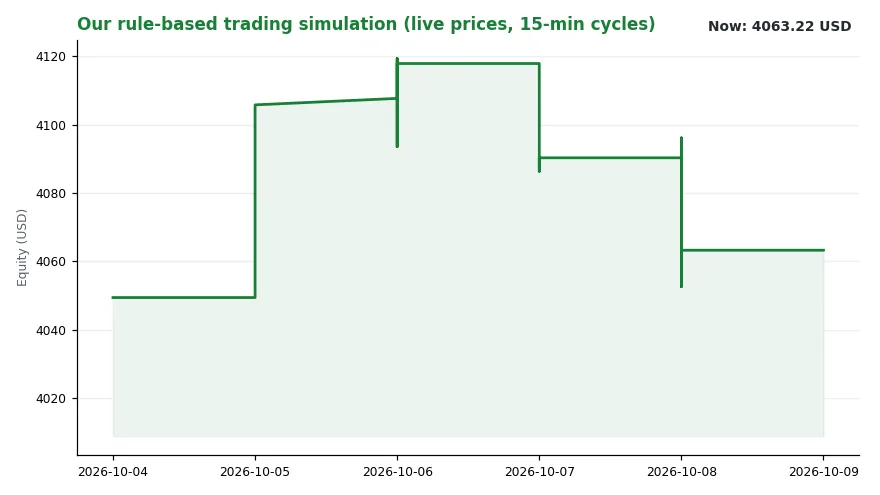
Our regime reading agrees on direction and disagrees on drama: trend=falling, level=3.63. The busiest signal channel on 2026-10-09 is “central banks,” with two events. Our rule-based simulation holds at 4,063.22 USD, flat against the same time yesterday, with 2,051.17 in cash and a latest decision to WATCH KWEB at 0.00. Nothing in our own data says panic. Something in the news says confusion.
The news, and the clock attached to it
On Thursday the Financial Times reported that OpenAI’s annualised revenue — recent sales projected across a full year — was approaching $50 billion (EUR 44.6bn) at the end of September, according to figures shared with investors. That is about $20 billion (EUR 17.8bn) less than the company projected last month. [1] The reaction was fast and broad. The Nasdaq Composite fell 1.25% to around 27,193. [1] The Philadelphia Semiconductor Index, which tracks major US chip stocks, sank 3.4%. [1] By Friday morning the futures had turned: Nasdaq 100 futures around 0.8% higher, S&P 500 futures up 0.4%.
But the gap is not a miss, and it is not lost sales. The roughly $70 billion (EUR 62.5bn) figure was an estimate, not a company forecast, built on a different way of counting revenue. According to the FT, the higher number came from OpenAI’s backers recalculating its sales to match the method of rival Anthropic, which counts what customers spend on its AI models through cloud platforms such as Amazon Web Services and Google Cloud as revenue, while OpenAI excludes such sales.
Now the clock. Dutch chip equipment maker ASML reports on 14 October and TSMC on 15 October. Those two reports, not Thursday’s headline, are where this argument gets tested against physical order books.
How Revenue Definitions Move Capital
Revenue recognition is not an accounting footnote. It is the channel through which this whole story travels. A valuation is a multiple applied to a revenue number. Change what counts as revenue and you change the multiple’s denominator. Change the denominator and you change the valuation. Change the valuation and you change how much capital is available to build data centres, and how many chips get ordered to fill them.
That chain may explain Thursday’s casualties better than any story about demand.
The stakes are concrete. OpenAI, valued at $852 billion (EUR 760bn) in March, is reportedly seeking at least $30 billion (EUR 26.7bn) in fresh funding at a $1.4 trillion (EUR 1.25tn) valuation. That raise rests on a multiple applied to a contested figure.
Who paid, who got paid
The companies that bet hardest on OpenAI’s growth absorbed the worst of it. Oracle, which agreed to supply OpenAI with vast computing power, slid 5.5%, while CoreWeave, an AI cloud specialist holding multibillion-dollar contracts with the firm, lost nearly 8%. Microsoft, a major OpenAI shareholder, plus Amazon, Alphabet and Meta each fell by more than 1%. All are hyperscalers pouring money into AI data centres. Chipmakers slid in sympathy: Nvidia fell almost 3%, AMD around 4% and Broadcom, which is building a custom chip with OpenAI, 4.35%. In Tokyo, SoftBank Group, which owns about 13% of OpenAI, fell as much as 7.3% before paring losses.
The winners were elsewhere, and they were hardware, not models. South Korea’s Samsung estimated on Thursday that its third-quarter operating profit hit a record 107.4 trillion won, or $80.2 billion (EUR 71.5bn) — the biggest quarterly operating profit ever reported by a technology company. Taiwan’s TSMC said the same day that September sales rose 54.6% year-on-year, taking third-quarter revenue to a record NT$1.49 trillion, or $46.8 billion (EUR 41.8bn).
So the same week produced a scare about one company’s revenue definition. Both can be true. They measure different things.
What we watch next, and what we do not know
Three readings will matter more than commentary: ASML on 14 October, TSMC on 15 October, and the audited accounts that listings would force into the open. Anthropic could come to market as soon as November, and OpenAI next year. A listing is the only mechanism that settles a dispute about definitions.
Until then, uncertainty is the honest label. Our own data says falling trend at level 3.63, with central banks as the busiest signal channel — a reminder that the discount rate applied to all of this is not set in San Francisco. Futures pointing 0.8% and 0.4% higher is an indication of sentiment, not a settlement of the accounting question.
That is the cost worth naming. A Nasdaq-tracking fund carries the outcome of this debate whether or not its holder signed up for it. A 1.25% index decline is small in isolation. But if the definitional question stays open until the audits arrive, that exposure is carried blind — priced on an estimate one month, recalculated the next, and comparable across rivals only after everyone agrees on what a sale is. The ticker will keep printing either way. The number underneath it is the thing still unresolved.
Sources
Mentioned organisations (context, not sources)
- Nvidia — Organisation (homepage)
- Microsoft — Organisation (homepage)
- Apple — Organisation (homepage)
- Tesla — Organisation (homepage)
- OpenAI — Organisation (homepage)
- Nasdaq — Organisation (homepage)
- ASML — Organisation (homepage)
- TSMC — Organisation (homepage)
- Oracle — Organisation (homepage)
- CoreWeave — Organisation (homepage)