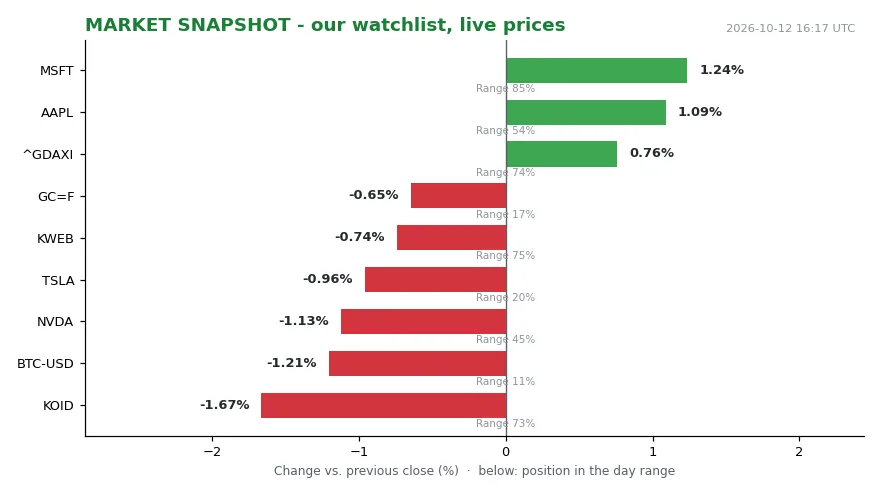
At 16:14 UTC on 2026-10-12, our own quote sheet opened with Microsoft at 541.79, up 1.26% against the previous close and parked at 87% of its daily range. Nvidia printed 226.78, down 1.09%, mid-range at 47%. Apple added 1.09% to 340.31, also mid-range at 54%.
Now the other side of the ledger. Bitcoin stood at 82634.37, off 1.24%, at just 9% of its range — near the floor of the session. Gold futures traded at 4188.40, minus 0.66%, at 16% of range. Tesla was at 379.06, down 0.95%, at 21% of range. The DAX rose 0.76% to 25277.68, mid-range at 74%. KWEB slipped 0.66% to 24.77 but held 89% of its range, close to the highs. KOID fell 1.67% to 34.81, mid-range at 73%.
Read together, those nine lines do not describe one switch being thrown in a single direction. They describe a split tape with a defensive tilt. The two instruments most often marketed as inflation protection — gold and bitcoin — were both lower, and both sat in the bottom fifth of their daily ranges. Leadership, such as it was, sat in software instead.
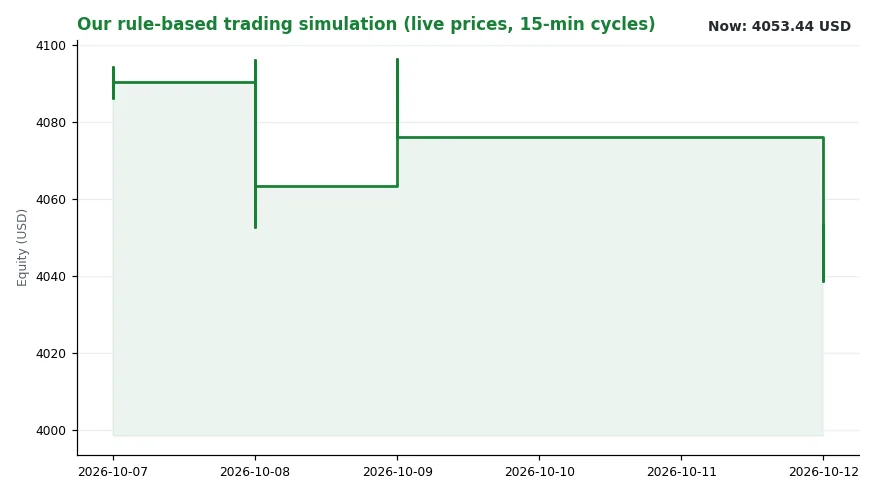
Our regime reading for the session put trend at falling and level at 3.63. The busiest signal channel on the day was “central banks”, with 2 events logged. Our simulated, rule-based book stood at 4051.80 USD, down 0.59% against the same time yesterday, with 2049.10 in cash. The latest rule-based decision was WATCH KWEB at 0.00.
That is the screen. Now to the print that lands on it.
The number due Wednesday
Traders on the prediction market platform Kalshi expect the September consumer price index to show a 3.6% increase year over year. [1] The release is scheduled for Wednesday at 8:30 a.m. ET. That 3.6% figure is in line with the FactSet consensus estimate.
So the headline expectation is a step up from August’s 3.4%, not a step down. Yet the same contract market places just under one-in-three odds on inflation reaching new highs at some point in 2026. [1] In plain terms: the modal trader treats the current neighbourhood as roughly the ceiling for the year, while something close to a third of the market does not.
Core inflation is a different story in the same dataset. Traders expect core prices — which exclude food and energy — to hold steady at 2.4% year over year, again matching the economist consensus tracked by FactSet. [1] They also expect core inflation to stay elevated through the remainder of 2026.
The mechanism the contracts actually measure
Two contract families sit behind those numbers, and their design matters more than the headlines suggest. One family asks whether CPI will come in above various levels for September specifically. The other asks whether it will exceed certain levels at any point during 2026. Those are different bets with different payoffs, and reading them as one number blurs a monthly outcome with a path-dependent one.
Resolution runs through a single arbiter. The contracts settle using official data from the Bureau of Labor Statistics. There is no survey panel, no nowcast and no committee judgement in the settlement — one statistical release decides the outcome.
A contract price aggregates what participants are willing to risk, not what they believe in private. It carries a fee, a spread and a time horizon. It can be right about the level and wrong about the direction of the next revision.
That is the plumbing. An inflation print enters the conversation through the institutions that set the price of money, and everything downstream — currencies, gold, long-duration equities — reprices off that.
Who holds which side
The actors here are few and identifiable. Kalshi operates the venue and sets the contract terms. Traders supply the odds.
CNBC and Kalshi have a commercial relationship that includes customer acquisition and a minority investment.
Winners and losers are not yet determined. The contracts put only a 6% chance on core inflation falling below 2.2% this year — so anyone positioned for core to stay above that level needs only for nothing much to happen.
What we watch next
Three things, in order. First, Wednesday’s 8:30 a.m. ET release, and whether the headline lands at 3.6% or somewhere else — the gap between an expected 3.6% and August’s 3.4% is the entire point of the exercise. Second, the core number, where 2.4% steady is the expectation and where a miss in either direction resets the year-end odds. Third, our own tape: whether gold and bitcoin keep sitting near the bottom of their ranges while software holds, or whether that rotation reverses.
None of this tells us whether inflation has peaked for the year. The contract market says it probably has, with a dissent of roughly a third. The consensus says the September print rises. Both can be true at once, and that is the honest shape of the evidence.
Wednesday will not resolve the question. It will only re-price it, and hand the market a new set of odds to argue about.