
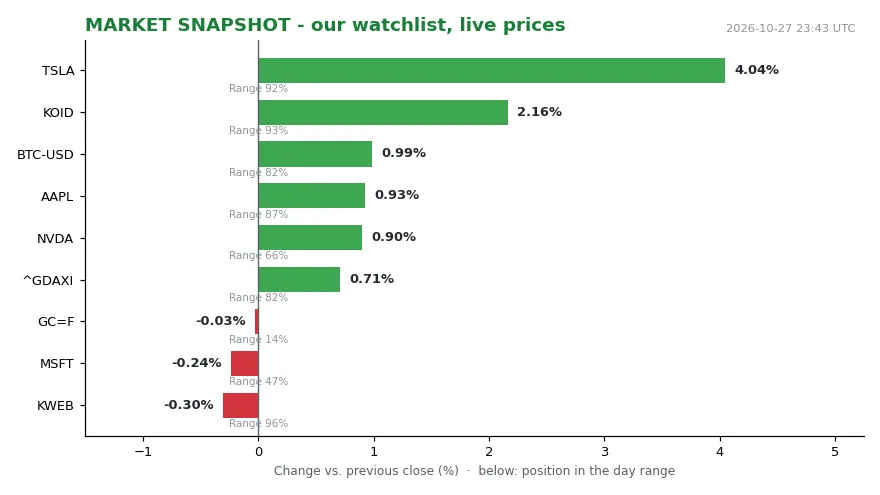
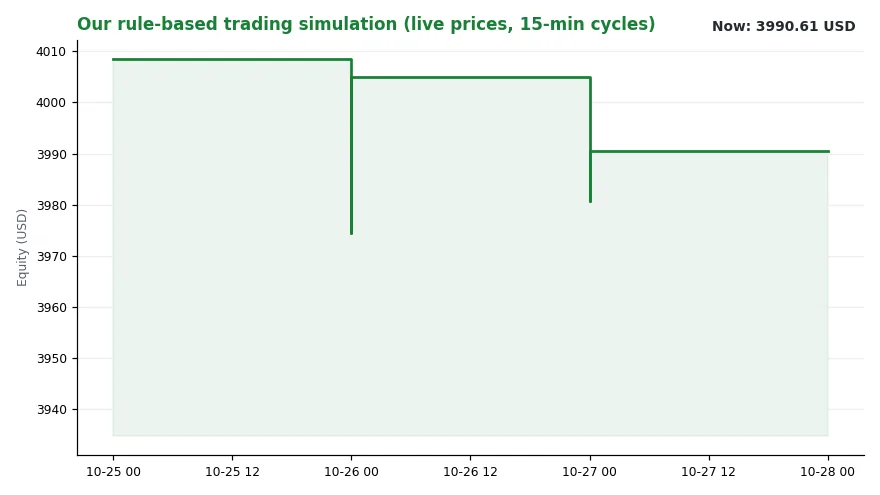
Our own measurement, stamped 23:38 UTC on 27 October, opens with TSLA at 407.46, up 4.04 % and holding 92 % of its daily range, where 0 % is the day’s low and 100 % the high. AAPL prints 347.10, +0.93 %, at 87 % of range. KOID trades at 34.48, +2.16 %, at 93 % of range. Then the pattern breaks. MSFT sits at 531.33, -0.24 %, mid-range at 47 %. Gold (GC=F) is at 4,074.10, -0.01 %, in the lower quarter of its range at 25 %. BTC-USD shows 80,733.03, +0.90 %, at 78 % of range. The DAX is at 25,590.77, +0.71 %, at 82 %. KWEB is at 23.13, -0.30 %, yet 96 % of range. Read together, this is rotation — money leaving one group of shares for another while the index barely moves — not a broad bid. Capital crowds into a handful of consumer and growth names near their highs while one mega-cap sits mid-range and gold sits near the bottom of its range. Our simulated book holds 3,990.61 USD, entirely in cash, flat versus the same time yesterday. The last logged decision is a WATCH on KWEB. The regime reading — the desk’s own label for the current trend state — is trend falling, level 3.63.
The arithmetic nobody applies for
Start with the term most often misused in this debate: the Barnett consequential, the automatic top-up Wales receives when England spends more on services that are devolved in Wales. In Welsh political conversation it is treated as a grant that Cardiff applies for and London grants or withholds. It is nothing of the kind. It is arithmetic triggered by decisions taken about England. BBC Wales sets out the mechanism plainly: any extra spending on things in England that are controlled in Wales by the Welsh government — healthcare, schools and roads — could trigger additional cash for the country. [1] That is the entire channel. Nobody in Cardiff has to win an argument for the money to arrive. Nobody in Cardiff can win an argument to make it larger. The size of the transfer is set by how much England spends.
That single fact rearranges Wednesday’s Budget. The question is not what the Chancellor says about Wales. The question is what the relevant English departments get.
What Cardiff can actually ask for
Plaid Cymru ministers want extra cash for railways and public services from the UK Budget on Wednesday. Finance minister Elin Jones called for Chancellor John Healey to set out a spending plan that “finally treats us fairly”. [1] The specificity matters. Jones asked Healey to bring forward £1bn of the £14bn the UK Labour government has promised for long-term rail funding in Wales. She also asked for extra money to help the Welsh government set its budget for 2027-28, which currently faces a real-term cut — a cut measured after inflation is stripped out — in day-to-day spending. Her earlier public position was that Wednesday’s settlement could be the worst for the Welsh government since the Covid-19 pandemic.
1) “This UK Budget is the moment of truth, and we need the chancellor to act, not just acknowledge the problem.” — Elin Jones 2) “Wales pulls its weight in the UK economy. We contribute. Now we need the UK government to match that ambition with action and deliver a budget that finally treats us fairly.” — Elin Jones
What is absent from the request list is telling. There is no request for a particular sum of consequentials — the extra money that follows arithmetically from English spending under the funding formula — because that is not something a devolved government, with powers such as health and schools handed from Westminster to Cardiff, can request. There is a request to accelerate a slice of a named capital envelope — a fixed pot earmarked for building projects rather than day-to-day running costs — and a request for room to borrow. Labour MP Nia Griffith has called for greater borrowing flexibility — permission to borrow for investment instead of funding it from the annual budget — so the Welsh government can fund investment projects.
The bill that arrives before any settlement
Energy prices rose at the beginning of this month. Typical bills are forecast to increase by 16 % in January, with the conflict in the Middle East cited as the driver. That figure reaches a household before any settlement reaches a devolved administration. The mitigations already announced are narrow. Import taxes on heating oil are being removed to bring the price down a little. The 5p fuel duty cut introduced by the previous Conservative government in 2022 has been extended twice and is expected to be frozen again in January. Petrol hit a four-year high in September, and diesel rose too. The Chancellor has been assembling what he calls “everyday fixes”, and the Prime Minister wants standing charges — the fixed daily fee on a gas bill charged before any gas is used — cut from gas bills. Any further support in the Budget would likely be limited and targeted at the poorest households.
A tenner a week, and the tax that eats it
The Welsh government plans a trial paying 15,000 children in families on universal credit — the UK’s main means-tested benefit for low-income working-age households — £10 a week. The scheme, Cynnal, is modelled on the Scottish government’s child payment, which helped reduce child poverty in Scotland. Welsh ministers have asked the UK government to exempt the payments from tax and benefit calculations, so recipients do not see their income cut. That points away from an announcement on Wednesday. The Prime Minister has previously said he was “open” to considering the exemption, and it has already been granted to facilitate the scheme in Scotland. [1] A tenner a week taxed back, or counted against a benefit award, is not a tenner a week. The exemption is the policy. Its absence on Wednesday would be an easily missed decision, and for those 15,000 households a consequential one.
Who is asking, and who decides
The decision sits with Healey and is executed through English spending lines. The asking is crowded. Reform UK Senedd member Cai Parry Jones wants his party to “stop using Welsh people as cash cows”, to build an M4 relief road, to scrap the family farm tax and to “reward working people” by raising the tax-free personal allowance to £15,000. Welsh Conservative Senedd leader Darren Millar wants money for major road projects including an M4 relief road, more defence spending in Wales, and a “pro-union Budget deal”. Welsh Liberal Democrat MP David Chadwick wants a Budget giving Welsh families “some much-needed breathing space”, with a 10p fuel duty cut, a guarantee on energy bills and a temporary VAT cut for hospitality.
“The chancellor is focused on giving households and businesses a bit of breathing space where we can. That’s why we have removed VAT from electricity bills, extended the 5p fuel duty cut and frozen rail fares.” — UK government spokesperson
At Swansea Market, the questions are immediate. Louise’s question is about the winter: “Will we be able to see through the winter without having to borrow money,” she said, adding “It’s quite a worry.” Richard, a father of two, describes a wage that has not kept up with energy bills, leaving his family “penny pinching towards the end of the month”. His summary of the trade-off: “Things that we used to have as a bit of luxury are out of the question, days out with family cost a fortune.” Gareth Evans, fourth generation at the Get Fresh fruit and vegetable stall, puts it plainly: “It’s a struggle at the moment.” Transport is part of it — “We’ve also got vans ourselves and we supply caterers and diesel is very expensive.” Emma, who runs a pet store, has raised prices because “it goes down the line”, and believes many working people are “struggling to live now”.
Two further issues sit outside Wales-specific bargaining. The state pension looks likely to top £13,000 a year, with the full flat rate expected to rise by £488 in April under the triple lock — the rule raising the state pension each year by the highest of earnings, inflation or 2.5 %. Pensioners relying entirely on the state pension are to be shielded from income tax, which normally starts at £12,570, with details still to come. The minimum wage is set to rise, but 18-20 year-olds will not get a bigger increase. On working-age welfare, reports suggest young people not in education, work or training may see big changes to their support, possibly unveiled after the Budget when former health secretary Alan Milburn publishes his reform recommendations.
What to watch after Wednesday
Wednesday delivers the numbers for the year ahead. Later in the week the Prime Minister and the First Minister hold their first substantive meeting at the National Economic Council, where devolution is expected to be discussed — that is where borrowing flexibility would either move or stall. The Cynnal exemption is in discussion, not in the text. The pension tax shield has been announced in principle. The reports on support for young people not in education, work or training remain reports. Our tape offers no verdict on any of it: the rotation within equities is our reading, and it says nothing about a fiscal event in Cardiff.
The set of asks — £1bn of £14bn, borrowing room, a tax exemption on a tenner a week — queues at different doors with different gatekeepers. So the number that reaches a kitchen table in Swansea is not the settlement headline. It is 16 % on a January bill, and whether a child payment escapes tax and benefit calculations. The Budget will be read in Wales as a verdict. In Whitehall it is written as a formula — and the formula, not the verdict, decides what reaches a kitchen table in Swansea.
Sources
Mentioned organisations (context, not sources)
- BBC Wales — Organisation (homepage)
- Plaid Cymru — Organisation (homepage)
- Welsh Government — Organisation (homepage)
- UK Government — Organisation (homepage)
- Labour Party — Organisation (homepage)
- Conservative Party — Organisation (homepage)
- Scottish Government — Organisation (homepage)
- Reform UK — Organisation (homepage)
- Senedd — Organisation (homepage)