
Britain’s Economy Grew in August. The Arithmetic Behind It Did Not.
The arithmetic behind the number did not grow with it.
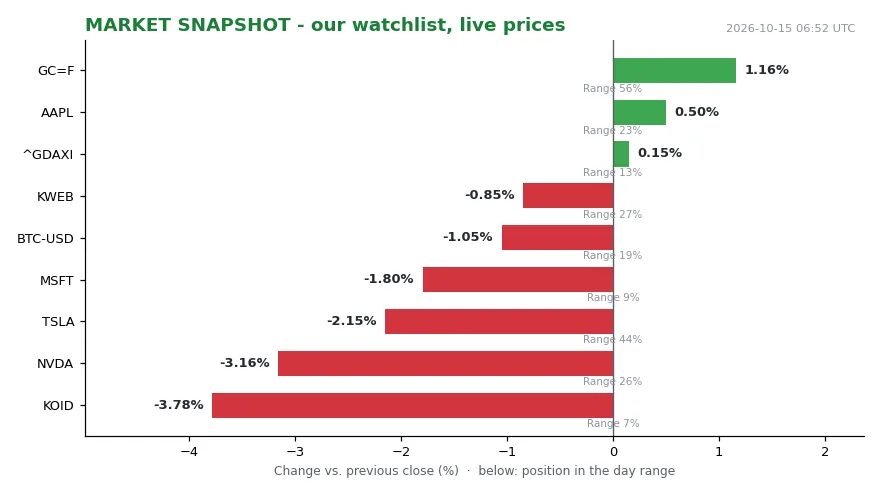
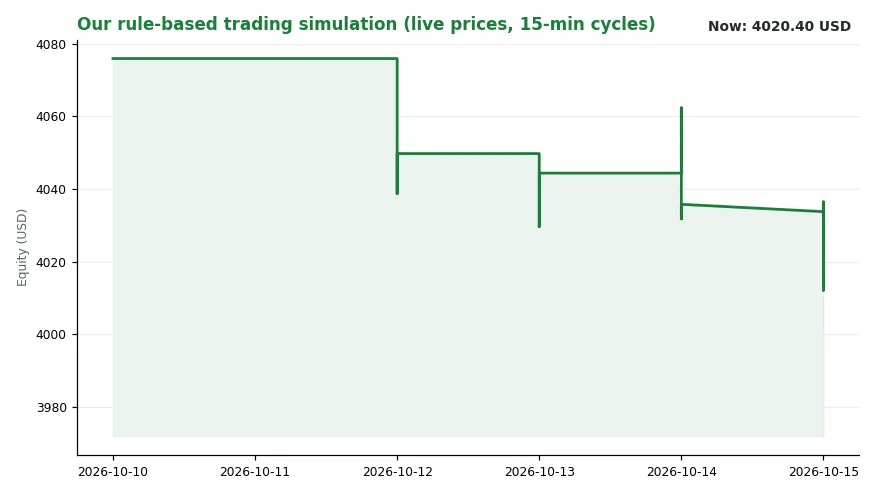
Our own measurement first. NVDA 221.30, down 3.16 percent, mid-range at 26 percent. AAPL 342.96, up 0.50 percent, near day lows at 23 percent of range. MSFT 533.69, down 1.80 percent, near day lows at 9 percent. TSLA 367.16, down 2.15 percent, mid-range at 44 percent. BTC-USD 80,914.05, down 0.81 percent, mid-range at 34 percent. Gold at 4,156.70, up 1.19 percent, mid-range at 57 percent. The DAX at 25,298.61, up 0.15 percent, near day lows at 13 percent. KOID 33.36, down 3.78 percent, near day lows at 7 percent. KWEB 24.51, down 0.85 percent, mid-range at 27 percent. Our simulated book stands at 4,020.40 US dollars, down 0.38 percent against the same time yesterday, with 2,402.15 in cash. The busiest signal channel today is central banks, with two events. The regime reading is falling, at a level of 3.63. Our own reading of the August print starts with three numbers. 0.1 percent. 0.4 percent. 0.7 percent. [1] The first is the month-on-month expansion the Office for National Statistics reported for August. The second is July’s figure, and separately June’s revised figure, upgraded from 0.3 percent to 0.4 percent. [1]. The third is the aggregate for the three months to August.
Read them together and a pattern emerges. This is not a trend. It is a rotation.
Within the three monthly prints the ONS has handed us for this summer, 0.1 percent sits at the bottom of the range. It is the weakest of the set. It is also better than analysts had expected.
That is the controversy at the centre of this release.
Work backward, and the evidence settles part of the argument.
August’s expansion came from production. That category covers manufacturing, oil and gas extraction and energy supply. It rose.
Services, the largest chunk of the UK economy, was flat. Construction contracted. [1] So the beat is real. It is also narrow.
Over three months the picture improves. The economy grew 0.7 percent. The ONS director of economic statistics, Liz McKeown, described that growth as “robust” and named computer programming as its single biggest contributor. [1] Now the correction. Across the same three-month window, production and construction both shrank. [1] The robust quarter and the shrinking sectors are the same quarter. Computer programming carried it. Factories and building sites did not.
Spring was stronger than previously believed, too. GDP rose 0.5 percent between April and June, above the 0.4 percent first estimated, on stronger exports and business investment. [2].
Pull the calendar together. A spring upgrade. A solid summer quarter. A July that grew. An August that barely moved.
Here is where the print stops being a statistic and becomes a constraint.
The channel runs from growth to expectations, from expectations to the cost of government borrowing, and from borrowing costs to what a chancellor can actually promise. Growth numbers do not tax anyone. They change the price of the promises made around them.
Paul Dales, chief UK economist at Capital Economics, called the economy “more robust than we thought.” [1] He warned separately that an expected rise in inflation would “dampen growth.” He added that the economy was showing “remarkable resilience to higher energy prices and borrowing costs.” [1] Jake Finney, senior economist at PwC, pointed at a different engine. AI infrastructure is underpinning the UK’s relatively strong performance. His words: “The UK still lags the US in both the scale of that investment and the boost it provides to growth, but it is making progress and remains ahead of many of its European peers.” [1] That is the supply side speaking. Data centres, and the programming work around them, are now visible in the national accounts.
The IMF’s read is the demand-side version of the same idea. Managing director Kristalina Georgieva said the UK was seeing “a bit of a better growth prospect” than other G7 nations. [1] John Healey, arriving in Bangkok for the IMF’s annual meeting, put it this way: “I’m pleased the IMF here in Bangkok backed our economic plans in London.” He added: “They say the UK stands out on growth despite the deep economic shocks that are affecting worldwide at present.” He promised to “stay the path.” [1] Now the arithmetic he is walking.
In March, the Office for Budget Responsibility calculated that the government could meet its first fiscal rule with headroom — a buffer — of 23.6 billion pounds. That headroom is expected to have shrunk.
KPMG puts the remaining buffer at 12 billion pounds, mainly because of the rise in government borrowing costs this year. [2].
The distance between March’s 23.6 billion pounds and KPMG’s 12 billion is 11.6 billion pounds. The IFS estimate of 20 billion pounds leaves a smaller gap of 3.6 billion pounds. [2].
That is the cost of higher borrowing costs, measured in lost room to move. Two respected forecasters, one balance sheet, and an 8 billion pound disagreement between them. The IFS also notes that higher inflation could push up tax revenues as pay rises drag people into higher tax thresholds, which is why its estimate is less severe. [2] That spread is the honest uncertainty inside this Budget.
The rules are the frame around it. Do not borrow to fund day-to-day public spending by the end of this parliament. Get government debt falling as a share of national income by the same point. Those were the previous chancellor’s rules. The current leadership has vowed to keep them. [2].
Who decides, who wins, who loses.
Deciding: Healey, who delivers his first Budget on 28 October. Andy Burnham, the prime minister, beside him. The OBR, which publishes its own economy assessment and forecasts alongside the Treasury’s costings. The IMF, which has already endorsed the debt plan. [1][2].
Winning so far: computer programming, AI infrastructure, spring exporters and business investment, and production in August.
Losing so far: construction across the three months, services in August, and any household budget exposed to higher borrowing costs.
And one item already sketched in outline. “Your First Home,” aimed at first-time buyers of new-build homes in England. A 2.5 percent deposit. A loan worth 20 percent of the property’s value. [2].
Deposit plus equity loan covers 22.5 percent of the purchase price. The remaining 77.5 percent still has to be financed some other way. The scheme changes the entry ticket. It does not change the price of the house.
Healey has refused to rule out tax increases. He has described government borrowing costs as being at “historic highs.” Labour’s 2024 manifesto promised not to raise income tax, National Insurance or VAT. Those three commitments close most of the obvious doors. [2].
One option floated in the run-up is that he accepts a smaller buffer anyway, and raises less in tax. That is a decision about risk, not about arithmetic. [2].
What we watch is short and specific. The OBR’s headroom figure on 28 October. Whether services return to growth, because August’s flat reading is the softest line in the release. Whether inflation does what Dales expects and dampens growth. Whether production — August’s engine — survives a full quarter. And whether the KPMG view or the IFS view lands closer to the OBR’s own.
We do not know.
One more caution. A single month of 0.1 percent growth is a small signal. Both things are true, and neither is a forecast.
This is educational analysis, not investment advice.