Treasury Yield Reaches Five Percent First
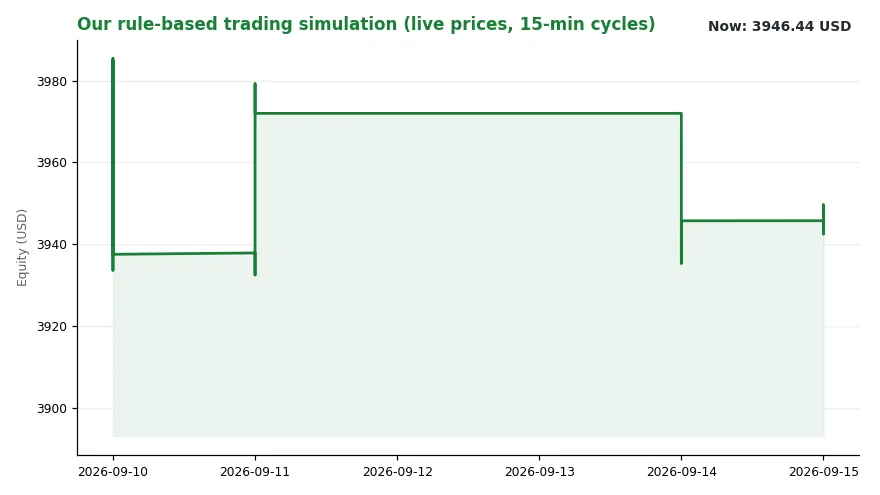
Start with the desk’s own measurement sheet, because it shows what the headline number cannot. As of 04:50 UTC on 2026-09-15, our watchlist reads like this: NVDA at 210.96, down 3.36% and parked at 53% of its daily range. TSLA trades at 358.97, down 1.77%, pressed into the lower fifth of its span at 18% of range. KOID sits at 34.71, down 3.29%, near its lows at 10% of range. Against that, MSFT is up 1.97% at 505.41, holding the upper part of its range at 69%. AAPL is fractionally higher at 333.08, KWEB is up 0.53% at 24.73, and both sit mid-range. BTC-USD is at 77602.65, down 0.74% and close to the bottom of its range at 7%. Gold is nearly unchanged at 4341.80, and the DAX is off 0.50% at 25440.81. This is not a uniform sell-off. It is a rotation, and a fairly selective one. The names falling hardest in our sample are the ones whose valuation leans furthest into the future. The names holding up are the ones with current earnings and current cash flow. Our regime read agrees: trend falling, level 3.63, with the most active signal channel on 2026-09-14 being “sonst” — nothing dramatic, just drift. Our rule-based simulation portfolio stands at 3946.44 USD, up 0.02% in a day, with 2010.97 in cash. The last logged decision was to observe KWEB and not trade, because the market was closed. That is the honest state of things: watching, not acting.
Now to the news that gives this rotation its context. The 10-year Treasury yield briefly touched 5% on Monday, peaking at 5.012%, its highest level since 2007. [2] That is the finish line the bond market reached first. Two teams have been running the same race with different maps for months. The bond market prices the long term, and it has concluded that inflation is entrenched. The equity market prices the next few quarters, and it still believes earnings can grow. On Monday, the bond team arrived first.
Yields are climbing for several reasons. Investors increasingly see inflation as sticky over the longer run, which implies the Federal Reserve must keep the Fed funds rate elevated to rein it in. Several forces feed that view. Inflation has run above the Fed’s 2% target for more than five years. [1] Oil prices remain elevated because of the conflict in the Middle East. Signals from the new Fed Chair, Kevin Warsh, are listed as a contributing factor. [1] And the ballooning national debt means more Treasury supply must be absorbed by the market. Whether yields keep rising or fall back is genuinely unknowable. What is knowable is that a nearly 20-year high rewrites the arithmetic everywhere else.
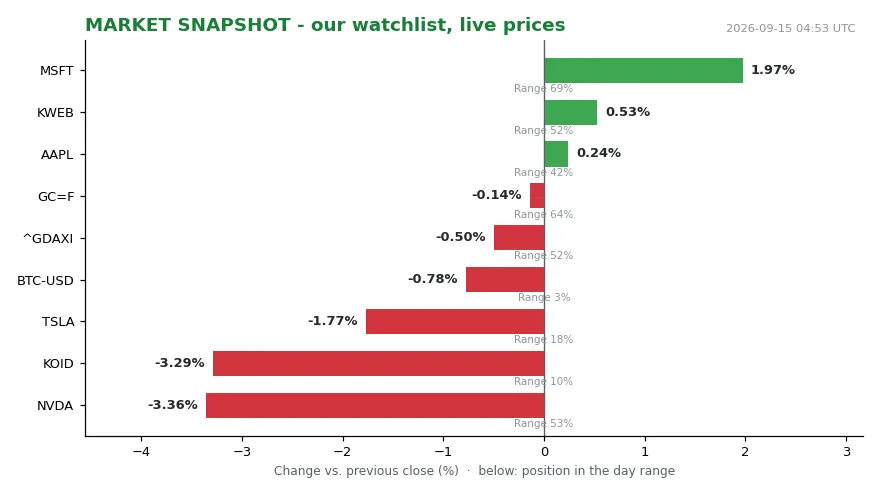
The mechanism runs through two channels. The first is portfolio rotation. Yields and stock prices tend to move inversely, all else being equal. When bond yields fall, bond investors rotate into the S&P 500 to chase returns. When bond yields rise, the traffic goes the other way, because a 5% coupon is a real competitor for capital. Dividend stocks feel this most directly. They compete with bonds for the same investor, who holds both primarily for income. If a Treasury yields more than a stock’s dividend, the swap is easy to justify. Growth stocks feel it differently, through the discount rate. Their earnings are long-dated, so much of their value in a discounted cash flow model comes from years in the future. Raise the discount rate, and those distant profits are worth less today. That is precisely the pattern our measurement sheet shows this morning.
The second channel is the real economy. Other key borrowing rates are set based on the 10-year yield, including 30-year mortgage rates. Housing has already been stagnant, partly because rates spiked after the pandemic. Push borrowing costs higher still, and more potential homebuyers are driven out of the market.
So who wins and who loses? Winners include savers and anyone who needs income, because a 5% Treasury yield is finally a genuine alternative again. Bond investors regain leverage they lost during the low-rate years. Losers include heavily indebted businesses that must refinance, and dividend payers whose yields no longer clear the bar. Long-duration growth companies sit on the wrong side of the discount-rate math, at least on paper. Mortgage-dependent businesses sit on the wrong side of the transmission channel. The decision-makers are few and powerful. The Federal Reserve sets the policy rate and shapes expectations. Oil producers and geopolitics set an input cost.
The next items to watch are three. Three things, with our uncertainty named plainly. First, whether 5% proves to be a ceiling or a floor. Second, whether the rotation inside equities continues. Third, whether housing deteriorates further as mortgage rates follow the 10-year. The log continues to record positions and decisions, including inert ones.
The 10-year Treasury note spent most of the past decade as the least-watched page in the terminal, ignored while attention stayed on the Fed’s press conferences. Its work never stopped. It priced the cost of money in the background the whole time. At 5%, that quiet arithmetic is now the number every other market has to answer to.