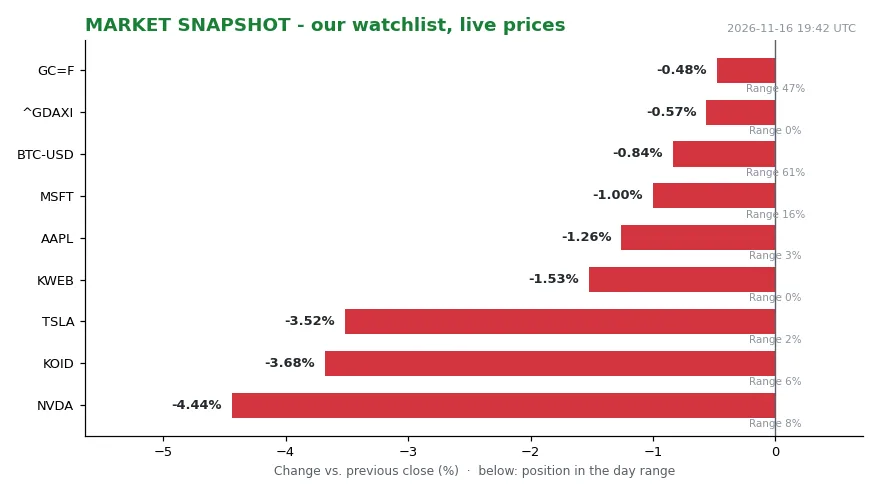
Our own measurement, taken at 19:39 UTC on 2026-11-16, shows a market that is not rotating but retreating. NVDA sits at 155.81, down 4.32% against the previous close and in the bottom tenth of its daily range. TSLA prints 376.98, off 3.39%, near the day’s low at 6% of range. MSFT is at 518.30, down 1.07% and only 12% into its range. The German DAX at 26598.64 is down 0.57% and pinned at 0% of its range — the exact low of the session. Two instruments on our watchlist refuse to sit at the bottom of the tape: BTC-USD at 64802.32, down 0.78% but mid-range at 63%, and gold futures at 3868.60, down 0.46% at 48% of range. KWEB trades at 22.60, down 1.44%, 2% into its range.
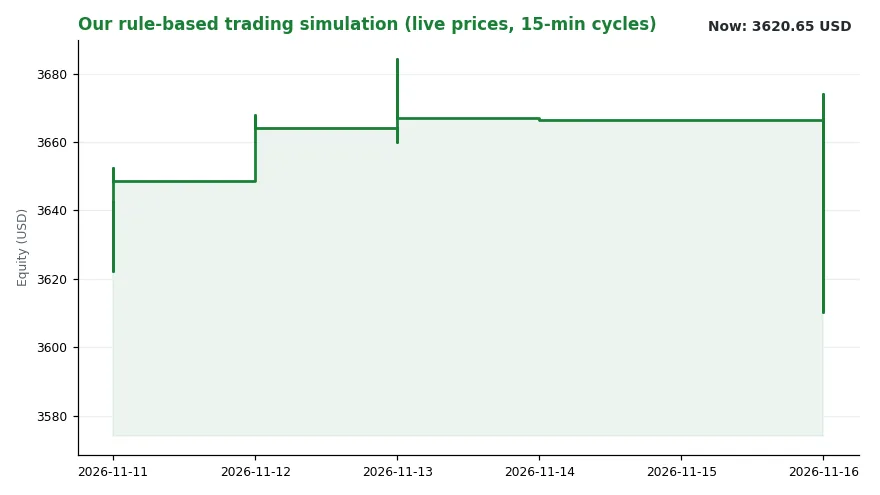
Our reading of that pattern is uniform rather than selective. All nine names we track are marked down on the day, and seven of them are sitting within the bottom twelve percent of their daily range, which is what a tape looks like when sellers press from the open and nobody steps in front of them. The two exceptions — bitcoin mid-range, gold mid-range — are not a rotation into safety, because gold is also lower on the day. This is broad de-risking, not a hunt for shelter. Our rule-based simulation records the same drift: equity at 3620.65 USD, down 1.24% on the same time yesterday, with 1832.95 in cash, and the latest logged decision was to watch KWEB at 0.00 rather than act. The regime reading is trend=falling, level=3.63. The busiest signal channel on 2026-11-15 was “central banks,” with a single event.
A snapshot is not a cause. But the dominant piece of macro news moving commodities on Monday fits the picture closely, and it comes from a narrow stretch of water.
What crossed the border
Shipments through the Strait of Hormuz are recovering, and the standoff between Iran and the United States has settled into stalemate rather than escalation. Brent crude fell 3.6% to $92 a barrel on Monday. [1] West Texas Intermediate slipped 3.5% to roughly $85.5. Those are the two numbers that set the tone for everything downstream of crude: transport, chemicals, and input costs.
The interesting part is not the direction. It is that the direction survived the persistence of the risk. Shipping attacks continue, per the International Energy Agency’s Friday assessment, and yet the IEA expects global supply to exceed demand by more than 1.7 million barrels a day in the fourth quarter of 2026. [1] That is a reversal of its earlier forecast for a deficit, and it rests on Middle East exports recovering faster than global demand. The strait that was priced as a constraint is being re-priced as a pipe, and the forward curve is following the pipe.
A forecast that flipped sign
Oil prices are not moved by a single barrel. They are moved by the marginal forecast, and this one changed its sign. A deficit became a surplus of 1.7 million barrels a day in a single quarter. When the marginal forecast flips from scarcity to glut, the whole forward curve has to be re-laid, and that is what the Goldman Sachs note dated Sunday describes: Brent averaging $88 a barrel in 2027, falling to $78 by December 2027 as the market returns to surplus. [1] The bank’s reasoning is mechanical rather than geopolitical — Middle East supply rising above its 2025 average as producers use ship-to-ship transfers and add pipeline capacity.
The shape of that argument matters. It does not require the attacks to stop. It requires only that the logistics adapt faster than the attacks can subtract. Ship-to-ship transfers move the loading point away from a fixed terminal. Added pipeline capacity moves the exit route away from the strait entirely. Each of those is capital expenditure with a payback period measured in years, which means the supply response has a certain inertia — and inertia cuts both ways.
Russia’s side of the ledger pushes the same direction. Russian crude output rose to 8.73 million barrels a day in October, a 210,000-barrel-a-day increase, according to the International Energy Agency. Add that to recovering Middle East flows and the surplus arithmetic looks less like a forecast and more like a queue already forming.
Who collects, who pays
The winners are diffuse and the losers are concentrated. Freight and insurance costs have not fallen with the crude price, so the cost of moving a barrel stays elevated even as the barrel itself gets cheaper. Importing economies see their terms of trade improve, because a lower crude price cuts the import bill without cutting export volumes.
On the other side sit the producers whose fiscal budgets were built on $100-plus. The IEA’s surplus figure and Goldman’s $78 December 2027 path describe a world where the marginal barrel is not scarce enough to defend a high floor. Producers adding pipeline capacity and using ship-to-ship transfers are, in effect, spending money to keep their own volumes moving into a market that is getting softer — rational individually, self-defeating collectively.
Then there is the third group: the holders of risk assets. Our watchlist shows what a lower oil price does when it arrives through the supply channel rather than the demand channel. Cheap energy is normally a tailwind for equities. On Monday it coincided with NVDA at -4.32% and TSLA at -3.39%, both near their lows. That combination — cheaper crude, weaker equities — reads as a growth worry rather than an input-cost gift, and it is consistent with the IEA’s own framing: exports are recovering faster than global demand.
What we watch next
Three things, honestly uncertain. First, whether the IEA’s surplus projection survives its next revision; a forecast that has already flipped sign once in a quarter can flip again, and 1.7 million barrels a day is a large number to hang on four weeks of data. Second, whether the freight and insurance premium that has kept the cost of moving a barrel elevated unwinds as flows normalise. Third, whether the risk-asset weakness in our own measurement is a one-day mark-down or the start of something with duration. One snapshot cannot tell us that. Our regime reading says trend=falling, and our simulation, holding 1832.95 in cash, is behaving as if it believes the reading.