UK inflation at 3.6% is not the story. The barrel behind it is.
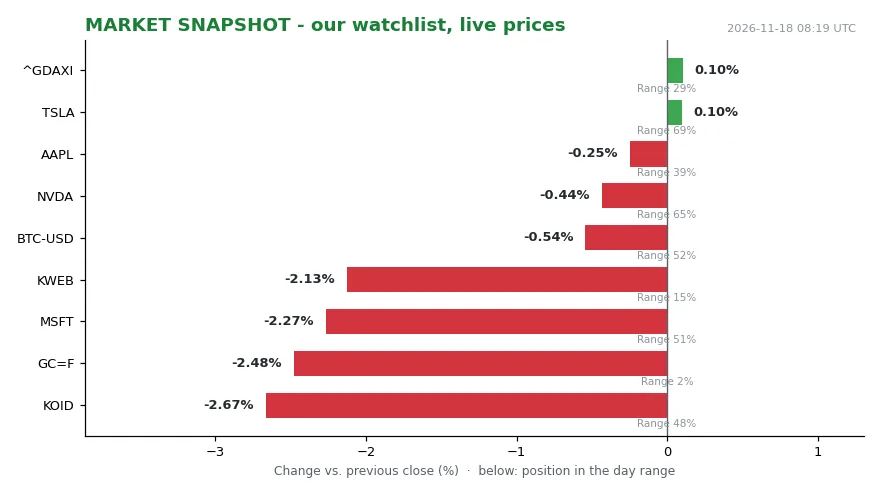
Gold at 3772.00 dollars an ounce, down 2.39% and sitting in the bottom 6% of its daily range. Microsoft at 506.24, off 2.27%, mid-range at 51%. KWEB at 22.08, minus 2.13%, bottom 15% of its range. Nvidia at 155.46, lower by only 0.44%, holding 65% of its range. Tesla at 380.11, up 0.10%, at 69%. Bitcoin at 64525.59, down 0.54%, at 52%. The DAX at 26045.37, flat on the day, parked at 5% of its range.
Those quotes came off our watchlist minutes before 08:15 UTC on 2026-11-18. They do not describe a market running for exits. They describe a rotation with one shape. The instruments most sensitive to the discount rate sit near their lows. The ones carrying index weight or earnings momentum hold the middle. Our signal layer logged “central banks” as the busiest channel on 2026-11-17. The regime reading is trend=falling, level=3.63.
The print that fits that shape is a single number. UK inflation ran at 3.6% in the year to October, the Office for National Statistics reported, against 3.5% in September. Higher petrol and diesel prices pushed it up again. Headline inflation is now at its highest rate in a year. That is the news. The mechanism underneath it is what matters.
Higher oil prices are feeding the wider economy as well as the forecourt, the ONS said, continuing to drive up the cost of raw materials and the prices of goods leaving factories. That is the difference between a line item and a regime. Petrol at the pump is a transaction. Oil in the input chain is a multiplier.
Global oil prices have surged in recent months because of the US-Iran war. The chain is mechanical, not psychological. Crude moves. Refining and freight follow. Diesel and petrol move at the pump. Factory input costs move next. Consumer prices move last, and slowest.
The Irish data published last week shows the same chain from closer up, according to the Central Statistics Office. Irish consumer prices rose 4.3% in the 12 months to October, against 4.1% in September. CSO statistician Anthony Dawson said the October rate was the highest since December 2023, when inflation was 4.6%. Home heating oil climbed 74.4% over the year. Diesel rose 27.9%. Petrol rose 16%. Electricity added 6.7% and gas 6.3%. Airfares rose 16%. Postal and courier services rose 12%.
Two channels are open, and only one is doing the visible work this morning. The first is cost-push: fuel is an input to heating, freight, manufacturing and eventually shelf prices. The second is policy, and it is the one our tape is pricing.
The Bank of England raised interest rates earlier this month for the first time in three years, taking them to 4%. It signalled a further rate rise could be likely unless the conflict in the Middle East is resolved. That signal is the hinge of the story. A central bank has just written a geopolitical outcome into its policy path.
Markets translate that into real yields, and real yields mark gold to market. In our reading, gold at minus 2.39% and near its range floor is not a demand story. It is a rate story. Long-duration software behaves the same way for the same reason. In our reading, Microsoft at minus 2.27% is a discounting exercise, not a business event.
ESRI research officer Muireann Lynch set out the logic of that scenario on RTE’s Drivetime. [1]
“I certainly wouldn’t anticipate this time next year for us to continue to see that kind of increase - we may have even seen a bit of a decrease, but that is really completely contingent on geopolitical factors that are outside of our control.” [1]
“The end of the conflict is a necessary condition in order for that to come back down. It’s probably not a sufficient condition because it depends on what happens after the conflict has ended - but the first thing is the [Iran] conflict has to end.” [1]
She called the near-75% rise in home heating oil “staggering” and “unprecedented”.
That is as honest as forecasting gets. A world where the war stops is not a world where prices revert. It is a world where the rate of increase slows. In Lynch’s view, the end of the conflict is a necessary condition for prices to come back down, but probably not a sufficient one.
Back to the real world. Decision-makers are easy to name. The Bank of England owns the rate path. The ONS and the CSO own the measurement. The Irish government owns the fiscal offset.
In last month’s Budget it extended tax reductions on petrol, diesel and home heating oil. It suspended rises to Carbon Tax. It provided more social welfare support to help with energy costs. That fiscal layer is doing more work than it looks. Had it not been for cuts in excise duty, carbon taxes and VAT, fuel prices naturally would be even higher, Lynch said. A subsidy is a postponement. The bill sits somewhere.
The losers are identifiable. Irish rents are up 7% year on year and 36% over five years. Mortgage interest is up 10.8% on the year and 98.3% over five years. It stands at its highest level since October 2008. Rents have risen every month since July 2021. They are at the highest level since the CSO began publishing detailed sub-indices in November 1996. Household maintenance rose 2.1% in the year and 19.3% over five years.
The winners are thinner and easier to miss. Food rose 0.8% over the past year, and dairy went the other way. Butter fell 57 cent. Irish cheddar fell 28 cent per kilo. Two litres of full-fat milk fell 4 cent. A kilo of sirloin is up 15 cent. A 2.5kg bag of potatoes is up 12 cent. An 800g loaf of white sliced pan is up one cent.
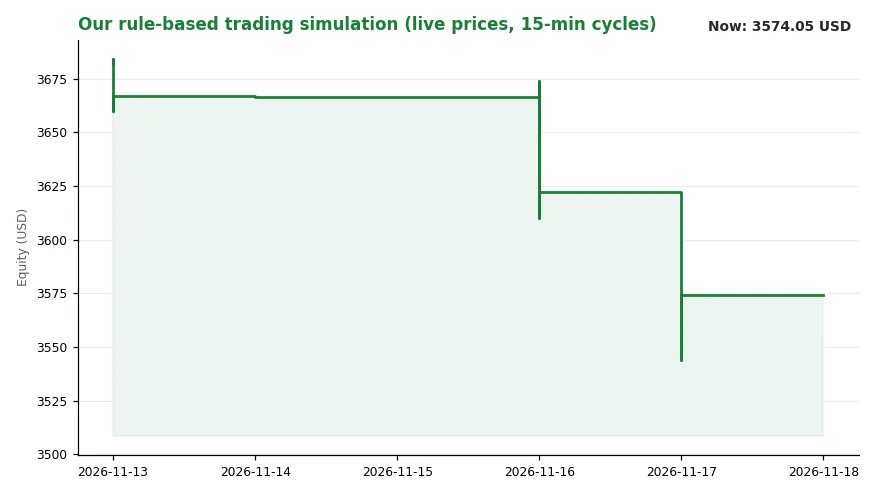
Our own book is honest about its limits. The rule-based simulation holds 3574.05 USD, unchanged from the same time yesterday. Cash stands at 1781.96. The latest logged decision was WATCH KWEB at 0.00. The system did nothing, and it records that. Doing nothing is a position, not an achievement.
Three things to watch from here. Whether the Middle East conflict moves toward resolution, which the Bank has made its condition. Whether factory input costs keep climbing, the mechanism the ONS flags. And the November prints, which will show whether the excise and carbon-tax offsets still mask the pump.
Nothing here resolves cleanly. Necessary but not sufficient is the right posture. A falling trend can coexist with sticky prices. Our tape shows exactly that mix.
The loaf is 800 grams, white, sliced. That single coin carries the war, the barrel, the refinery, the fertiliser, the freight, the rise to 4% and the Budget extension holding the pump down.
Bildung und Analyse, keine Anlageberatung. Die eigene Messung basiert auf dem regelbasierten Simulationskonto; Positionen und Cash sind wie oben ausgewiesen.
Sources
Mentioned organisations (context, not sources)
- Microsoft — Organisation (homepage)
- Nvidia — Organisation (homepage)
- Tesla — Organisation (homepage)
- Office for National Statistics — Organisation (homepage)
- CSO — Organisation (homepage)
- RTE — Organisation (homepage)
- Bank of England — Organisation (homepage)
- ESRI — Organisation (homepage)
- Irish government — Organisation (homepage)