
Wall Street Is Hiring the Referees Before the Robots Arrive
Our screens show a market rotating, not fleeing. The job data shows banks staffing an agent economy that has not arrived yet.
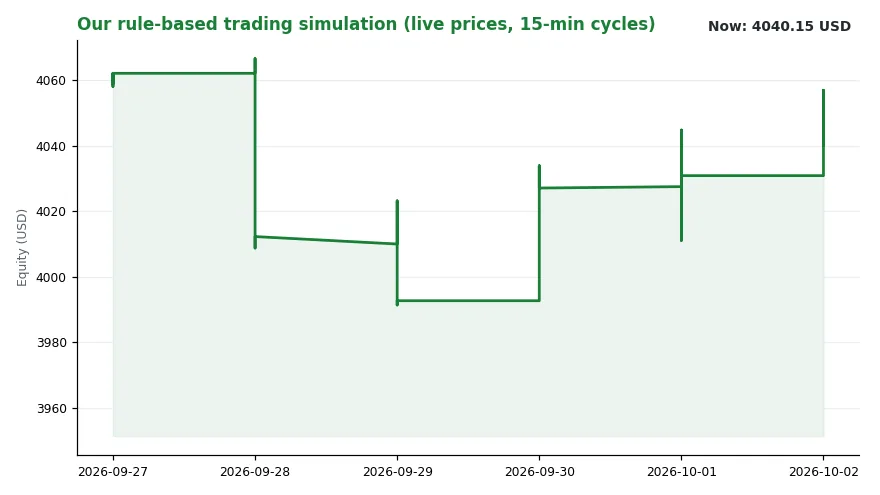
Nvidia reads 234.64 on our watchlist, up 1.64 % — and parked at just 12 % of its daily range. Apple prints 333.14, up 0.86 %, mid-range at 65 %. Microsoft shows 515.22, up 0.47 %, near its lows at 18 %. Tesla is the outlier: 371.68, up 4.96 %, near its highs at 82 %. Bitcoin sits at 84,818.52, flat at -0.04 %, near the bottom of its range at 11 %. Gold trades 4,162.00, down 0.96 %, also near its lows at 8 %. The DAX stands at 25,231.20, up 1.17 %, near its highs at 78 %. KWEB is at 23.86, down 1.92 %, mid-range at 28 %. Our regime reading says trend=falling, level=3.63. That is rotation between names, not a rush for the exits. Our rule-based simulation holds 4,040.15 USD, up 0.23 % against the same time yesterday, with 2,020.64 in cash. The last logged decision was a WATCH on KWEB at 0.00. The busiest signal channel on 2026-10-01 was “central banks,” with three events. Weather metaphors are cheap in markets. Here is one that fits: this is drizzle, not a squall.
Then a different weather system arrived, and it came as a hiring number. AI-related posts at banks including JPMorgan Chase, Citigroup and Capital One rose 49 % this year compared with 2025, reaching 139,819 listings. The analysis comes from enterprise hiring data firm Draup, drawn from public job posts and platforms including LinkedIn. The volume is not the interesting part. The composition is.
What the Hiring Numbers Actually Say
The fastest-growing cluster of skills concerns AI agents. References to agent orchestration — the ability to design agents that work in concert on a task — jumped 1,721 % this year. That is the largest single move in the dataset.
The expectation packed into those listings is specific. The next productivity gain will not come from one model answering questions. It will come from many narrow agents wired into one workflow. A bank doing this strings several together. One agent inspects raw data. A second analyzes a document. A third checks regulatory compliance. Someone must decide which agents are needed and what each one does. Someone must pick the technology and mark the point where a human overseer steps in. The market has a name for that person: a forward-deployed engineer. The role requires technical ability plus domain knowledge of a specific business or function — a trading desk, a back office, a human resources file.
[1] “This is arguably the hottest skill on Wall Street.” — Vijay Swaminathan, CEO of Draup, in an interview with CNBC. [1] [2] “It’s a massive opportunity. They need people who understand data and people who understand AI and where to put it.”The earlier wave of AI hiring looked different. Engineers and data scientists built models or adapted them to corporate data. The current boom has widened to include the people who embed those systems directly into business lines. That is the step where a research budget becomes an operations budget.
Banks Are Buying Capacity, Not Chatbots
The channel here is not interest rates or earnings guidance. It is labor. Banks convert capital into headcount, and headcount into capacity. If the agents work, the cost curve may bend and later headcount needs may fall. If they do not, the spending lands as cost with no offset. Either way, the bet is placed now. Job postings are its visible footprint.
Two secondary channels run alongside the headcount. The first is tooling, visible in the frameworks named in postings. LangGraph, a framework for building multistep workflows, appears 679 % more often than a year earlier. LlamaIndex, which connects AI applications to data, rose 291 %. Retrieval-augmented generation, or RAG — a technique for feeding models information from company databases — climbed 259 %.
The second channel is governance, and it is bigger than the raw build numbers suggest. References tied to “responsible AI” surged 657 % this year. Mentions of AI governance rose 394 %, and risk management 359 %. Governance-related skills now account for more than 16,000 references in the Draup data. That is nearly twice the roughly 8,400 references tied to training, deploying and running models.[3] “There is a lot of focus on making sure that the third parties that we are using in these products are not going rogue from a cybersecurity standpoint.” — Vijay Swaminathan, CEO of Draup, in an interview with CNBC. [1]inathan. [1] By this proxy, the guardrail budget now outruns the model budget. That is our reading of the ratio, not a disclosed figure.
Two Ways to Read One Dataset
Two readings of the same dataset deserve a hearing.
The optimist sees a second wave that has left the laboratory. The productivity promise is finally being staffed rather than announced. The listings reach trading desks, back offices and HR. That is where repetitive work actually lives. The pay supports the story: generative AI managers earn a median base salary of about $190,000, according to Draup.
The skeptic accepts the volume and disputes the ease. Enterprise complexity is the obstacle, not the[4] “There is a lot of complexity in an enterprise.” — Vijay Swaminathan, CEO of Draup, in an interview with CNBC. [1] Swami[5] “Sometimes these complexities are visible, but many times they are hidden. It takes a long time even to automate a simple process.” — Vijay Swaminathan, CEO of Draup, in an interview with CNBC. [1]mple process.” His example is a vacation request. Building a team of agents to approve employee vacation requests sounds trivial. In practice it opens a web of edge cases and specific exemptions. The skeptic calls that the real workload. The optimist calls it the reason the job exists. Someone has to map the exemptions before an agent can honor them. So the disagreement is not about demand. It is about conversion.
The Scarce, the Exposed and the Ones Who Choose
Winners: forward-deployed engineers with domain depth. They are scarce, and the scarcity is priced. Exposed: anyone whose job is a chain of rule-bound, repetitive steps. Those are the steps the agents are being assembled to handle. Constrained: the banks. Filling these specialized roles remains a challenge despite the higher pay. That is a decision about who gets redeployed and who gets hired from outside. Redeployment assumes displaced staff move rather than exit. The least exposed group, judging by the postings, is the one that can walk into a messy process, question it, and describe it precisely.
[6] “Our analysis shows that there is a renewed focus on soft skills like problem solving, creativity, ability to ask tough questions, being assertive deeper understanding of the processes.” — Swaminathan. [1]In a technical hiring boom, that is an odd sentence to find in the data. It is also the hardest part of the skill set to replicate.
What We Watch Next
What comes next has to be framed as questions. First, conversion: does the volume of postings become systems with measurable cost effects? Draup measures demand for skills. Second, ratio: does governance hiring keep pace with build hiring? Third, redeployment: do reskilling programs absorb people or defer the question? Uncertain: how long this build phase lasts. Uncertain: whether the pay premium survives a downturn — our own tape, after all, reads falling. Uncertain: whether “agent orchestration” is a durable discipline or a label firms outgrow. None of that is settled by 139,819 listings. It is only made visible by them.
Sources
Mentioned organisations (context, not sources)
- Nvidia — Organisation (homepage)
- Apple — Organisation (homepage)
- Microsoft — Organisation (homepage)
- Tesla — Organisation (homepage)
- JPMorgan Chase — Organisation (homepage)
- Citigroup — Organisation (homepage)
- Capital One — Organisation (homepage)
- Draup — Organisation (homepage)
- CNBC — Organisation (homepage)
- LinkedIn — Organisation (homepage)