Europe’s Job Shortage Index Has a Blind Spot — And It Is the Border
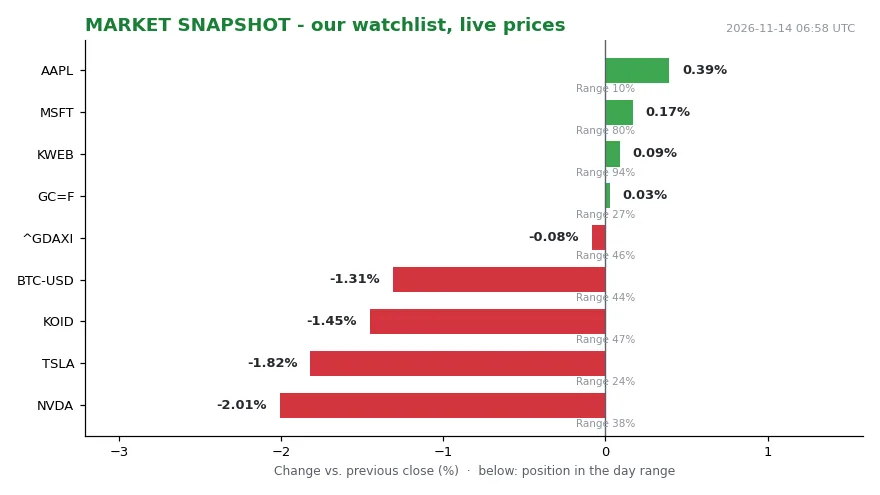
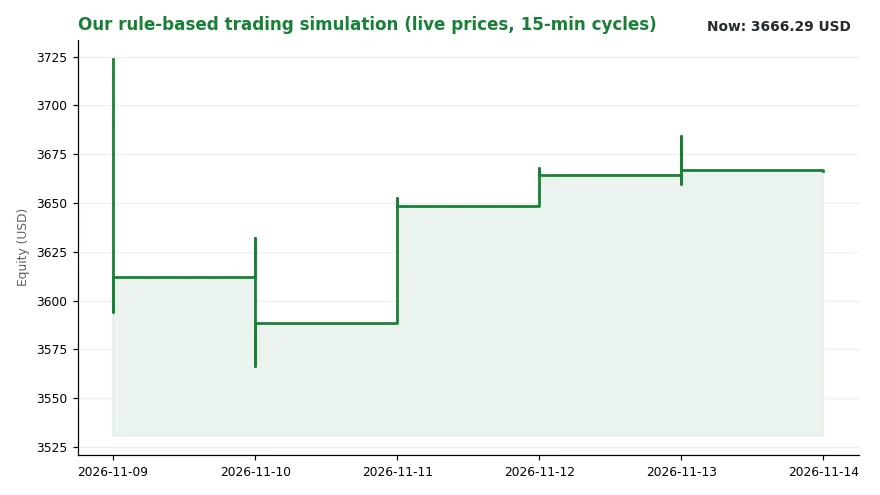
MSFT 523.88, up 0.17% and trading at 80% of its daily range. NVDA 162.85, down 2.01%, parked mid-range at 38%. KWEB 22.93, up only 0.09%, yet sitting at 94% of its range — almost the top of the day. Three quotes, fetched 0 minutes ago from our own watchlist. They describe a market that is neither selling everything nor buying everything. It is picking sides inside the same sector. TSLA 390.22 is down 1.82% and near its day lows, at 24% of range. AAPL 356.27 is nominally green at 0.39% but pinned near the bottom, at 10% of range. Gold, GC=F 3886.30, is flat at 0.03% and mid-range at 27%. The DAX, 26749.95, is flat at -0.08%. Our simulated equity book stands at 3666.29 USD, -0.02% against the same time yesterday, with 1839.73 in cash. The regime reading is trend=falling, level=3.63. The busiest signal channel on 2026-11-13 was “central banks”, with a single event. Across the list, the pattern is dispersion, not direction. This is paper, not advice: a rule-based simulation, documented honestly.
Now the document. On top of the pile sits a line from our log, timestamped 2026-11-14 07:43:21: WATCH KWEB @ 0.00. Underneath it sits something slower and duller — the OECD’s index of skill shortages, built from 2024 data for most of the 27 European countries it covers. That set includes Norway, Switzerland, Turkey and the UK. The common claim is that Europe cannot fill its jobs. Here is what the index actually measures, and what it quietly leaves out.
What the table says
The index does not count vacancies. It does not count missing workers either. It compares occupations within each country: a positive score means relative shortage, a negative score relative surplus. What it produces is a ranking of difficulty, not a headcount of the absent.
On average, teaching is the hardest occupation to fill. Health professionals come second, information and communications technology (ICT) professionals third. Health associate professionals — medical technicians and some nursing staff — and business and administration professionals complete the top five. At the other end, labourers are the easiest to recruit, followed by elementary workers (people in simple manual or routine jobs requiring no formal qualification), food preparation assistants, sales workers and assemblers (factory workers who put components together into a finished product).
The country counts sharpen the picture. Teachers appear among the five hardest occupations to fill in 13 countries. Health professionals and ICT professionals appear in 12 each. Managers make the top five in seven countries. Health associate professionals, personal care workers and business and administration professionals each do so in six.
The easy end is just as specific. Labourers rank among the five easiest occupations to fill in 14 countries. Food preparation assistants follow in 12, other clerical workers in 11. Elementary workers make the list in 10 countries, assemblers in eight.
Beyond the top and bottom five, the OECD bands every occupation by relative difficulty. Health professionals are hard to find in 23 of the 27 countries. Health associate professionals are in short supply in 21. Teachers are hard to find in 21. ICT professionals and business and administration professionals are hard to find in 18 countries each. Labourers are easy to find in 21 countries, food preparation assistants in 17, elementary workers in 16. Sales workers and other clerical workers are easy in 15 each.
How scarcity is built, layer by layer
Now the people inside those numbers. Nursing first, in the words of Paul De Raeve and Manuel Ballotta of the European Federation of Nurses Associations:
“EU and European healthcare systems are unable to retain and recruit nurses at the frontline of care, which is leading to extensive nursing shortages everywhere. [1]”
Behind that sentence sits a list. High patient-to-nurse ratios. Unsafe working conditions. Widespread mental health problems. Low pay, limited career prospects, thin professional recognition, frequent exposure to harassment and violence. Scarcity in nursing has coexisted with every one of those conditions.
Doctors, in the words of Dr Ole Johan Bakke, president of the Standing Committee of European Doctors:
“Doctors across Europe are increasingly expected to compensate for systemic workforce shortages through excessive working hours and increased workloads. Violence against healthcare professionals, an increasingly common phenomenon experienced by doctors, further compounds these problems.”
Bakke said these pressures contribute to burnout and make medicine less attractive as a lifelong career.
Teaching, in the words of Daniel Wisniewski, secretary general of the European Federation of Education Employers:
“Teacher shortages are no longer simply a question of filling vacant positions; they increasingly concern the long-term attractiveness and sustainability of the teaching profession.”
And further:
“We need to recognise that teachers’ working conditions, professional autonomy, career development opportunities and the quality of school leadership are equally important in determining whether people enter and remain in the profession.”
Wisniewski said competitive salaries remain essential, but teachers also face growing demands as schools adopt digital tools, make classrooms more inclusive and take on more responsibility for student wellbeing. The demands have multiplied anyway: digital tools in classrooms, more inclusive teaching, more responsibility for student wellbeing, more administration.
The channel runs through demand and supply. Demand depends on a country’s economic structure. OECD economist Isabel Skak Olufsen points to South Korea and Germany, where large manufacturing sectors help explain shortages in several mid-skilled occupations, assemblers and machine operators among them. [1] Supply depends on relative pay: countries that pay teachers and health professionals relatively well may face fewer shortages in those occupations. Digitalisation has raised demand for ICT professionals. One caveat sits inside the same analysis: advances in artificial intelligence may reduce demand for some ICT professionals in future, particularly at entry level.
Above both sides sits a structural frame, stated by Pia-Johanna Fallström, a spokesperson for the European Labour Authority:
“Europe’s labour shortages are increasingly structural rather than temporary. Demographic change, skills mismatches, job quality and limited labour mobility all play a role.”
And a paradox runs through the whole report. These shortages persist while young people face a tougher job market. The OECD found that the unemployment gap between young graduates and the wider working-age population has widened in the countries it analysed. The European Central Bank found that job prospects for young people in the eurozone have weakened since 2023. Hard-to-fill posts and hard-to-enter labour markets, in the same geography, at the same time.
Who gains, who pays, who decides
The national outliers carry the most information. In Norway, labourers are the hardest workers to recruit — in a category that is relatively easy to find in 21 of the countries studied. In Spain, food preparation assistants are the hardest to recruit, although they are easy to find across much of Europe. In France, elementary workers top the difficulty list.
ICT splits as well. The OECD classifies the ICT labour market as broadly in balance — neither a clear shortage nor a clear surplus of workers — in Denmark, Finland, Germany, the Netherlands, Norway and Sweden. It classifies it as in surplus in Austria, Switzerland and the UK. Teaching is broadly in balance in exactly six countries: Germany, Greece, Italy, Norway, Spain and Turkey. Everywhere else in the sample, it is hard to fill.
Employers hiring into the surplus occupations — assemblers, other clerical workers, elementary roles — face the least recruitment difficulty in the sample. Workers in the shortage occupations hold the scarce side of the bargain, at least on paper. On the paying side sit patients on understaffed wards, pupils in understaffed schools, and the young graduates the OECD and ECB describe. Our reading is that the deciding parties are national: pay scales, training places and working conditions are set by member states, not by an index. The OECD measures, and the European Labour Authority calls for fair labour mobility to help workers in surplus countries find jobs where they are needed.
The outlook, with the uncertainty left in
What to watch next. First, whether the six teaching markets in balance stay in balance; the OECD data are a snapshot, not a trend line. Second, whether the Nordic ICT equilibrium survives the next hiring cycle or whether AI moves it. Third, whether entry-level ICT demand actually falls, as the analysis suggests it might; that is a possibility, not a forecast. Fourth, mobility: whether workers in surplus countries move toward shortage countries. Fifth, the graduate gap, which no shortage figure currently offsets.
One more reading from our own tape. MSFT near its highs, KWEB at 94% of range, TSLA near its lows and NVDA mid-range: dispersion inside a sector, not a verdict on it. The same is true of the OECD table. Aggregates hide the argument; the argument lives in the country rows.
The unintended consequence sits inside the instrument. A ranking built inside national borders cannot, by construction, see the match across them. Pia-Johanna Fallström, a spokesperson for the European Labour Authority, states the point plainly: “ELA’s analysis shows that many occupations reported as being in shortage in one country can be a surplus elsewhere.” [1] The table that tells a government where its gaps are also tells it, silently, that a neighbour may already have filled them. Nothing in the ranking prompts anyone to pick up the phone.
Sources
Mentioned organisations (context, not sources)
- OECD — Organisation (homepage)
- European Union — Organisation (homepage)
- Standing Committee of European Doctors — Organisation (homepage)
- European Federation of Education Employers — Organisation (homepage)
- European Labour Authority — Organisation (homepage)
- European Central Bank — Organisation (homepage)