
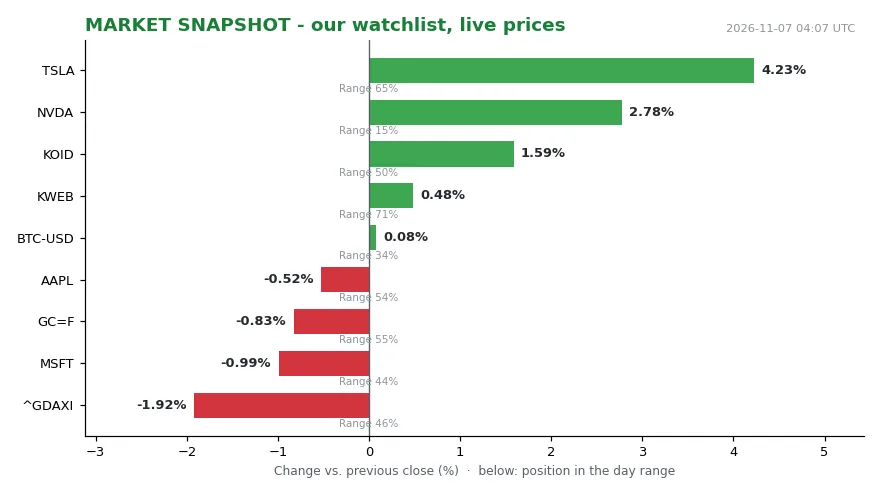
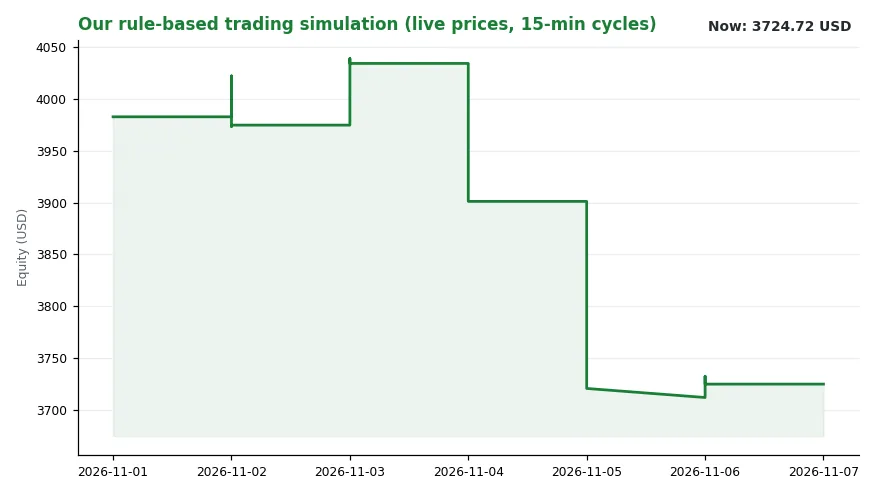
Our own measurement on 7 November 2026 opened with a 6.15 percentage point gap between the best and worst name on our watchlist. TSLA traded at 358.22, up 4.23%, at 65% of its daily range. ^GDAXI held 25,820.36, down 1.92%, mid-range at 46%. NVDA printed 186.64 for a 2.78% gain but sat near the day’s lows — only 15% of range. BTC-USD was almost motionless at 75,788.76, up 0.06%. Our simulated equity book stood at 3,724.72 USD, unchanged from the same time yesterday, all of it in cash. The regime reading was trend=falling, level=3.63. The busiest signal channel carried 7 events, filed under ‘other’. That is dispersion without direction.
Our watchlist holds no gilts, no sterling, no mortgage-backed spread. So the tape above measures global risk appetite, not the price of a British home loan. The price of a British home loan moved on Thursday.
The Bank of England raised interest rates for the first time in over three years. The aim was to get a grip on rising inflation linked to the Iran war. Experts say there could be more hikes over the next 18 months, as the conflict continues to push up food, fuel and energy prices across the UK and worldwide. Higher rates change borrowing costs. Mortgages, credit cards and personal loans can get more expensive for millions, even as savings rates improve. That is the map. The territory is a set of household budgets.
A Rate Decision Is a Cash-Flow Story
It is not. It is a cash-flow story, and it travels through three separate channels. The first is the variable-rate mortgage, which tracks the base rate with a lender margin on top. The second is the fixed-rate refix, where nothing happens on the day and everything happens at the end of the term. The third is revolving credit, where providers can raise the interest they charge with 30 days’ notice.
Peter Gill sits in the first channel. He is 48, runs a small tiling business in Halifax, and is one of around 1.3 million Britons on a variable rate mortgage. Thursday’s quarter-percentage point increase lifts his monthly repayments by roughly £45. He expects they could climb higher. He is also prepared to stay put, on the calculation that moving to a fixed deal would cost him more. “From my point of view, inflation goes up which costs you, then interest rates go up and you have even less money.” [1] His costs are rising on every side. He pays his staff more because the national minimum wage has gone up. Raw material costs have risen because of the war in Iran. At home, food, gas and electricity bills are higher. He and his wife Faye have a combined household income of £45,000 and two children. He is working “about six and a half days a week” to shield the family from the worst of it.
The Protection That Expires With the Term
Most UK mortgage holders are on fixed deals, and the protection is real — until the term ends. David Hollingworth, of the brokers L&C Mortgages, says many people will be shocked at how much higher fixed-rate deals are than they were five years ago. “Fixed rates have already risen due to market anticipation that interest rates would need to rise to combat higher inflation,” he says. [1]
Dawn Fazackerley-King’s refix shows what that means in pounds. She is a Pilates instructor who lives near Ipswich. In January 2022 she took out a five-year fix at 1.4 %. She is now refixing for two years, and the best deal she can find is 5.69 %. The change adds about £200 a month. “I don’t know where that money is going to come from, it’s something we are going to have to figure out as a family. It’s stressful.” She and her husband have a joint income of about £70,000. They have already been through their direct debits, and there is “no more obvious fat to trim”. Neither of them has room to take on extra work, because both already work full time. “We’re still living in the same property, our household costs are remaining the same,” she says. “It’s an additional cost of several hundred pounds but we’re not getting anything extra for that.” The two numbers sit side by side. Peter Gill’s quarter point costs him £45. Dawn Fazackerley-King’s refix costs her £200. The first is monetary policy. The second is the expiry of a contract signed in a different world. Both land in the same account.
The Households With Nothing Left to Cut
Ben Thomas is 41 and lives in Shropshire. He left a career as a chartered accountant during the Covid pandemic after a mental health crisis and retrained as a paramedic. The drop in income left him relying on credit cards and personal loans for everyday living expenses. He is now £52,000 in debt. He has agreed a pause on the interest on most of it. Around £2,000 of credit card debt is still incurring charges, and he is worried about repayments going up. “With all that’s going on, rising interest rates is another cost to deal with,” he says.
He and his wife pay £760 on their mortgage and around £300 a month on debt repayments. Higher food and energy bills have already taken their share of the budget. The marginal pound is the one that was not there to begin with.
StepChange has been helping him manage the debt. Simon Trevethick, the charity’s head of communications, says it has seen a 20% increase in people asking for support this year. “If higher borrowing costs feed through into household budgets over the coming months, we could see further pressure on people seeking support,” he says. [1]
Why Savers and Borrowers Do Not Net Off
The idea is that savers gain what borrowers lose, so the country roughly breaks even. Savings rates improve, but that gap matters. An improvement in a savings rate is a gain on a balance. A rise in a repayment is a loss on a flow. The two do not net off inside the same household.
What to watch next
The list is narrower than the headline. First, whether fixed-rate pricing holds near current levels or eases, since that decides what the next cohort of refixers pays. Second, how many of the roughly 1.3 million variable-rate borrowers choose to move rather than absorb. Third, the 30-day notices on credit card rates, which are the slowest channel and the least visible. Fourth, the volume figures from debt charities, which lag the arrears they describe. Fifth, our own tape: whether a 6.15 point spread between the top and bottom of the watchlist resolves into a direction, or simply keeps widening. None of that is a forecast. It is a description of what we are holding while we wait.
The uncertainty deserves a plain sentence. Nobody quoted here knows the path of the Iran war, and the war is the reason given for the inflation the Bank is fighting. Nobody knows how many further hikes follow. The 18-month horizon is an expectation, not a schedule.
What remains is a set of household budgets where the monthly figure grew by several hundred pounds and nothing was added to the household in return.