Fewer Immigrant Workers Raise Prices and Cut Social Security Benefits
Our readings first
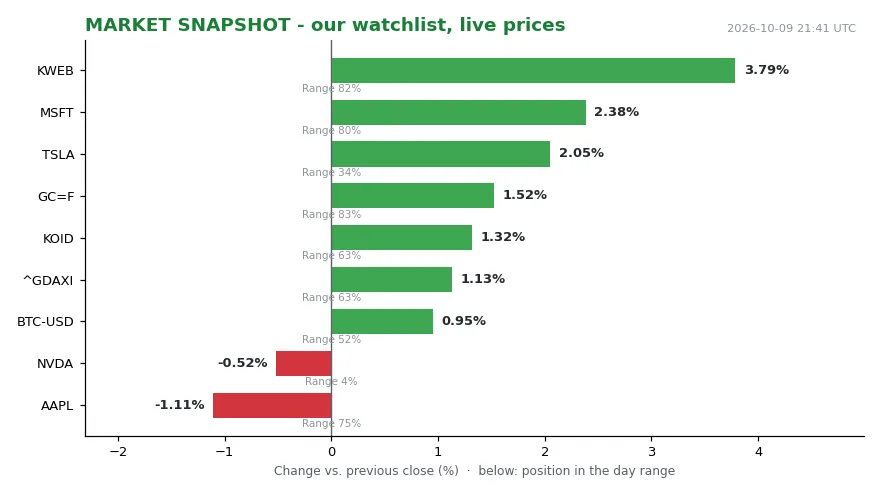
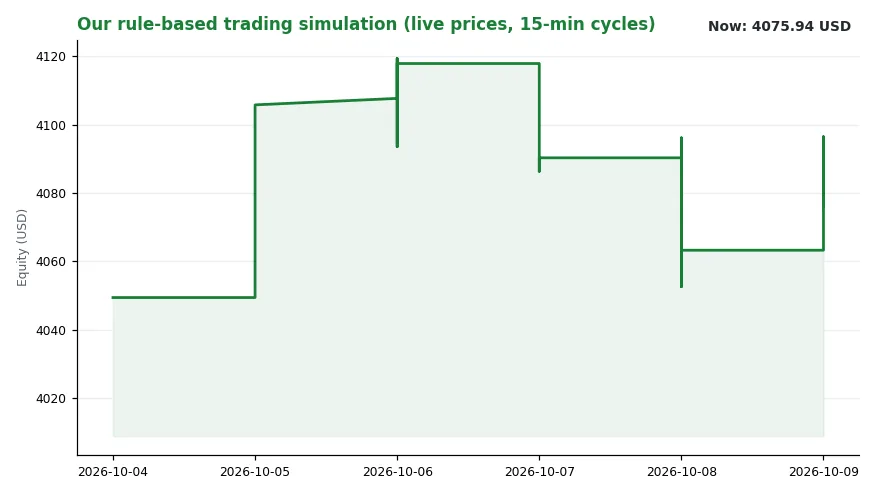
Our watchlist closed mixed on 2026-10-09: NVDA at 229.28 (-0.52%, near day lows), AAPL at 336.64 (-1.11%, near day highs), MSFT at 535.07 (+2.38%, near day highs), TSLA at 382.70 (+2.05%, mid-range), BTC-USD at 82,495.60 (+0.99%, mid-range), gold at 4,220.30 (+1.52%, near day highs), the DAX at 25,087.27 (+1.13%, mid-range), KOID at 35.42 (+1.32%, mid-range) and KWEB at 24.93 (+3.79%, near day highs). Our simulated book stands at $4,075.94 (+0.31% versus the same time yesterday), with $2,049.10 in cash. The busiest signal channel today was central banks, with two events; our regime reading is trend falling, level 3.63. Against that tape, one number from the immigration debate deserves the desk’s attention: an average of $2,152 in annual Social Security benefits lost per elderly American. A projected 8.6% reduction in retirement payments beginning in 2034 and repeating every year thereafter. A labor force smaller by an estimated 919,000 people across 18 months. Single-family construction costs up 10.9% in states that lean hardest on immigrant labor, from an average of $305,752 to $338,752. New single-family housing permits down 10.6% nationwide since January 2025 [1].
Read together, they describe subtraction rather than rotation: fewer workers entering the base, higher unit costs on the goods those workers produce, and a payroll-tax pipe that narrows as the base contracts.
What the report actually found
The findings come from “Economic Impacts of Trump Administration Immigration Policy,” commissioned by America’s Voice, a pro-immigration-reform organization, and produced by researchers at Economic Insights and Research Consulting, a firm focused on economic analysis.
The headline result is fiscal. Unauthorized immigrants supply a large segment of the roughly $26bn in annual payroll taxes that help fund the Social Security trust fund, while being unable to draw benefits themselves. Social Security trustees — among them Treasury Secretary Scott Bessent, Health and Human Services Secretary Robert F Kennedy Jr, Labor Secretary Keith Sonderling and Social Security Commissioner Frank Bisignano — have warned that lower net immigration than expected threatens worse finances for the system [1].
The report’s authors put that into household terms [1]: > “The share of that annual loss due to the Trump immigration policy would be $2,152. Thus, the Trump immigration policies, if continued, would reduce projected average annual Social Security benefits by 8.6% in 2034, and every year thereafter.” [1] Two caveats sit on top of that figure. It is a projection, not an observed cut, and it assumes the policy path continues largely unchanged. It also originates with a report commissioned by an advocacy organization, even though the analysis was performed by an outside consulting firm.
How the money actually moves
Channel one is labor supply. The report counts an exodus of 1.2 million foreign-born workers over two years and a labor force shrunken by an estimated 919,000 people during 18 months of the second term, with job growth slowing to roughly a third of its prior rate [1]. Agriculture is the purest case: 68% of crop workers are foreign-born and 42% are undocumented, and farmers report workforces that disappeared largely, or in some cases entirely, overnight — leaving produce to fall to, or rot in, the ground [1].
Prices follow. Over the 19 months after the inauguration, compared with the 19 months before, immigrant-reliant groceries outpaced overall grocery inflation: fresh whole milk up 5.7%, canned vegetables up 6.3%, apples up 7.2% [1]. In the earlier period, most of those same categories had risen more slowly than other foods, and some had fallen outright [1]. Robert Lynch, one of the report’s authors, described the reversal:. Before, the trend for all those goods was a lower inflation rate. And afterward, the trend was higher inflation. So the trend was reversed, and that was quite striking.” [1]
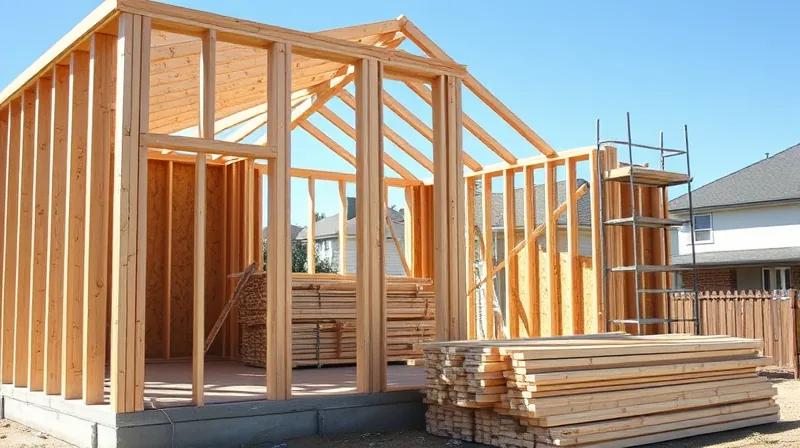
Channel two is construction, where foreign-born workers fill almost a third of all occupations. In states more dependent on that labor, the cost of a new single-family home rose 10.9% in 2026 versus the first eight months of 2024 [1]. Permits fell 10.6% nationally [1]. The knock-on deserves the pause: construction employment is declining in California, Nevada, New Jersey, Florida and New York, and native-born electricians and plumbers lose the project when no immigrant roofer is there to begin it [1]. Michael Ettlinger, another of the authors, said:. And we’re losing people who have been here for decades working in construction. That could be fixed, but it’s going to take time.” [1]