Skydance Warner Merger Built On 80 Billion Debt
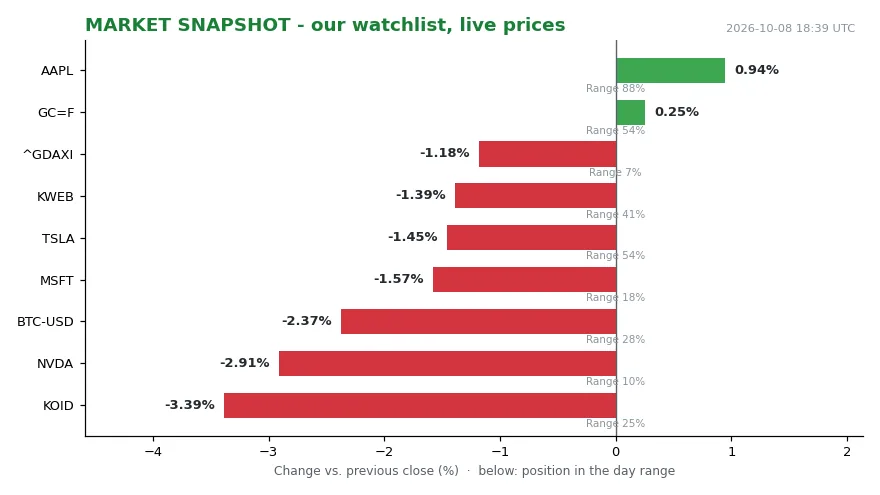
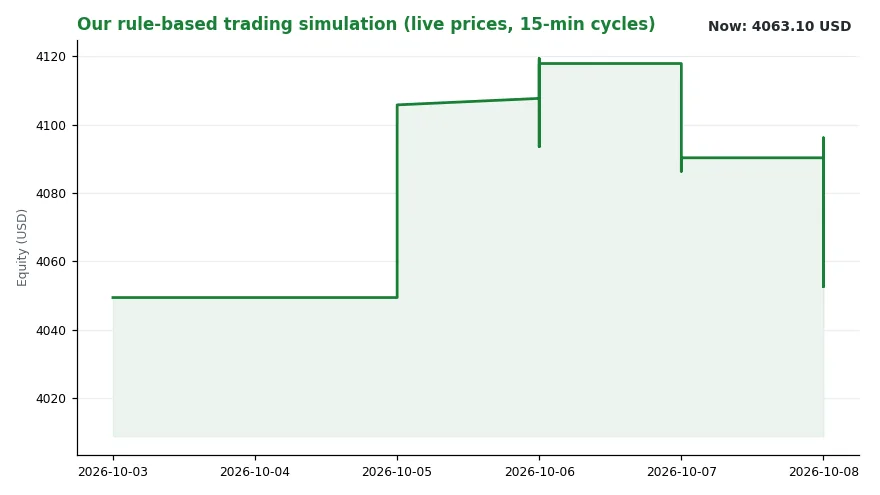
Our watchlist closed mixed on 2026-10-08: NVDA at 230.93 (-2.75%, near day lows), AAPL at 339.62 (+0.88%, near day highs), MSFT at 522.27 (-1.41%, near day lows), TSLA at 371.93 (-1.56%, mid-range), BTC-USD at 81,449.40 (-2.19%, mid-range), gold at 4,149.70 (+0.22%, mid-range), the DAX at 24,806.97 (-1.18%, near day lows), KOID at 35.00 (-3.23%, mid-range) and KWEB at 23.99 (-1.38%, mid-range). Our simulated book stands at 4,063.10 USD, down 0.66% from the same time yesterday, with 2,051.17 in cash. The busiest signal channel today is central banks, and our regime reading is falling at level 3.63. Against that backdrop, the Skydance–Warner Bros merger closed: Skydance Corporation reports close to $70 billion in annual revenue against roughly $80 billion in net debt, created by a $110 billion transaction. Three numbers, then, and a separate release requirement matters: under the settlement with US states, Paramount must release at least 30 films every year. Read together, the figures describe a pattern familiar from many debt-financed consolidations of the past decade. Scale is bought with borrowed money; the discipline is written into a legal agreement rather than a business plan, because regulators reached the terms before the deal closed.
The news, and the expectation inside it
The deal is done. Paramount Skydance has formally taken over Warner Bros Discovery, merging two of Los Angeles’ largest studios under a parent renamed Skydance Corporation, the company David Ellison founded before acquiring Paramount and then Warner Bros Discovery. The combination pulls HBO, CBS, CNN, Nickelodeon, Showtime, Comedy Central, DC Studios, MTV, Food Network, HBO Max and Paramount+ under one roof, and hands the buyer a library that now includes Harry Potter, Game of Thrones and The Lord of the Rings alongside Indiana Jones, Mission: Impossible and Shrek. Ellison has said the Paramount and Warner Bros. studio brands will retain their individual identities.
The strategic expectation is straightforward: that a bigger single competitor can survive a streaming market that has stopped rewarding companies too small to compete profitably. Supporters say the merger creates a brand large enough to compete in an increasingly unforgiving streaming landscape; critics warn it could mean greater consolidation, fewer creative risks and pressure to cut costs.
Ellison’s closing statement reads: “From the start, our ambition was to bring these two storied studios together and create a stronger competitor, with the talent, resources, and reach to tell great stories in every genre, on every platform, for audiences everywhere. Now that ambition is a reality.” [1] He has called the completion “historic” for the film industry. President Donald Trump, asked about the merger after it closed: “They’re terrific people and it’s going to be a great company.”
The mechanism: where the debt meets the content
There are four channels through which this deal transmits into the wider market, and only one of them is creative.
The first is the price the company pays for the money it uses. Dan Coatsworth, head of markets at AJ Bell, frames the arithmetic plainly: “The combined entity, now called Skydance, needs to cut costs and make bigger profits to be able to get the debt down to more manageable levels.” [1] He adds that the company carries high debts into a period of high interest rates, and he points to Warner Bros’ last pre-merger release — the Tom Cruise film Digger, which he calls a major flop — as “a reminder of how the film industry is not a guaranteed ticket to riches.” The mechanism here suggests that the regular interest and repayment instalments on a loan compete directly with variable content spend. When one is contractually obliged, the other becomes the adjusting item. Ellison also plans massive layoffs to cover roughly $6 billion of the new company’s reported $80 billion debt, and a report issued by Los Angeles County in August estimated the merger will likely result in the loss of around 4,500 film and TV jobs in the city over the next three years.
The second channel is streaming. Mike Proulx, research director at Forrester Research, reads the executive appointments as a signal about who now runs that business: the change “essentially means the HBO leadership team is now in charge of Skydance’s combined streaming operation.” [1] His warning is specific — “While that bodes well for the HBO brand, make no mistake, Bloys will be pressured to find and deliver cost efficiencies that could affect content quality,” he warned.”
The third channel is regulation, and it is unusually explicit. Under the settlement with US states, Paramount must release at least 30 films each year, ensure 20% of all film production takes place in the US for the first two years, rising to more than 30% through the following three years, and accept strict guardrails against AI-generated films. If it fails to meet its annual production quota, it must sell its 49% stake in Miramax.
The fourth channel is the competitive field itself. Lawyers in 12 US states then sued, arguing the merger would stifle competition, raise consumer prices and cause “substantial” harm to movie theatres, cable distributors and “ultimately, audiences nationwide. The settlement, announced last month, cleared the path.
Winners, losers, and who decides
Ynon Kreiz, the outgoing Mattel chief executive, becomes co-chief executive with responsibility for day-to-day operations and integration, while Ellison takes strategy and technology. Mark Thompson continues as chairman and editor-in-chief of CNN Worldwide; Bari Weiss remains editor-in-chief of CBS News; Casey Bloys, formerly of HBO and Max content, becomes co-chair and chief content officer for direct-to-consumer content.
The uncertain side of the ledger is longer. Filmmakers see fewer doors, and the settlement’s $300 million annual commitment to US film and television production for five years is the counterweight. Tony Gilroy, premiering his $36 million adult drama Behemoth! — the kind of mid-budget theatrical film that has become hard to finance — put the case this way: “People say the movie business is in trouble. You go around, you stand anywhere you want, what do people talk about? Did you see this? Did you see that? What episode are you on? The business is solid, and to destroy the architecture that made it so in the name of venture capital, it’s tragic.” His producer, Sanne Wohlenberg, said: “God, it’s certainly turbulent and uncertain times, isn’t it? It never seems to get any easier.” She added that the industry is steering into a period that “will make the competitive nature of the industry and possibilities for a filmmaker alarmingly limited.”
What to watch
The next observable events are unglamorous and specific. Does the merged company hit 30 theatrical releases in its first year — and does the Miramax trigger ever come close to firing? Does the US production share hold at 20 percent for the first two years and then climb past 30? Does the news editorial independence board acquire any visible authority, or remain a clause? Does Bloys’s cost-efficiency mandate show up in the slate, and does the debt load fall fast enough to matter at current rates?
What the deal does not tell us is whether the promised stronger competitor actually competes differently, or merely at larger scale. That question will be answered in release schedules and subscription prices, not in press releases — and it will take several quarters before the answer is anything other than a guess. The debt load, the production quota and the editorial independence board are the three numbers that will settle it.
Sources
Mentioned organisations (context, not sources)
- Skydance Corporation — Organisation (homepage)
- Paramount Skydance — Organisation (homepage)
- Warner Bros Discovery — Organisation (homepage)
- Warner Bros. — Organisation (homepage)
- HBO — Organisation (homepage)
- CBS — Organisation (homepage)
- CNN — Organisation (homepage)
- Nickelodeon — Organisation (homepage)
- Comedy Central — Organisation (homepage)
- DC Studios — Organisation (homepage)