The Insurance That Pays When Stocks and Bonds Fall Together
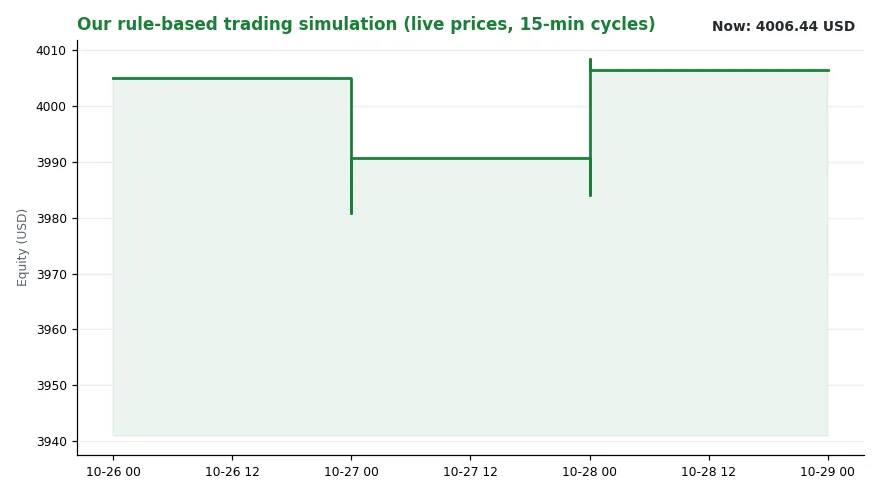
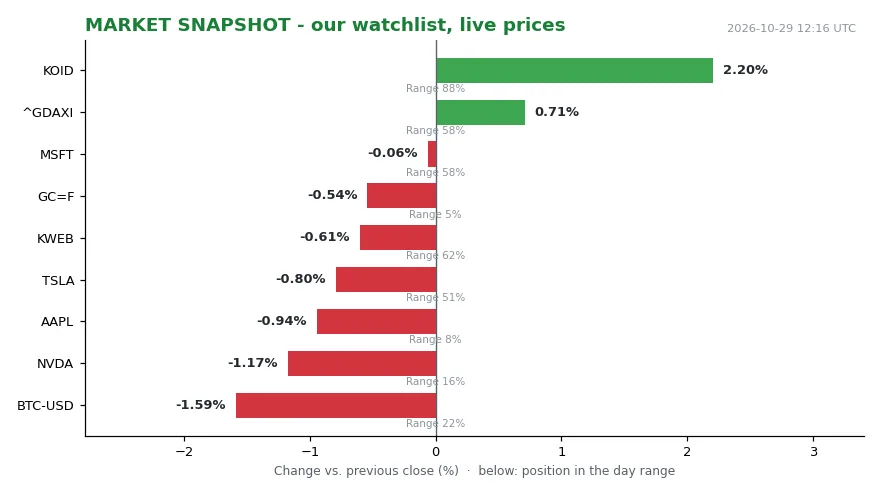
At 12:12 UTC on 29 October 2026, our watchlist printed a pattern worth pausing on. Nvidia traded at 215.38, down 1.17% and stuck in the bottom 16% of its daily range. Apple sat at 343.83, off 0.94%, in the bottom 8% of its range. Bitcoin was at 80,025.90, down 1.52%, in the lower quarter of its range. Gold, the asset investors normally reach for on a soft day, was also lower at 4,031.80, minus 0.49%, in the bottom 9% of its daily range. Only two things on the list refused to cooperate: the DAX, up 0.71% mid-range, and KOID, one of our thematic positions, up 2.20% and closing near its high at 88% of range. Our regime reading says trend=falling, level=3.63. The simulated book stands at 4,006.44 USD with 2,003.41 in cash, unchanged from the same time yesterday.
The snapshot shows a narrow but real message: within US large-cap technology there was no bid into the afternoon, and the usual hedge — bullion — did not deliver one either. That is a one-session observation from a small list, not a forecast. It is also, almost word for word, the weather that a small corner of the ETF market exists to survive.
What the news actually says
ETF.com published a primer on that corner on 21 October 2026, and the numbers in it are the story. Managed futures are a decades-old hedge fund strategy run by commodity trading advisors, and roughly 17 US-listed funds now package it for ordinary investors. The largest, DBMF, the iMGP DBi Managed Futures Strategy ETF, holds over $5 billion in assets. Second is CTA, the Simplify Managed Futures Strategy ETF, which pairs systematic trend signals with an options overlay. Third is KMLM, the KraneShares Mount Lucas fund, tracking a rules-based index across commodity, currency and bond futures. Around them sit RSST, which layers managed futures on top of full S&P 500 exposure using leverage, plus FFUT, IMF, FMF and WTMF. Most charge between 0.65% and 0.99%; IMF at 0.65% and WTMF at 0.66% anchor the cheap end, RSST at 0.99% and FMF at 0.98% the expensive one.
Then came a product extension. On 5 October 2026, iM Global Partner and DBi announced that the iMGP DBi Absolute Return ETF, ticker DBAR, had launched on 30 September. DBAR targets 100% exposure to DBi’s managed futures strategy plus 30% exposure to US equities — stacked, not carved out, so the futures sleeve stays whole while an equity layer sits on top of it. The managed futures sleeve uses the same replication model as DBMF, which crossed $5 billion in assets on 18 September 2026. That model seeks to replicate the pre-fee returns of the largest CTA hedge funds across ten highly liquid futures markets in four asset classes, rebalanced weekly, unchanged since July 2016, with no discretion for the sub-advisor to override it.
The performance history cited is the reason anyone cares. In 2022, DBMF returned +23.07% while the S&P 500 fell 18.11% and the Bloomberg US Aggregate Bond Index fell 13.01%. Managed futures has shown roughly zero correlation and beta to US equities for more than two decades. And during the April 2026 equity selloff, the major managed futures ETFs posted gains while broad stocks fell — the behaviour the category markets as “crisis alpha.”
The mechanism: they just need things to move
The channel is mechanical, not narrative. A trend follower runs rules-based models that identify assets moving persistently up or down, then goes long the uptrends and short the downtrends across dozens of global futures markets at once: crude, gold, the dollar, Treasuries, the S&P 500. That short leg is what separates the category from nearly every other ETF type, and it is why the returns can arrive precisely when a 60/40 portfolio is being hit from both sides — 2022 being the cleanest recent example, when trend models shorted bonds and rode commodity rallies.
Two frictions come attached. First, whipsaw: in markets without clear direction, trend followers endure long, frustrating stretches of flat or negative returns. Second, cost: the category’s fees are a lot next to a plain index fund, and the funds behave quite differently from one another even in identical conditions.
Who wins, who loses, who decides
In our desk view, the commercial winners so far are the replication camp: DBMF’s assets and the DBAR launch both point the same way. Mike Pacitto of iM Global Fund Management framed DBMF’s growth to more than $5 billion as evidence of what he called “a structural shift in how advisors think about diversification and a vote of confidence in the replication approach that DBi pioneered.” [1] Andrew Beer, co-portfolio manager of DBAR and co-founder of DBi, described the question driving the new fund this way: “The question we hear most from advisors isn’t whether managed futures works in a crisis. It’s how to hold it through the years in between.” [1] He added that “DBAR keeps the managed futures exposure at a full 100% and adds equity, seeking to boost returns over time, especially in raging bull markets.” Beer also made the case for replication over manager selection: “DBMF showed that replicating the hedge fund industry, and cutting out the fees, is a better way to own managed futures than trying to pick the right manager. DBAR takes that same strategy and seeks to make it easier for clients to stay invested.” Co-portfolio manager Mathias Mamou-Mani tied the design to cost: “Andrew and I believe that every basis point not paid in fees or lost to trading costs is return retained by the investor, and that principle carries straight through to this Fund.” [1] He noted the new fund has “the same fee structure as our flagship DBMF ETF so investors gain the benefits of equity exposure without additional drag.” In our desk view, the losers are identifiable too: traditional CTA managers charging hedge-fund fees lose the argument when a replication model, unchanged since July 2016, delivers the exposure cheaper.
The decision-makers are financial advisors, who may size the position as a complement to a stock-and-bond portfolio rather than a core holding — the source frames managed futures as a sleeve that earns its keep in the bad years, not a core holding judged by its return in a bull market.
What we watch next
Three things, with honest uncertainty attached. First, whether the softness in our snapshot matures into a sustained downtrend or dissolves into the chop that is a trend follower’s worst enemy — a single session at 12:12 UTC cannot distinguish trend from noise, and our quotes were one minute old. Second, whether DBAR gathers assets: the fund launched on 30 September and its whole premise is that investors stay in managed futures through the flat years, which only shows up in flows over quarters, not days. Third, fee pressure, where the spread between the cheapest and most expensive funds is the visible battleground.
Nothing above is a recommendation to buy or sell any fund; it is the arithmetic of a strategy category, read against our own snapshot, presented for education.