The hum that could stop the AI build-out
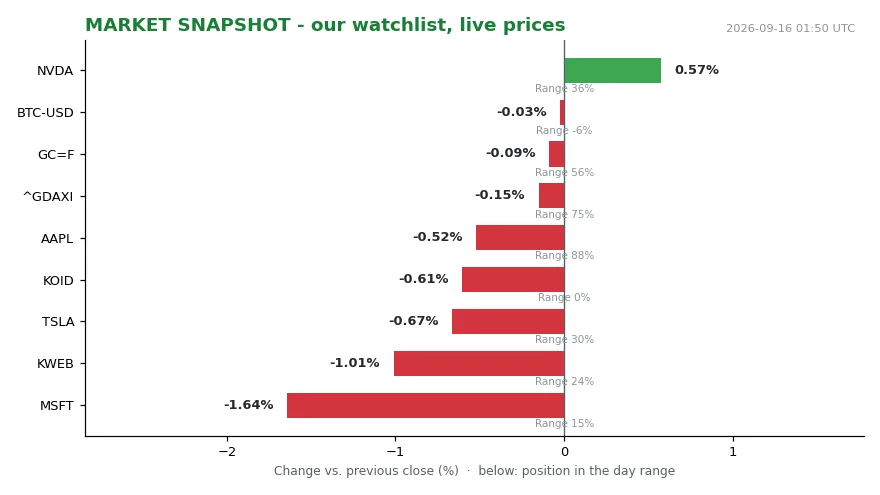
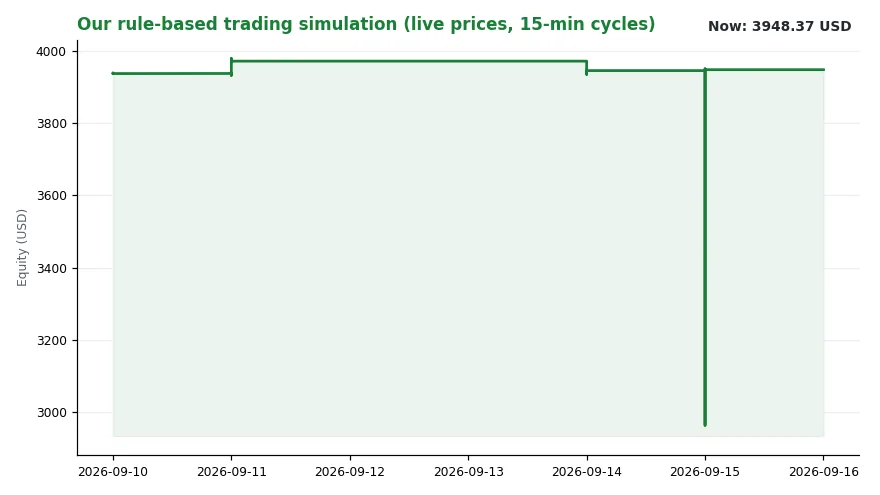
Our own tape opens this story, not the headlines. NVDA printed 212.17, up 0.57 percent against the previous close, and it sat mid-range at 36 percent of its daily band. MSFT traded at 497.12, down 1.64 percent, near day lows at 15 percent of range. AAPL held 331.34, off 0.52 percent, yet it was near day highs at 88 percent of range. KOID, our proxy for the wider AI complex, closed at 34.50, down 0.61 percent, at 0 percent of range — the bottom of the band. KWEB fell 1.01 percent to 24.48, also near its lows at 24 percent. GC=F gold at 4328.90 and BTC-USD at 75605.33 barely moved, minus 0.09 and plus 0.02 percent. ^GDAXI stood at 25402.28, down 0.15 percent, in the upper part of its daily range at 75 percent. Our simulated equity book is 3948.37 USD, unchanged since this time yesterday, cash 1979.60. The last rule-based decision was a logged observation of KWEB, not a trade, because the market was closed. Regime reads: Trend falling, level 3.63. This is not a crash tape. It is a rotation tape, and the rotation has a shape: compute stays bid, software and broader AI proxies look heavy. That is the backdrop on which a very old-fashioned problem is now landing on a very new industry.
In Slough, home to Europe’s densest cluster of data centres, more than 500 people signed a petition saying the town “should not become an experiment.” Among them were people who had expected to live in new housing rather than beside a server farm. The site in question had been designated for 1,000 homes, and was sold to a data centre company as part of the council’s attempt to clear its debts. Neighbours complained that waste heat from the centres made already sweltering summers worse. In Brick Lane, in east London, plans for a facility likely to serve the City’s high-frequency traders face a backlash from residents who would rather see social housing and local businesses. These are ordinary people, not analysts. Their concerns are electric rates, water use and the school run.
That is the actual news here. The global AI race is being challenged not only by warnings about humanity’s survival, but by very local political and environmental friction. Data centres make no dramatic sound: the computations inside them, trillions of transistor switches per second, are silent. What is audible is the low whir of thousands of fans and, at larger sites, the thrum of substation transformers. Nearly every watt drawn leaves the building as heat. Almost none of it leaves as permanent jobs. A functioning facility tends to need a few dozen staff, a few hundred at the very largest. Construction brings employment; operation brings remarkably little.
The politics have followed the physics. Polling by Gallup published in May suggested having a data centre in one’s area was more unpopular than having a nuclear power station. [1] On data centres, 71 % were opposed, including 48 % strongly opposed. [1] For nuclear stations, 53 percent were opposed, including 34 percent strongly opposed. [1] Opposition is loudest on the political left. Democratic Senator Bernie Sanders has called for a moratorium on any new construction, warning that people are worried about how fast the technology moves, how little control they have, and what it does to their community’s rates and water. [2] But this is not a one-party story. Anti-data-centre sentiment is plain among Republican voters too. City councils have been voted out over their data centre policies, and whole states, red and blue, are considering bans. In New Jersey and Virginia, Democratic governors won last year partly on anger about rising power prices blamed on data centres. Because the US energy system runs locally, those bill effects arrive fast.
Texas shows how far the flip has gone. The state was the most pro-business, pro-energy, pro-data-centre jurisdiction in the country, and competed ferociously for these facilities. It won much of the multi-billion-dollar relocation investment tied to Elon Musk’s AI expansion. Now a pro-Trump Republican Senate candidate there, Ken Paxton, is attacking data centres. [2] He campaigns against their tax breaks and proposes that operators be criminally liable if the technology “empowered AI chatbots that undermine children’s safety.” [2] In March, seven Big Tech CEOs stood beside Trump to sign a “Ratepayer Protection Pledge,” promising to “build, bring or buy” their own energy and not pass costs to ordinary households. The pledge was non-binding. New Jersey and Virginia went further, legislating new energy tariffs for data centres plus disclosure of energy and water use. Nvidia’s chief Jensen Huang took to social media in August to cast data centres as the engine of US reindustrialisation. [3] Other Big Tech CEOs did not follow him, which may say something about the optics.
So where does this reach markets? The channel is regulation and permitting, not demand. Demand is not in question; the build-out is still accelerating. What is newly uncertain is how fast a site can be zoned, connected and cooled. Rate cases, state legislatures and planning committees now sit between a chip order and a revenue-generating data hall. That lengthens the gap between capital spending and return. It also shifts cost to operators, which is exactly what the pledges and tariffs do. If a company must “bring or buy” its own generation, capex per gigawatt rises. If it must disclose water use, siting options narrow. Both raise the effective cost of compute capacity, and compute cost is the input price of the entire AI trade.
This is why the tape may matter. Firm bids in NVDA alongside weak software and infrastructure proxies are consistent with a market that still expects hardware volume but is starting to price deployment friction. They are equally consistent with ordinary rotation. One day of quotes cannot separate the two.
Who wins in this configuration? Incumbents that already hold land, grid interconnects and power contracts. Utilities earning regulated returns on new transmission. Communities that negotiate binding clean-energy and rate conditions before saying yes. Who loses? Latecomers queuing for interconnection. Developers who assumed green-belt and brownfield sites were available by default. And ratepayers in places where tariff design pushes infrastructure costs onto the general bill. Who decides? In the US, city councils, state legislatures, governors and, ultimately, voters in November. Control of both houses of Congress is up for grabs, and hyper-local opposition could decide races — and with them US energy and AI policy.
The argument has already crossed the Atlantic. The UK holds the third-highest number of data centres in the world, one place ahead of China; the US holds the most. Labour designated data centres as Critical National Infrastructure last year to speed their roll-out, viewing them as underpinning public services and economic competitiveness. [5] Ministers backed a Buckinghamshire scheme the local council had repeatedly rejected on green-belt grounds. Campaigners crowdfunded a court case; the government acknowledged errors and quashed its own approval. The developer eventually conceded it needed binding clean-energy obligations with the council. The campaigning group, Foxglove, vowed to keep fighting. [6] Baroness Pola Uddin put the local position plainly: the need for data centres is understood, but health and wellbeing must be properly considered, and industrial areas may be a better option. [5]
What we watch next is not a model release. It is rate cases, tariff filings, planning decisions and November ballots. We also watch our own spread: if compute stays bid while infrastructure proxies stay pinned to their lows, the market is telling us something about cost and friction. If that spread closes, this was local noise. We do not yet know which.
The doomsday version of this story — a technology that escapes human control — is the loud, cinematic fear. That fear is loud, cinematic and very hard to act on. What is happening in Slough and Brick Lane is the opposite kind of fear: small, procedural and entirely actionable. A petition, a planning committee, a rate case. That is precisely why it may be the more serious threat to the AI build-out. The hum is not the sound of the future arriving. It is the sound of a neighbourhood deciding how much of it to accept.
Sources
1. Gallup
2. Senate
3. Nvidia
4. Congress
5. Labour
6. Foxglove