
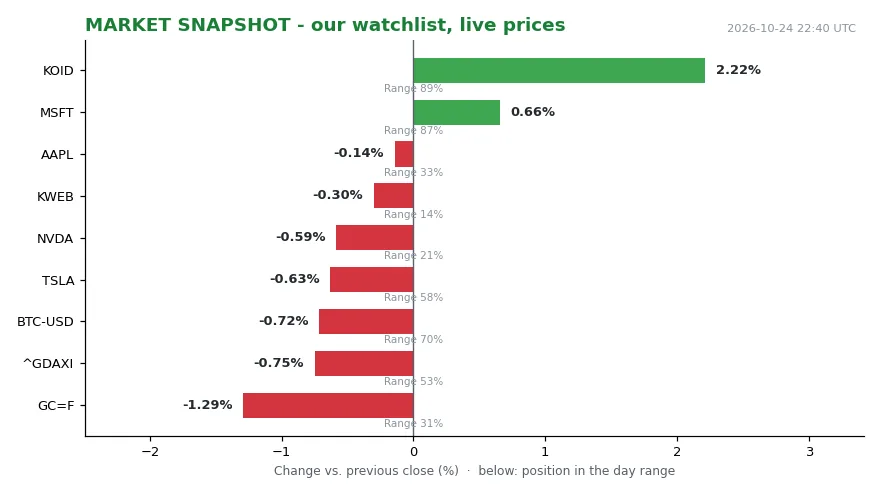
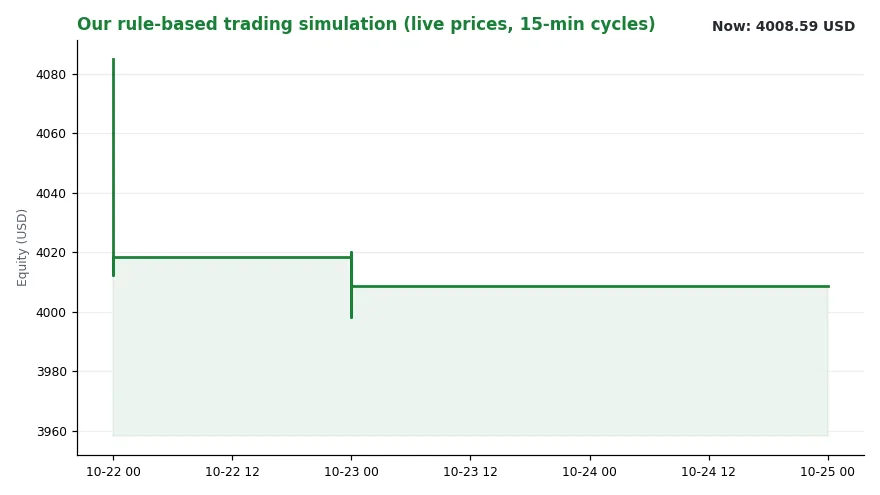
Three readings from our own tape, fetched a minute before this was written: NVDA at 210.96, down 0.59% and sitting at 21% of the way between its daily low and high; MSFT at 524.51, up 0.66% and parked at 87% of its range; gold at 4007.90, down 1.29% and mid-range at 31%. Add ^GDAXI at 25181.65, off 0.75% and dead centre at 53%, and the pattern is not a crash — it is a rotation. Money is leaving semiconductor stocks and bullion and settling into software companies with the largest stock-market values. Our simulated portfolio run on fixed rules sits at 4008.59 USD, flat against the same time yesterday, with 2012.65 in cash and the latest logged decision a plain WATCH on KWEB at 23.14, near its day’s lows at 14% of range. Our internal tally of market-relevant events by topic had its busiest channel on 24 October as “central banks” with three events; our summary label for the market’s trend and level is trend=falling, level=3.63. Nothing on that tape is screaming. That is exactly the mood a finance ministry wants going into a budget — and exactly the mood that can flatter a modest package.
Now the human-scale calculation. The energy support package trailed for the UK budget is around £1.5bn. The safety margin Rachel Reeves built against Labour’s self-imposed limits on government borrowing was £24bn, and higher debt interest on a £3tn debt pile may have halved it. Our arithmetic on those two figures: the missing £12bn is eight times the size of the support being considered. One percentage point on £3tn is £30bn a year — again our arithmetic, not the Treasury’s. That is the whole argument of the week compressed into a ratio.
What the news actually is
John Healey, three months into the job, delivers his first budget on 28 October. He has promised Britain’s “battered consumers” breathing space. He has also postponed the hard choices: the spending review comes at some point next year, and with it the question of when the UK will spend 3% of gross domestic product on defence — the issue that prompted his resignation as defence secretary in June and hastened Keir Starmer’s departure.
The colour around the decision-making is unusual. Every Sunday night Healey walks next door to Andy Burnham’s Downing Street flat, where the two order a curry and work through politics on the prime minister’s sofa. Some aides see it as a deliberate instrument: a way to separate the chancellor from cautious Treasury officials and get him to kick around the politics. One aide contrasts the current process with Starmer’s: “Keir wanted to be presented with three ideas and then pick one,” the aide says. “But, actually, in politics, sometimes you need to bash things around and come up with ideas. And that Sunday night is a bit of that — wrestling with some of Britain’s problems.” [1] If the curry is the unit of account, the budget is being measured in whether families can still afford one — a takeaway being one of the small treats, like a pint at the football, that fewer households can now stretch to.
How debt service, the Bank and fraying confidence pull in one direction
First, the interest bill on government debt. Trump’s Middle East adventure has pushed up inflation and, with it, the interest rate the UK government must pay servicing its £3tn debt pile. Those higher interest costs are likely to have more than offset the benefit of higher-than-expected growth in bumper tax revenues — perhaps halving the £24bn headroom Reeves had built up against Labour’s fiscal rules.
Second, monetary policy. The Bank of England is widely expected to raise interest rates the week after the budget, hitting mortgage borrowers directly. Inflation is expected to top 4% in the new year, and the energy price cap may rise by perhaps another 16% in January. A £1.5bn package, with the IMF urging that support be “targeted and temporary”, does not offset a 16% rise in the energy price cap; advocates of more generous support argue precisely that it could cut bills, and hence inflation, and so ease the pressure on the Bank to hike.
Third, expectations. Consumer-confidence data published on Friday showed the sharpest slide into pessimism since Covid, amid what the consultancy GfK, which collects the figures, calls “relentless cost-of-living pressures”, even before winter bites. Confidence is the channel through which a low-key budget becomes a political problem rather than an economic one.
Who wins, who loses, who decides
The awkward presence in the room is Reeves. Labour strategists now speak of her with gratitude. One adviser: “She made the mistakes, yes, but she left us a Labour Treasury.” In Bangkok, at the IMF annual meetings, her tax and spending plans meant the UK was praised as the only G7 country with a plan to tackle its budget deficit — and urged to “stay the course.” Healey’s presence in Thailand was brief; he left the speechmaking to the foreign secretary, Ed Miliband, and filmed a tuk-tuk video instead, HP sauce in the luggage.
The fault line is ideological, and it is audible. One Labour adviser: “I am not sure how we reconcile the end of 40 years of neoliberalism and the approach of this chancellor.” Burnham’s No 10 is also advertising for political advisers with economic backgrounds, including a specialist in macroeconomics and growth — staffing that looks like a shadow economic team.
Michael Jacobs, an emeritus professor of political economy at the University of Sheffield and a former adviser to Gordon Brown, is blunt about the risk of caution: “He needs to do something big and bold enough for the public to think, this is why we’ve got a new prime minister and chancellor,” he says. “I think the public will be bewildered by a steady as she goes budget.” Sanjay Raja, chief UK economist at Deutsche Bank, points across the Channel, where the riots on the streets of France have been partly driven by the soaring cost of living, and argues that “if there are some low-hanging fruit — temporary measures — across the next two or three-quarters, it could go a long way.” [1]
A lens on who gains and who loses, borrowed from the US
A separate paper in the Journal of Economic Policy and Finance supplies the structural question underneath it: who absorbs adjustment when fiscal space narrows. Its US findings are stark — in 2017 an American CEO’s pay was 361 times the median worker’s; multinationals avoid an estimated $90bn a year in federal income tax by booking profits in low-tax jurisdictions; the financial sector is about 7-8% of GDP but 25-30% of corporate profits and only 4% of jobs; and US inequality is almost twice as high as in Europe. Those are American measurements, not British ones, and should be read as a comparison, not a diagnosis. But the logic travels: a budget that raises a few billion from banks and returns part of it to households is a choice about who gains and who loses, not a neutral one.
What we watch, and when it closes
The budget on 28 October and the public response to it will set the course. One aide says: “After this we will be in election mode.” That may not mean an imminent snap election, but few people believe Burnham will go longer than May 2028.
That is a market waiting for a number, not a narrative. It gets one on 28 October. The Bank of England moves the week after. The energy price cap resets in January. Our tape will tell us which way the rotation runs once the number is out.
This is analysis and education, not investment advice.