Nvidia zero percent AI doomsday versus market signals
Meta commentary - no external expert source; basis: Theguardian (2026-09-21). #MetaEconPol
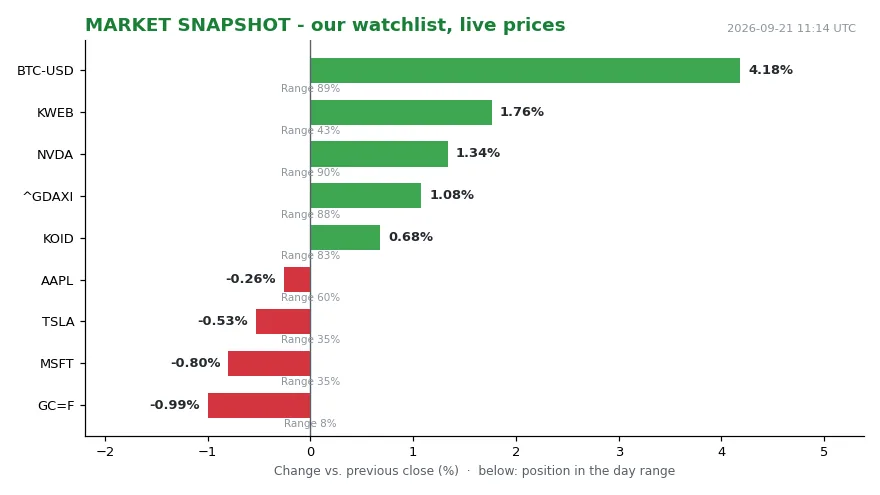
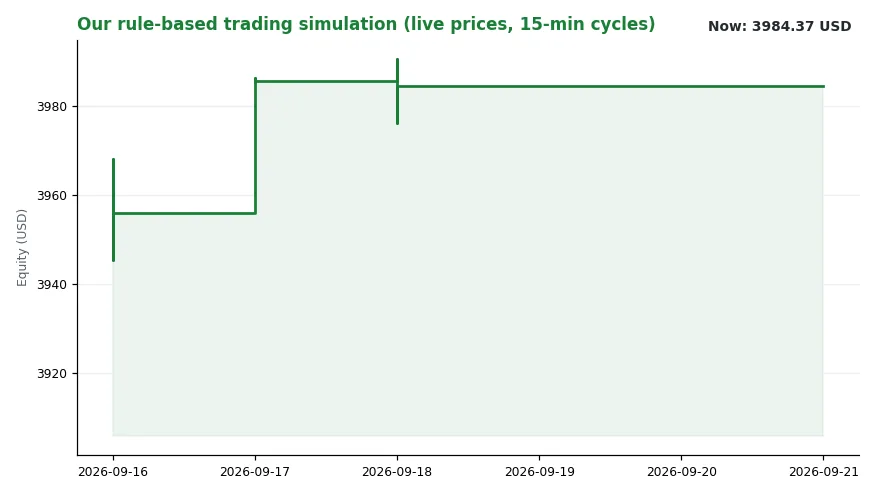
The tape, fetched a minute ago, shows a market that has already voted on the AI doomsday question — and voted no. Nvidia (NVDA) trades at 222.27, up 1.34% against the previous close and sitting at 90% of its daily high-low range, near the highs. Bitcoin (BTC-USD) prints 84,535.23, up 4.16% and at 89% of its daily high-low range. Gold (GC=F) is the mirror image: 4,381.10, down 0.99%, pinned at 8% of its daily high-low range, near the day’s lows. The German index (^GDAXI) is up 1.08% at 88% of its daily high-low range, and the KOID basket, a custom basket of stocks, is up 0.68% at 83% of its daily high-low range. Microsoft (MSFT) is down 0.80% at 35% of its daily high-low range, Apple (AAPL) down 0.26% at 60% of its daily high-low range, Tesla (TSLA) down 0.53% at 35% of its daily high-low range, and KWEB up 1.76% at 43% of its daily high-low range, mid-range. The rule-based simulation holds 3,984.37 USD, of which 2,002.35 USD is cash, flat over 24 hours, and the latest logged decision was to watch KWEB at 0.00. The busiest signal channel was “central banks,” with one event, and the model’s classification of current market conditions is trend=falling, level=3.63.
Gold at 8% of its daily high-low range and bitcoin at 89% of its daily high-low range are two contradictory statements about the same world, and both are true. That is not uniform buying of higher-risk assets across the market; it is a rotation. Hedges are being sold, crypto is being bought, megacap software is being trimmed, Europe is bid. The market’s implicit forecast is that an extreme low-probability outcome is no longer reflected in prices, while the expected policy path is priced in.
Jensen Huang, co-founder and chief executive of the $5tn chipmaker Nvidia, told CBS News that predictions of an AI-caused extinction event are “not grounded in science.” [1] He put the probability of the world ending by 2030 at 0 %. [1] Jacob Coxon, a former researcher at Anthropic, the maker of the Claude system, has argued on social media that AI could become “superhuman” and kill off humanity within the decade. Both cannot be right about the decade. Both can be right about the present, because they are answering different questions.
Huang’s number — 0 % — is a claim about a horizon. Coxon’s warning is a claim about a trajectory. The market trades the horizon; the regulators, the insurers and the lawyers live in the trajectory.
Anthropic published a report cataloguing security threats detailing how criminals, state-sponsored groups, spyware vendors, scientists and propagandists have tried to use its powerful AI models to design missiles and bombs, create deadly pathogens and spy on dissidents. That is not a forecast; it is a log. US lawmakers have criticised AI companies over these risks. Huang calls the doomsday framing “irresponsible” and says “scaring people is unnecessary.” [1] Coxon’s remarks were backed by two other researchers at Anthropic. The disagreement is not about facts on the ground; it is about which facts deserve the microphone.
The actors line up accordingly. Huang wins if the framing stays on the horizon, because the horizon is where his product cycle lives. The AI labs win if the framing shifts to a new international rulebook they help write, because a rulebook is a durable competitive advantage. The losers, if liability law is applied as written, are the labs’ balance sheets. That is precisely why the argument is being had in public. Dario Amodei of Anthropic, Sam Altman of OpenAI and Elon Musk have all called for development of the technology to be slowed down. Donald Trump has dismissed AI anxiety as a “hoax” and a “conspiracy,” adding that a slowdown could give China the edge. On Sunday, US Treasury secretary Scott Bessent said the US and China had agreed to set up an AI dialogue mechanism to alert each other to the technology’s potential dangers. The chipmaker says existing law covers the risk. The labs say a new framework should. The Treasury says a bilateral channel should, at least between Washington and Beijing.
Three things remain unresolved. Whether the US-China dialogue mechanism produces anything operational beyond a channel — a notification standard, a red line, a shared list. Whether existing liability and computer-misuse statutes are actually used against an AI developer, because that, not a communique, changes the cost of the next model. And whether the market’s own 0 % — the one visible in gold at 8% of range and bitcoin at 89% — survives a headline it does not like. The uncertainty is not evenly distributed. Huang’s 0 % is a probability statement with no confidence interval. Coxon’s decade is a timeline with no stated mechanism. The threat report is evidence with no verdict. The measurement here is a snapshot with no forecast; the simulation is flat, holding cash, watching KWEB.
Sources
Mentioned organisations (context, not sources)
- Nvidia — Organisation (homepage)
- Microsoft — Organisation (homepage)
- Apple — Organisation (homepage)
- Tesla — Organisation (homepage)
- Anthropic — Organisation (homepage)