
The 51000 Economy and Stalling Wage Growth
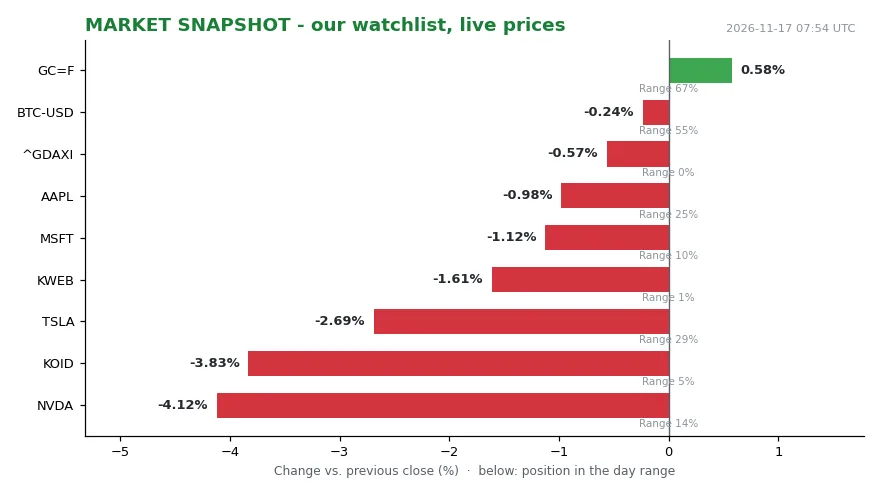
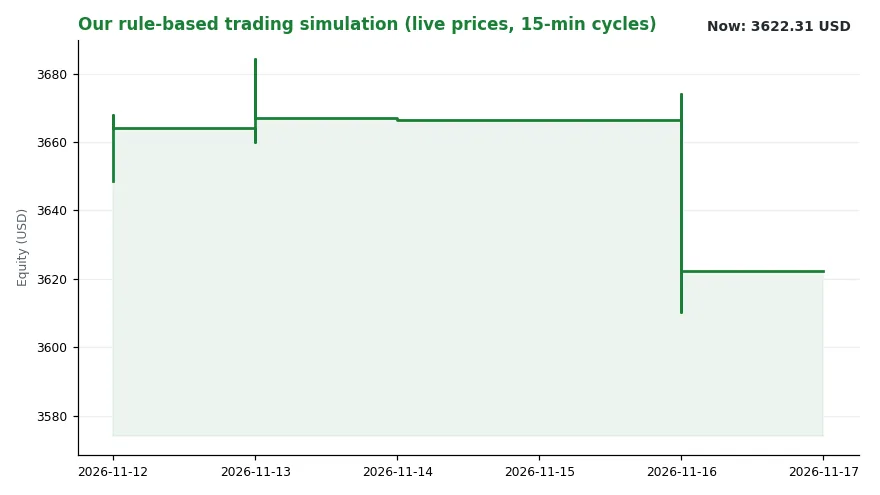
At 07:51 UTC on 17 November, our watchlist was not pricing a soft landing. It was pricing a wait. Nvidia traded at 156.14, down 4.12% on the previous close and sitting at 14% of its daily range — close to the lows. Microsoft printed 517.99, off 1.12%, at 10% of range. Germany’s DAX stood at 26598.64, down 0.57%, at 0% of its range: the exact bottom of the session. KWEB was at 22.56, down 1.61% and at 1% of range, while KOID fell 3.83% to 31.88 at 5% of range. Against that, gold at 3875.40 was up 0.58% and holding mid-range at 68%, and bitcoin at 64589.17 was nearly flat at -0.37%, also mid-range. Equity risk pressed to the floor of the day, the metal bid, crypto unmoved — that is the shape of a market that is not panicking but is not adding risk either. Our rule-based sim book sat at 3622.31 USD, unchanged versus the same time a day earlier, with 1832.95 in cash; the last logged decision was to watch KWEB. The regime reading: trend falling, level 3.63. The busiest signal channel on 16 November was central banks.
What the number actually said
The September employment report was a wide miss. Employers added 29,000 jobs against analyst projections of roughly 90,000, and the unemployment rate edged up a tenth of a point to 4.2%. Revisions removed another 60,000 from the two preceding months: July was cut by 31,000 to a loss of 10,000, and August by 29,000 to 133,000. The three-month average landed at 51,000.
Wages told the more important part of the story. Average hourly earnings rose 3.0% year over year, the smallest twelve-month gain since May 2021. Compare the last three months with the three before and the annualized pace is 2.6% — well below the rate of inflation.
There were genuine positives in the household survey. The unemployment rate rose partly because the labor force participation rate increased; JPMorgan’s Michael Feroli pointed out that 485,000 people entered the workforce, and read that as a positive sign about the strength of the economy. The employment-to-population ratio for prime-age workers (25-54) rose, reversing earlier declines, and is unchanged year over year at 82.7% — 86.2% for men, down 0.1 percentage point, and 75.3% for women, up 0.2.
The mechanism: quits, raises, and the inflation gap
The transmission channel here runs through bargaining power, not through headline unemployment. The share of unemployment attributable to voluntary quits fell to 10.5%, the lowest since May of last year. In a labor market with unemployment near 4.0%, that figure would normally sit above 13.0%. Fewer people choosing to leave means fewer workers trading up — and workers who change jobs typically win larger raises than those who stay put. That is the plumbing that connects a soft hiring print to stalling pay.
From there it travels into real incomes. Workers’ wages are no longer keeping pace with inflation, after two years (2023-2024) in which real wages had been rising at more than a 1.0% annual rate. For a central bank watching for signs of demand-driven price pressure, a 2.6% annualized wage pace is not a tightening signal. For a household, it is a squeeze.
Feroli’s read on the 51,000 three-month average was that it sits “close to most estimates of trend monthly growth in the labor supply, i.e. breakeven job growth.” [1] RSM’s Joseph Brusuelas framed the same figure structurally: “Growth in the domestic supply of labor will remain soft given the well-known long-term demographic challenges posed by the retirement of baby boomers and restrictive immigration policies,” and added that an underlying trend of around 50,000 new jobs monthly “will be the norm over the next two years at the least.” [1] Heather Long of Navy Federal Credit Union put it plainly: “The September jobs report tells us the ‘low hire, low fire’ job market is still here.” [1]
Who gained, who lost
The sectoral concentration is extreme. Health care and social assistance added 23,000 of the 29,000 new jobs in September. Over the past year those sectors contributed 520,400 jobs against 496,000 overall — more than 100% of all net job growth. Restaurants added 10,800, but the gain across the four months since May is just 8,000, which suggests seasonal adjustment is doing some of the work. Local governments shed 13,000 after adding 54,000 in August, almost certainly the same statistical artifact; September employment is down 8,000 from the May level.
Construction added 11,000, slightly above its 9,000 average over the past year but well short of the 16,000 monthly pace it averaged in 2023 and 2024. Manufacturing gained 9,000, its fourth consecutive month of modest growth, and is up 40,000 year over year. Mining, oil included, lost 2,000; oil industry employment including support activities is up just 1,900 over twelve months, and coal mining fell to 37,900, down 1,400.
The white-collar and media cuts keep grinding. Insurance lost another 2,300 in September after shedding 72,700 jobs between August 2025 and August 2026, equal to 2.4% of sector employment. Publishing cut 4,000 and is down 32,600 over the year, 3.6% of its workforce. Motion pictures lost 200, bringing the twelve-month total to 20,300 — 5.8% of total employment in the sector.
The distributional picture is uglier. Black unemployment rose from 6.0% to 7.0%, with the Black employment-to-population ratio up slightly from 57.8% to 58.1%; the rate for Black women climbed 1.2 percentage points to 6.8% even as their EPOP rose to 57.7%. Unemployment among 20-to-24-year-olds went from 7.1% to 8.0%. These series are erratic month to month, and more data is needed before calling it a trend. Native-born workers are not visibly gaining from deportation policy: their EPOP is down 0.7 percentage points year over year and a full point from September 2024, while the foreign-born ratio is 0.4 points higher at 63.9%, versus 58.3% for native-born. Self-employment has stopped growing: the three-month average for unincorporated self-employed is down 1.6% year over year and incorporated self-employment down 2.4%, after 2024 levels that ran 4.0% and 10.3% above their pre-pandemic 2019 marks.
On the AI question, the arithmetic is sobering rather than dramatic. The index of aggregate hours rose at a 1.2% annual rate in the quarter; starting from there, even 3.0% GDP growth would translate into only 1.8% productivity growth — slightly above recent trend, not an unprecedented boom.
What we watch next
Three markers matter more than the headline. First, the quits share: if it stays near 10.5%, the wage deceleration continues and the inflation gap widens. Second, whether 51,000 proves to be a floor, as Brusuelas and Long suggest, with Feroli reading the figure as close to breakeven trend growth, or a waypoint on the way lower; revisions have already taken 60,000 out of the summer, so the error bars on any single month are wide.
Our own tape offers no verdict either. Risk assets pinned near session lows, gold bid, a sim book sitting on cash and a falling trend reading are the marks of positioning, not of conviction — and a labor report from early October is already priced. The uncertainty is real: the demographic-immigration explanation for slower hiring is a hypothesis about supply, not a measurement, and the household survey’s erratic readings for Black workers and young workers need several more months before they mean anything.
The good news is that the labor market has found a level. Unemployment at 4.2% is low by historical standards, prime-age employment has stopped falling, and the monthly figure has settled at a recognizable 51,000. The bad news is what that level means for pay: with quits near 10.5% and wages annualizing at 2.6%, the squeeze on real incomes is now the pattern to watch, not a single month’s miss.
Analysis and market observation only; nothing here is investment advice.