
The Bench and the Machine: What Barclays’ 5,000 Cuts Say About the Order of Op
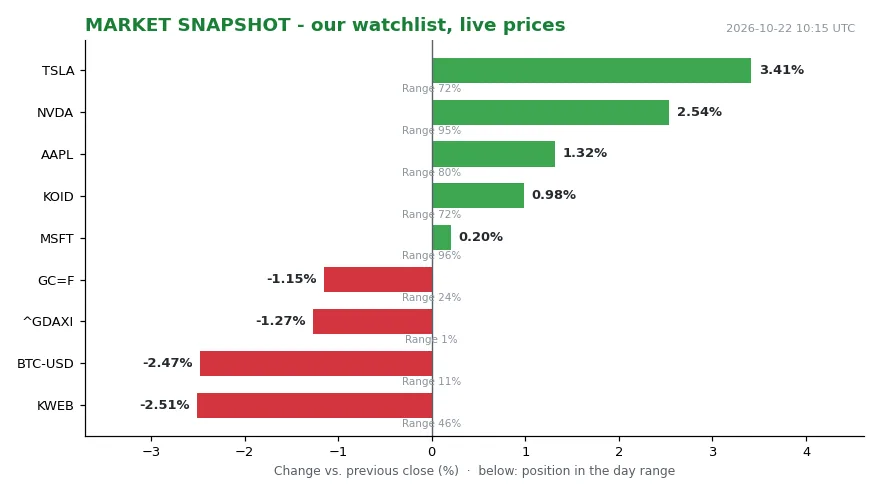
erations At 10:12 UTC our watchlist was not selling risk. It was sorting it.
Nvidia printed 221.97, up 2.54% and sitting at 95% of its daily range. Microsoft traded at 532.95, only 0.20% higher, but at 96% of range — the very top of the day’s band. Tesla showed 386.47, up 3.41% and mid-range at 72%. Apple stood at 343.99, up 1.32%, at 80% of range.
The other column read differently. Bitcoin was at 81,896.68, down 2.53% and pinned at 9% of range, close to its low. Gold fell 1.13% to 4,103.00. The DAX lost 1.23% to 25,328.91 and sat at 4% of range, near the floor. KWEB, our China internet proxy, slipped 2.51% to 23.74.
That is a rotation, not a retreat. Money is being paid for the layer that does the automating. It is being taken out of the assets that live off liquidity and soft real rates.
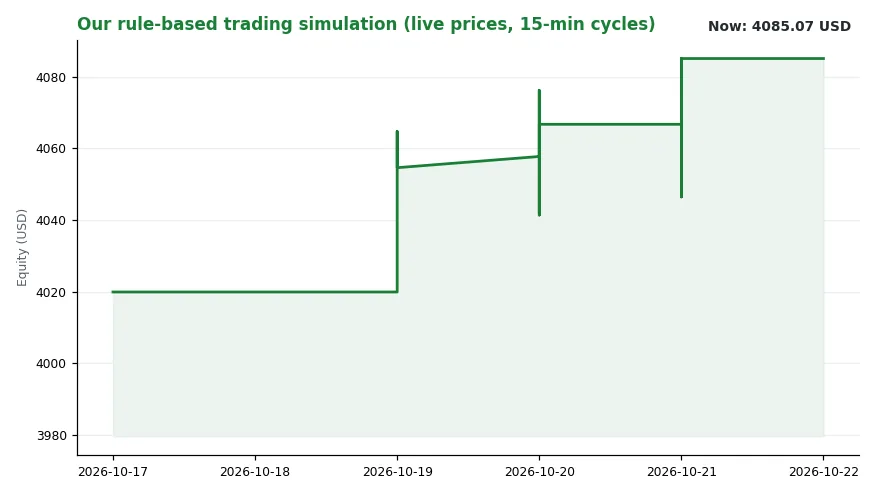
Our regime reading says the same thing in one line: trend=falling, level=3.63. The busiest signal channel today is “central banks”, with 3 events. Our simulated book sits at 4,085.07 USD, flat against the same time yesterday, with 2,038.21 in cash. The last logged decision was WATCH KWEB at 0.00. We are not adding risk into this tape.
Earlier this morning, Barclays gave that rotation a name.
The word itself is older than the ticker: “bank” traces to the Italian banca, the bench or table where a money changer laid out coins. Every cost programme in the industry since has been an argument about how much of that counting still needs a person sitting at the table.
This week the answer moved again.
Where the seats are falling
Barclays is cutting around 5,000 jobs, roughly 5 % of its global workforce. The bank says 1,000 posts are already closed. It expects the remaining 4,000 to be gone by the end of this year.
Around 60 % of the reductions fall inside support functions, and that figure includes developers. That is the detail worth pausing on. They are the people who build the systems.
The geography is part of the story. Cost reduction is concentrated in the UK retail bank. But some back-office work for the UK is delivered from India, and a significant share of the cuts is expected to land there.
The financial backdrop is mixed, and the mix matters. Barclays reported £2.3bn of profit for the three months to September. That is higher than a year earlier, but slightly below forecast.
The investment bank explains the gap. Fixed income and currency trading revenue fell 19 % from a year earlier to £1.01bn, short of analyst estimates. Equities revenue rose 47 % from a year earlier, the best showing since at least 2009, but it was not enough to carry the quarter. Shares traded as much as 2.4 % lower than the previous close as the London market opened.
Costs are already moving. The bank cut £201m of costs in the quarter to September and plans roughly £300m more in the final three months of the year. It expects its efficiency measures to deliver a further £1.1bn of savings in 2027.
Barclays employed about 93,000 people globally at the end of 2025, the base against which the 5,000 reduction is measured. The programme itself is three years old and now reaching its end. It was focused primarily on UK retail, and the investment bank is affected too.
So the headline says AI. The calendar says something else.
The mechanism: cake, icing, and the order of operations
Here is the puzzle the market has been trying to solve. Economists have been watching corporate results for evidence that spending on new technology, and on AI in particular, actually changes day-to-day operations — more efficiency, fewer people. The question was never whether the spending exists. It plainly does. The question is when it surfaces in the headcount line.
Barclays’ chief executive CS Venkatakrishnan described the sequence on the call: > [1] “AI has an important role to play and may have a more important role to play in the future.” [1] > “We will employ the AI at scale… But AI is the icing on the cake not the cake.” [1] > “Because you need to do the infrastructure build to get the benefits of AI.” [1] > — CS Venkatakrishnan, Barclays Group chief executive, third-quarter call That is the mechanism in three sentences, and it is not the mechanism the headline implies. The cake is the infrastructure: data, systems, process redesign, the unglamorous plumbing. The icing is the model layer that sits on top. A process that has not been rebuilt cannot be cut.
The first channel runs through cost-to-income, not through revenue. The bank describes the exercise as “structurally reducing” costs in order to “generate capacity for investment”. A lower cost base buys more room to spend. That is a balance-sheet argument, and it holds whether or not the model layer delivers.
The second channel is the one that bites first: support functions. Back office, middle office, tooling, developers. These are tasks with defined inputs and defined outputs. Defined tasks are the easiest to instrument, and instrumentation is the precondition for automation. That is why around 60 % of the reductions land there.
A third channel runs through the map. A UK retail mandate, delivered partly from India, means the labour-cost arbitrage and the automation programme point at the same desks. When two levers pull in the same direction, the impact concentrates.
None of this is instant. The bank is closing a three-year programme, not launching one. The savings carry dates: roughly £300m in the fourth quarter, £1.1bn in 2027. Headcount is being reduced ahead of the efficiency that is meant to fund it.
That ordering is why the honest answer to “how much of this is AI?” is: not all of it, and possibly not most of it. The chief executive’s own formulation puts the models on top of the cake rather than inside it. In our reading, attribution is a claim here, not a measurement.
The actors: who wins, who pays, who decides
The winners are visible on our tape. Nvidia at 95 % of range and Microsoft at 96 % of range are the vendors of the layer the bank says it will deploy at scale. Equities traders inside Barclays also won the quarter.
The decision-makers are few: a chief executive, a board, and a three-year clock running out. The bank frames the choice as simplification and efficiency, driven by AI. That framing is not neutral. It converts a cost programme into a technology story, and technology stories are easier to tell to shareholders than redundancy stories.
The analysts split, and the split is instructive. Russ Mould of AJ Bell read the move as Barclays “reaching for the AI lever, expecting to cut a decent chunk of its workforce as it expands the use of artificial intelligence” — and, in the same breath, as a set of results that failed to match expectations. Will Howlett of Quilter Cheviot read it structurally: “Banks have spent heavily on technology for years, but we are increasingly reaching the point where that investment translates into fewer people being required to run the business”.
Both readings can be true at once. A bank can reach for the lever and still miss the number. A cost programme can be real and still be older than the technology it is credited to.
The outlook: what we watch, and what stays open
Four things are checkable, and one is not.
First, the remaining 4,000 cuts: do they land before the end of 2026? A programme that slips into next year tells you the process redesign is harder than the announcement.
Second, the £300m of fourth-quarter savings and the £1.1bn promised for 2027. Cost targets are the closest thing this story has to a scoreboard.
Third, the investment bank. Fixed income and currency revenue remained weak, and the chief executive called the FICC result “somewhat disappointing”. If trading stays weak, the retail cost programme carries more of the group.
Fourth, the read-through to peers. If support functions can absorb around 60 % of a 5,000 cut at one institution, the same arithmetic is available to its competitors. The Bank of England’s governor has warned that an AI boom could trigger market shocks, a reminder that the same technology story cuts both ways for the sector.
What stays open is causality. One bank, one quarter, one cost programme that began before the models arrived. That is a data point, not a law. The economists waiting for proof will need more than this.