Rheinmetall Says Orders Not Capacity Limit Rearmament
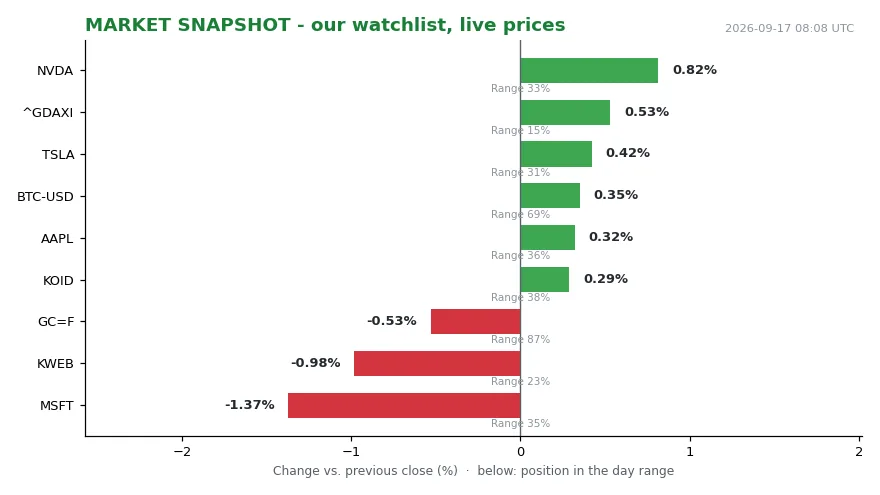
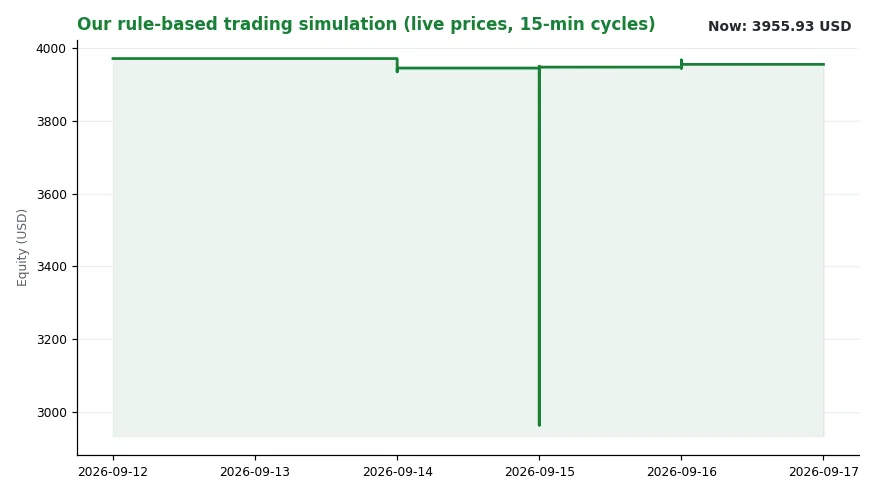
At 08:01 UTC on 17 September 2026 the tape showed no market in a hurry. Gold printed 4,369.60, down 0.41 percent on the previous close, but sat at 94 percent of its daily range, hard against the day’s high. The German index came in at 25,704.85, up 0.65 percent, the strongest move among the broad equity lines tracked. Microsoft fell 1.37 percent to 490.30. [1] Nvidia rose 0.82 percent to 213.90. [2] Apple added 0.32 percent to 332.41. [3] Tesla gained 0.42 percent to 358.08. [4] Bitcoin traded at 76,387.27, mid-range at 65 percent. KWEB, the China internet line, lost 0.98 percent to 24.24, near the day’s lows at 23 percent of range. KOID, the defence-linked instrument, moved 0.29 percent to 34.60, mid-range at 38 percent. The pattern is quiet but legible. Money is not running. It is tilting. Real assets sit high in their range. A European index leads mildly. One US mega-cap breaks lower while the others hold. The simulated equity book was unchanged at 3,955.93 dollars, with 1,984.99 in cash. The last logged decision was to watch KWEB and do nothing, because the market was closed. The regime layer reads trend as falling, level at 3.63. The sign layer named the central bank channel as the most active on 16 September. Nothing in this frame shouts. Together the numbers ask where European industrial capacity is being repriced.
What the interview contains
The news itself is not an earnings print. Armin Papperger, chief executive of Germany’s largest defence firm, spoke to Euronews at the keel-laying of the third fleet service boat of class 424 in Wolgast. [5] He repeated a warning he first gave in March: missile stockpiles remain worryingly low, and missiles cannot be built that quickly. The bottleneck sits in rocket motors and in warheads. Europe and NATO need to reach target levels fast enough to matter if they are threatened. [6] On Skyranger he was specific. Series deliveries must begin in 2027 under the contract, with only minimal delays described. Chassis, radar technology and integrated missiles still need updating. From the end of next year, he said, capacity reaches up to 400 units a year. [5] On deep strike he named two joint ventures. Lockheed Martin covers artillery rockets. [7] Destinus covers cruise missiles. [8] Both sit in the final stage before signature. He expects the first cruise missile order at the end of this year or the beginning of next. [5] Around 34,000 people work at Rheinmetall outside the civil sector. [9] Net growth runs at roughly 10,000 a year. The target is 70,000 by 2030. [9] Behind that sits a supply chain of 210,000 people. Added up, that is close to 300,000 jobs. Medium calibre ammunition went from under one million rounds to four million. Artillery went from 70,000 to 1.5 million. Tank ammunition reached 240,000, up from 40,000 to 60,000 depending on the year. Then came the sentence that matters most for a market reader: the constraint is not capacity, it is orders. Rheinmetall runs a 30 billion euro investment programme over six years. [9] On the future he was plain. Robots will come; Bremen hosts a humanoid research centre, though there is no serial product yet. Space investment covers satellite construction and communications processing. Drones stay, and so does everything else, because combined-arms warfare needs artillery, armour, conventional ammunition, drones and missiles. The only open question is the mix.
The channel: budgets, bottlenecks, labour
Defence is no longer a niche industrial story. It is a fiscal story that trades like an industrial cycle. The first channel runs from government budgets to orders, from orders to backlog, then to capital spending and hiring. The sign layer’s most active channel on 16 September was the central bank: rearmament is financed by issuance, and issuance is priced against rate expectations. The second channel is capacity. Bottlenecks in rocket motors and warheads are friction inside the transmission, and whoever delivers inside the bottleneck sets terms. The third channel is labour. A company adding 10,000 net people a year competes for engineers, machinists and fitters. The fourth channel is expectation. Equity prices do not wait for deliveries; they price the probability that announced contracts become signed ones. Papperger’s remark about orders is the mechanism in plain language. If the bottleneck were steel or labour, money would solve it. If the bottleneck is a budget decision, only a budget decision solves it.
Who gains, who waits, who decides
Rheinmetall gains if the order signal becomes durable. The 210,000 people in that chain gain when volume holds, not when it spikes. BAAINBw and the defence ministry decide the timing; they are the counterparty that turns a threat assessment into a purchase order. Lockheed Martin and Destinus sit on the other side of two joint ventures that are not signed yet. The Inspector of the German Army frames the requirement. Papperger quoted him: “In two years the threat will look completely different.” [10] Cheap interceptors and.50 calibre guns handle light drones, on his account, while jet-powered drones are barely manageable that way. Skyranger, he argued, can engage a missile travelling at Mach 3. That claim belongs to the company, and should be read as such. On the other side of the ledger sit budget lines that do not get funded. If the mix shifts, yesterday’s capacity becomes tomorrow’s surplus. The quantities in each area will change.
What we watch next
Four milestones and one number are now on the calendar: Skyranger series deliveries in 2027, a capacity line of up to 400 units a year from the end of next year, two joint venture signatures described as imminent, a first cruise missile order around the turn of the year, and the German budget. Gold at 94 percent of range says real assets are still bid. The German index at plus 0.65 percent says Europe is not being sold. KOID at 34.60, up 0.29 percent and mid-range, says the defence complex is not yet running. That gap between narrative and price is where uncertainty lives. Whether the orders arrive on schedule, whether the mix shifts faster than the capacity, and what a 30 billion euro programme does to margins in year four are all open. What is documented is an interview, a set of figures, named bottlenecks and named dates. That is enough to watch honestly, and not enough to conclude.
Closing
In
Wolgast they laid a keel. A keel is the first piece of a ship that will not float for years, and the ceremony is a photograph of a promise. Around it sat a chief executive talking about missiles that cannot be built fast enough. Between the keel and the delivery there is nothing but time, budget and decisions. The tape, refreshed at 08:01, recorded none of that. It recorded gold near its high, a German index up 0.65 percent, a defence line barely moved. The market is waiting for the paper, not the keel.
Sources
1. Microsoft
2. Nvidia
3. Apple
4. Tesla
5. Euronews
6. NATO
8. Destinus
9. Rheinmetall
10. German Army