Netflix Cuts 1,000 Jobs, and Starts Two Clocks
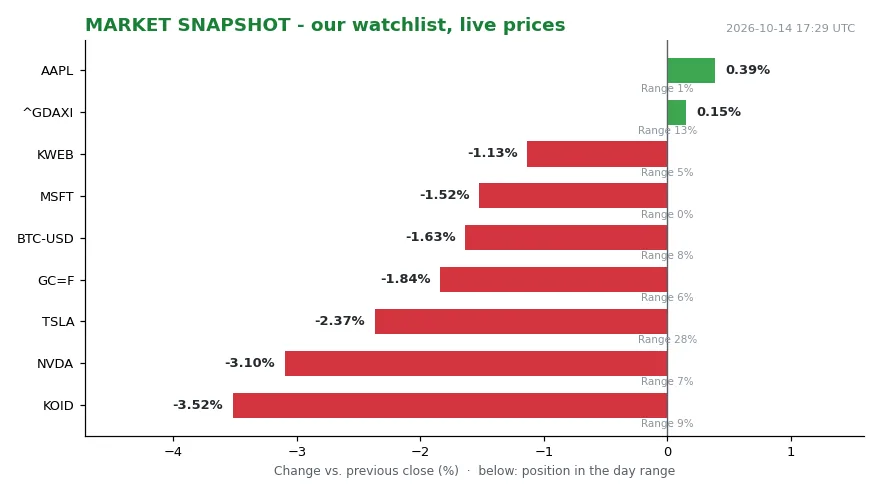
Our watchlist spent the session drifting lower, and it did most of that drifting late. Nvidia closed at 221.91, down 2.89 percent, near day lows, in just 16 percent of its session range. Microsoft finished at 535.77, off 1.41 percent, pinned near its low at 3 percent of range. Tesla traded 366.92, down 2.21 percent, mid-range at 37 percent. Apple was the only green ticker at 343.06, up 0.52 percent, and even that gain closed in the bottom 3 percent of its range. Gold fell to 4,101.40, down 1.82 percent, and Bitcoin slid to 81,815.97, down 1.54 percent; both settled in the lower reaches of their ranges, at 6 and 11 percent. The DAX added 0.15 percent to 25,298.61 but closed in the lower 13 percent of its range. KOID dropped 3.29 percent to 33.53, near day lows at 21 percent of its range, while KWEB eased 1.13 percent to 24.44, near day lows at 5 percent of its range.
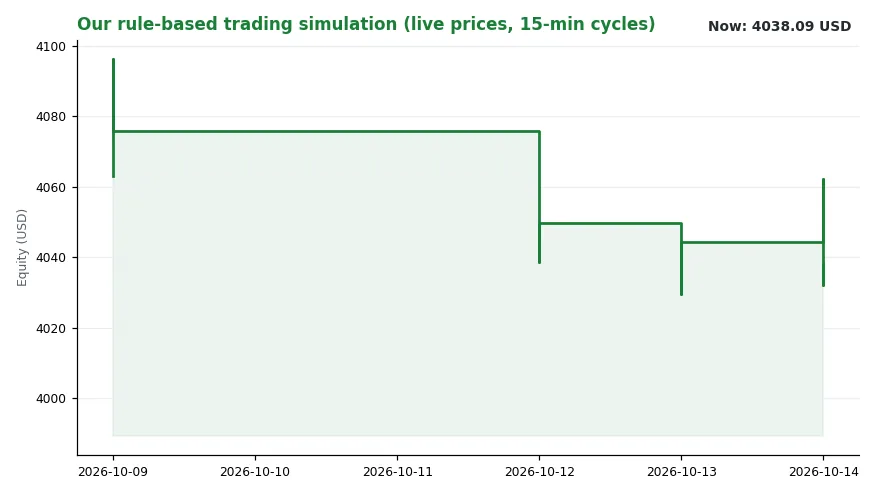
Our rule-based simulated book stood at 4,038.09 USD, down 0.16 percent against the same time yesterday, with 2,402.15 in cash. The latest logged decision was WATCH KWEB @ 0.00, timestamped 2026-10-14 19:22:58. The signal layer was almost silent: the busiest channel on 2026-10-14 was ‘central banks’, with a single event. Regime reading: trend=falling, level=3.63.
Read together, that is not panic. It is a fade into the close, with one large cap holding a bid and with gold and bitcoin falling alongside equities. The simple risk-off rotation story does not fit. What fits is a market de-risking without a headline to point at, and our own book reflects it: mostly cash, one watch decision, no new exposure.
Into that thin tape comes a corporate decision.
Netflix will cut 1,000 jobs worldwide, around 6 percent of its total workforce. It is the steepest round since 2022, when the company cut about 450 roles after losing subscribers for the first time in more than a decade. This time the reductions land mainly on human resources, legal, product and technology. Those are support functions, not the teams that make the shows.
Managers will tell employees whether their job has been cut “soon”. That word is the first clock. The second sits on the calendar: Netflix reports results on 20 October. Until then, staff get an email, a number and a wait.
The email, from co-CEOs Ted Sarandos and Greg Peters, states: “Our mission - to entertain the world - is ambitious, and delivering on it requires us to be disciplined about where we prioritise our people and resources.” [2] The same note says: “Our business is strong and growing, and we remain on track to deliver our full year forecast.” It promises the company will “continue to invest aggressively in high-impact areas to improve our service and further drive growth and innovation.” Why does a cost cut move markets at all? Because this one is a growth statement, not a distress statement. Netflix reported revenue of around $45.2 billion in 2025, and its worldwide headcount stood at around 16,000 last year. A 1,000-person reduction against that base is a rounding decision at the top and a life decision in the middle.
Sarandos told the Bloomberg Screentime summit that the company was “not growing as fast as I want us to.” [2] That sentence is the thesis. The cuts are the reaction function.
The channel here is not interest rates. The mechanism looks like subscription satiation.
Netflix sells a monthly subscription, and that line grows three ways: more households join, existing households pay more, or households stay longer. Investors have been weighing user engagement, the time customers spend on the service, because attention is what YouTube and TikTok take first — and they take it without charging a subscription. Consolidation is compressing the rest of the field. Paramount agreed a $110bn (GBP 83.6bn) merger with Warner Bros, the owner of HBO. Netflix came close to its own deal with Warner Bros but was outbid by Paramount.
Each is a second revenue line. None is yet a second revenue engine. eMarketer senior analyst Ross Benes put the gap plainly: “they haven’t been able to find another line of major revenue.” [2] He added: “Eventually, because they’re nearing a ceiling with that, they’ll need another revenue stream to diversify, and that’s where it’s been more of a struggle.” That is the mechanism in one line: a fixed cost base, a subscriber base nearing a ceiling, and diversification that has not yet scaled. Cutting 6 percent of staff is what a company does when it believes the next dollar of growth comes from precision rather than from more people.
The losers are the roughly 1,000 employees whose roles are being eliminated, concentrated in HR, legal, product and technology. The message-bearers are managers, who will deliver the news “soon”. Paramount gains the Warner Bros assets it outbid Netflix for, and inherits the integration work of a $110bn combination. The email says nothing about programming, so viewers are not part of the arithmetic.
The decision-makers are two people. Sarandos and Peters describe the move as “organisational changes” and say the company must make “focused” choices to reach its growth targets. That vocabulary is instructive. “Organisational changes” is the language of structure; “focused” is the language of subtraction.
The next hard datapoint lands on 20 October. The question is whether gaming, advertising and live events are material enough to be named as separate revenue lines. And watch guidance: a reiterated forecast plus a 6 percent reduction implies the company believes it can do the same work with fewer people. If it can, this is a one-off. If it cannot, the next round has a template.
We cannot tell which of those futures is arriving from the information available today. Our regime reading is falling, at level 3.63, and our book sits in cash. That describes our risk posture, not a forecast, and it is not advice.
For subscribers, this story surfaces in two places: price and product. Prices rose earlier in the year, and the advertising tier exists to hold the entry point down while monetizing the same hours. So the question for a subscriber is not whether Netflix survives. It is what the cheapest acceptable version of it looks like in twelve months.
For anyone working at a scaled platform, the geography of these cuts is the useful part. HR, legal, product, technology: four functions that form the shared services layer of a large digital business, and the layer where cost discipline tends to land first. The 1,000 people affected are not a statistic about streaming. They are a map of where the fixed costs of the last growth cycle were parked.
Two clocks are running. The market waits until 20 October for numbers. The people inside Netflix get told “soon”, and their clock runs faster than any earnings calendar.