
The 83% Threshold: Portugal’s Housing Math, and What Our Screens Said First
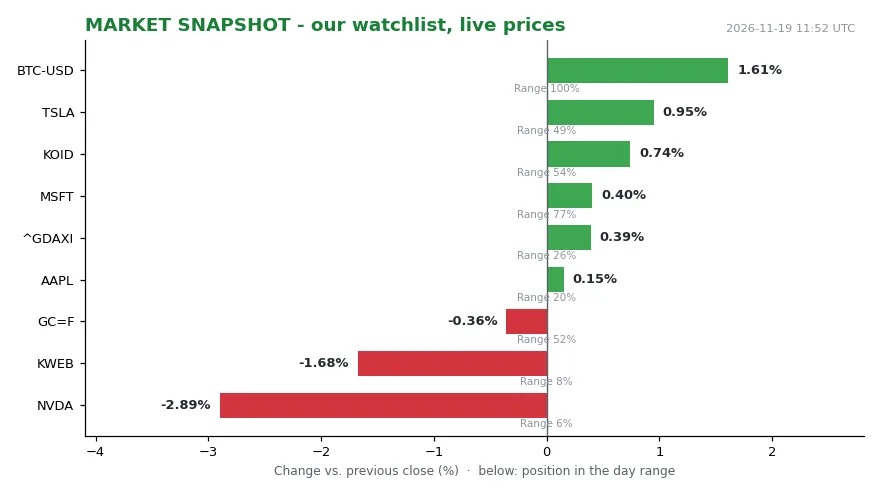
At 11:48 UTC our watchlist looked like a market exhaling slowly rather than sharply. Nvidia printed 150.96 dollars, down 2.89% against the previous close and pinned near the day’s low, with only 6% of the intraday range above it. Apple traded at 352.45, a 0.15% gain that still left it near the bottom of its range at 20%. Microsoft went the other way: 508.29, up 0.40%, near the day’s high at 77% of range. The KraneShares China internet tracker KWEB fell 1.68% to 21.71, close to its low with 8% of range above it. Bitcoin stood at 63,979.12, up 1.57% and at the very top of its range, 100%. Gold was 3,731.30, off 0.28%, mid-range at 57%. The DAX was 25,843.42, up 0.42%, mid-range at 30%.
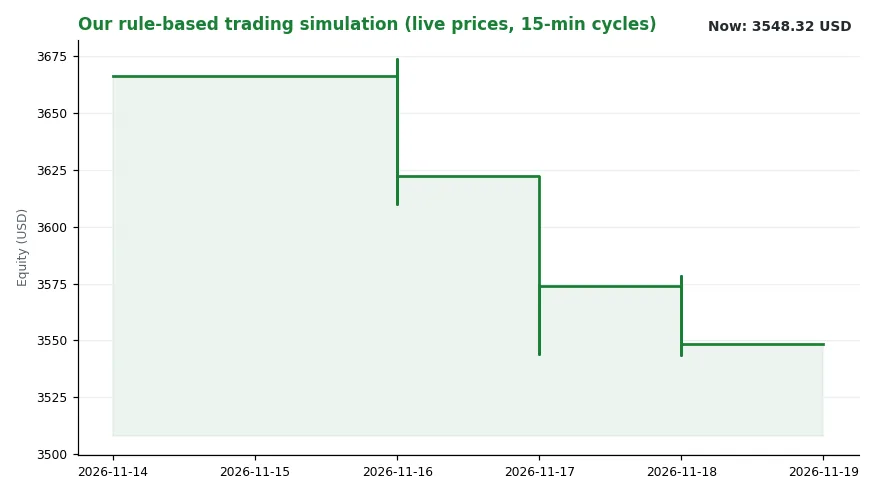
That is not a broad risk-off tape; it is a rotation inside risk. Semiconductors and China-exposed equity sit at the weak end, enterprise software and bitcoin at the strong end, and gold is neither hedging nor leading. Our regime reading says trend=falling with level 3.63. The busiest signal channel on 18 November was “central banks”, with 3 events. Our simulated equity book stood at 3,548.32 dollars, flat against the same time yesterday, with 1,788.13 in cash. The latest recorded decision was WATCH KWEB at 0.00 — we did nothing, and we document that rather than dress it up.
Central banks were the busiest channel on our screens. Housing effort rates are where central bank policy lands in a household budget: the rate a bank pays for funding becomes the payment a family makes each month.
What the analysis actually found
The headline is blunt. Portuguese families spend on average 83% of their net annual income on rent. [1] For buying a home, the same measure falls to 70%.
The study’s conclusions state: “Renting or buying a home consumes a large part of household income, reflecting the difficulties that many families face in accessing adequate housing” [1] The national averages hide a wide dispersion. Faro carries the heaviest rental effort in the country at 92% of household income. Lisbon follows at 88% and Funchal at 85%. Porto (66%) and Setúbal (64%) complete the top five. At the other end, Coimbra, Viseu, Beja, Vila Real and Bragança are the cities where rents weigh least on household income. Only three cities stay inside the recommended 33% limit for renting: Castelo Branco and Portalegre at 32%, and Guarda at 29%.
The purchase side is, for many households, worse. The analysis identifies Funchal as the city where “buying a home represents the greatest financial effort”, at a rate of 96% [1] Lisbon follows at 90% and Faro at 79%. In Funchal, almost all of a family’s net annual income would go on repaying a housing loan. The 33% reference for buying is exceeded almost everywhere: Porto 76%, Aveiro 68%, Ponta Delgada 59%, Setúbal 57%, Braga 53%, Viana do Castelo 53%, Leiria 51%, Coimbra 47%, Évora 45%, Viseu 45% and Santarém 43%. Six district capitals remain within the recommended level for purchase: Guarda 20%, Castelo Branco 23%, Portalegre 23%, Bragança 26%, Beja 29% and Vila Real 30%.
How fixings turn into monthly bills
An effort rate is arithmetic before it is politics. It divides a housing payment by net income. If the payment rises and income is flat, the ratio rises, and no household decision is required for that to happen.
Supervision moved too, in the opposite direction of comfort. The Bank of Portugal this year reduced the maximum recommended effort rate from 50% to 45% of net monthly income. That is a recommended maximum on new lending, not a statement about what a household can comfortably carry. The gap is the point: a loan can sit inside the 45% rule while the borrower sits far outside the 33% reference for sustainable effort.
A ratio at 83% does not stay a spreadsheet entry for long; it becomes a political variable.
Who wins, who loses, who decides
The losers are legible from the figures. Renters in Faro, Lisbon and Funchal, and buyers in Funchal, Lisbon and Faro, face ratios that leave almost nothing between payment and income. Households in Guarda, Castelo Branco and Portalegre live in a different arithmetic altogether, and that spread is the real finding: national figures at 83% and 70% hide rent and purchase gaps that run from 29% to 92% and from 20% to 96%, respectively.
Banks sit in the middle. They originate the loans whose effort rates the central bank caps, and they hold the credit risk if those ratios deteriorate after origination. A public guarantee lowers the deposit barrier; on its own it does not shrink the monthly payment that produces a 90% effort rate in Lisbon.
What we watch next
We watch the Euribor curve before we watch the headlines. If short-dated fixings keep climbing from the March 2026 inflection, effort rates in the high-cost cities have room to rise further.
We watch whether the 45% recommended maximum is applied to new lending in the cities where the arithmetic is worst. We watch the next Idealista release for the same 20 cities; one quarter is a snapshot.
The uncertainty is worth stating plainly: a single quarter of effort-rate data is a snapshot, not a trend.
The caution
An effort-rate table is a diagnostic, not an instrument. If read as a policy target, a 33% reference line could push lending away from the households that need it most, or steer those households toward costlier credit outside the banking system. If read as a scoreboard, it invites comparisons between cities with different income distributions and different housing stocks.
If read narrowly, it says something useful: in Faro, Lisbon and Funchal, housing cost relative to income has moved past the range where a household absorbs a rate shock without cutting something else.
The Bank of Portugal sets the recommended maximum, the banks hold the loans, and a government facing street demonstrations owns the political consequence. Our tape read rotation, not rupture. Whether Portugal’s housing math resolves the same way is not something one ratio can answer - but the 45% ceiling and the next Idealista release will tell us which way the arithmetic is moving.
Quotes
[1] Idealista analysis, as reported by Euronews: “Renting or buying a home consumes a large part of household income, reflecting the difficulties that many families face in accessing adequate housing”; and “buying a home represents the greatest financial effort” (Funchal, 96%).
Data notes
Key figures: 83% (rent, national average), 70% (purchase, national average). City-level effort rates and the Bank of Portugal’s 50%-to-45% ceiling change are as reported in the source. Market prices, range positions, regime reading (trend=falling, level 3.63), signal-channel activity, simulated equity (3,548.32 USD), cash (1,788.13 USD) and the WATCH KWEB decision are from our own measurement as of 2026-11-19 11:48 UTC. This is educational analysis, not investment advice.