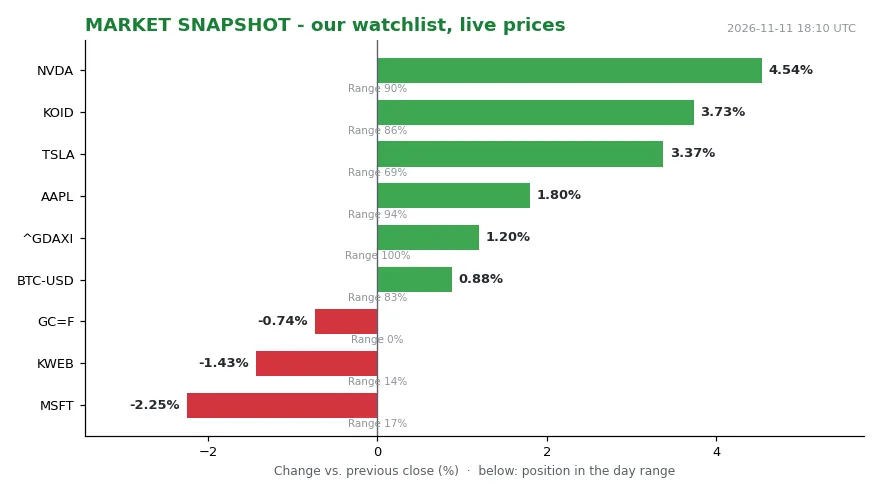
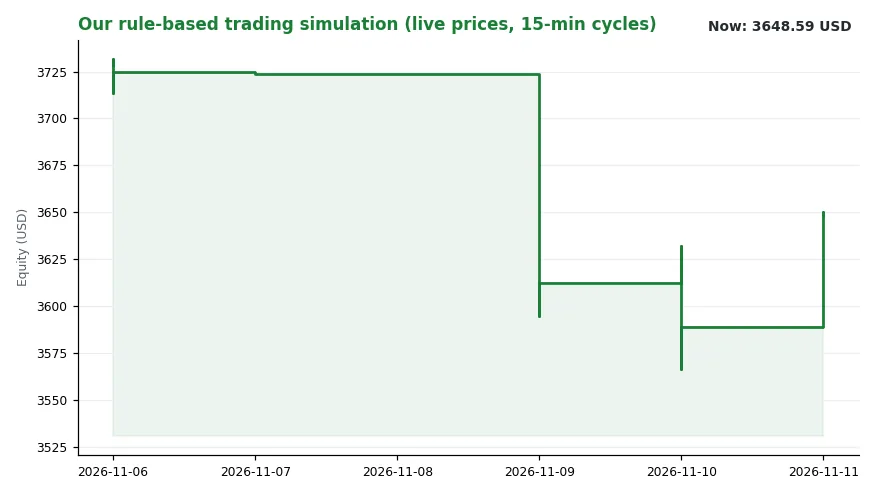
The tape we measured at 18:08 UTC on 11 November 2026 does not look like a market that has priced political risk in Europe. Nvidia traded at 176.35, up 4.48 % on the previous close and near the day’s highs at 88 % of its daily range. Apple sat at 354.65, up 1.76 % and at 92 % of range. The DAX stood at 26,662.77, up 1.20 % and at the very top of its range — 100 %. Microsoft, by contrast, was at 520.86, down 2.31 % and near the day’s lows at 15 % of range. Gold at 4,003.70 was down 0.66 % and at 1 % of range, effectively pinned to the floor. Bitcoin was at 74,331.24, up 0.84 % and at 81 % of range. In our reading, that combination is not a safe-haven pattern. It reads as rotation: capital leaning into growth and AI exposure, stepping back from mega-cap software, and paying almost nothing for social or political disruption in Europe. Our rule-based book reflects the same mood rather than predicting anything — simulated equity at 3,648.59 USD, up 1.67 % versus the same time yesterday, with 1,824.65 USD in cash, and a logged decision to buy Microsoft at 521.07 at 17:04:52, a position that is now slightly underwater at 520.86. That is documented honestly, not presented as a call.
The future this points at, and the present it comes from
A national election in which housing stops being one line in a manifesto and becomes the axis on which coalition arithmetic turns, because a single day of withheld labour showed that the cost of shelter can mobilise a workforce. That scenario is not the news. The news is narrower and more concrete: workers across Spain staged the country’s first general strike in 14 years, and the action was primarily over housing costs. [1] It took place before a national election. Three facts, tightly packed, and each one carries weight.
The “before” picture is simple to state. For 14 years Spain had not seen a general strike. [1] The “after” picture is a country where that instrument was used again, and where the stated trigger was not pay but rent and the cost of a home.
Why this moves markets at all
A general strike is a supply-side event with a political multiplier: a day of withheld labour removes output and, framed around housing, adds an electoral variable. That matters because housing is the largest fixed cost in most household budgets, and it feeds into three channels at once.
First, disposable income. When shelter absorbs a rising share of pay, consumption compresses and wage demands rise. Second, expectations. A strike explicitly framed around housing, timed before an election, tells every landlord, developer, lender and voter that the issue has become politically priced. Third, policy risk. Elections can produce housing measures — rent rules, subsidy schemes, planning changes, tax treatment — and those measures land on owners, on construction margins and on bank balance sheets exposed to mortgages.
Our own signal layer offers a counterweight. The busiest channel in our event log on 10 November 2026 was “central banks”, with exactly one event recorded. Labour action did not register as the dominant driver of the flow we track. Our regime reading shows trend falling, level 3.63. In our data, a central-bank channel was busier than a labour channel on the eve of Spain’s first general strike in 14 years. That is a measurement, not a verdict.
Who wins, who loses, who decides
The strikers carry the immediate cost. A general strike is a day of forgone pay for the people who take part, which is why it is used rarely — 14 years rarely, in this case. Their leverage is visibility before an election.
The government and the parties contesting that election are the decision-makers. The structural point: a pre-election strike converts an economic grievance into an electoral input, and the response — a policy package, a negotiation, or silence — becomes the thing markets actually trade.
Owners of residential property, landlords, developers and mortgage lenders are on the other side of the transaction. Any housing measure that lowers the cost to renters changes the return to ownership. Construction firms face a different trade-off: intervention can compress margins, but supply-side measures can expand volumes.
And then there is the market itself, which in our measurement behaves as if none of this is systemic. Gold at 1 % of range is the clearest single reading: no defensive bid. The DAX at 100 % of range says European equities are absorbing the news without visible strain. Rotation into semiconductors and hardware — Nvidia at 88 % of range, Apple at 92 % — says the marginal euro and dollar is still chasing growth narratives rather than hedging social ones.
What we watch next
Four things, each with a named uncertainty.
Participation. A strike with thin turnout is a headline; one with broad turnout is a precedent, and the difference is empirical, not rhetorical.
Whether the demand converts into a policy offer. Housing costs are the stated trigger. Whether any party responds with a concrete measure before the vote determines if this is a one-day event or the opening of a campaign theme.
Contagion. The question stays open: does the tactic spread, or does it remain national?
Cross-asset confirmation. Our watchlist has no direct Spanish exposure — no IBEX constituent, no Spanish bank, no Spanish REIT. That is a real limitation. If that changes — gold lifting off its low, European breadth narrowing while the index holds — the read shifts.
The cheapest version
One day of not working. No new institution, no new instrument, no capital requirement. That is the entire technology of a general strike, and it took 14 years for Spanish workers to use it again. The policy counterpart is just as cheap: a single housing measure written into a manifesto before an election, costing a party nothing but a commitment. Both versions are already here. The expensive part is what happens if neither is enough — and on that, our data offers no answer yet.
This is educational analysis of published market data and reported news, not investment advice. Simulated performance is rule-based and documented, and past behaviour of any signal does not guarantee future results.