
The Tape Said Rates. The World Bank Said the Same Thing, Only Louder.
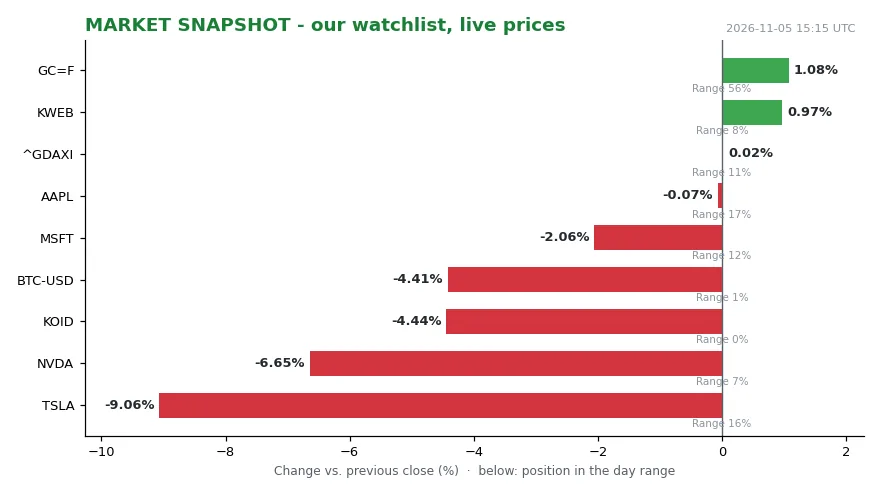
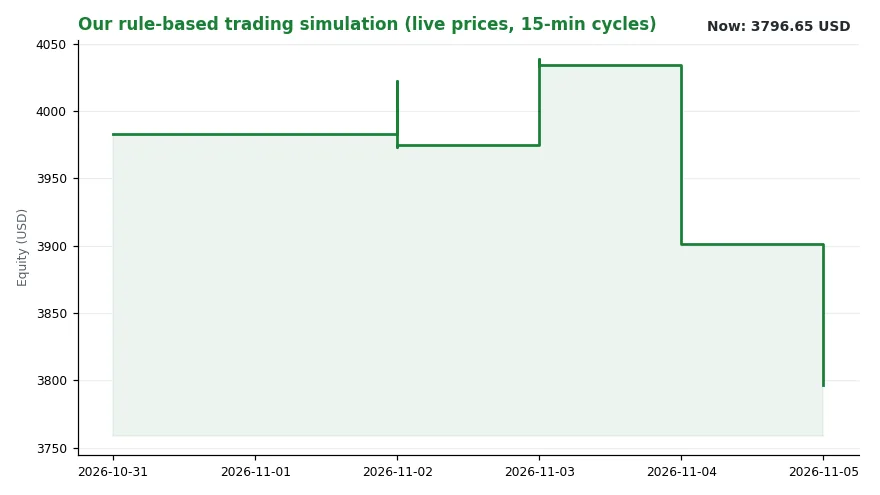
Our own measurement comes first, as it always does. At 15:12 UTC on 5 November, NVDA printed 186.63, down 6.74% against the previous close and sitting within 1% of the day’s low. TSLA traded at 348.74, minus 9.46%, sitting just 11% up from the bottom of its range. Gold (GC=F) stood at 4118.40, up 1.11% and mid-range at 58%. The DAX was 26444.22, plus 0.02%, holding the lower part of its band at 7%. BTC-USD changed hands at 76810.81, down 4.50%. KWEB was the odd one out at 24.54, up 0.88%. KOID sat at 32.20, minus 4.30%, pinned at 0% of its range — the exact low. Our simulated equity book marked 3796.65 USD, 2.68% below the same time yesterday, with 1911.74 in cash and a logged decision to buy NVDA at 191.09.
Read as a set, those prints describe dispersion, not a crash. The long-duration growth complex sold off, bullion caught a bid without breaking out, Europe barely moved, and one China proxy went the other way. We first read the session as plain rotation out of AI hardware into defensives. The gold print corrected us. Rotation stories do not usually park bullion in the middle of its range while pushing a single mega-cap to within 1% of its low. That is a discount-rate pattern, or at least it is closer to one than a growth-scare pattern.
Which is why the World Bank’s annual International Debt Report lands on our desk with an uncomfortably familiar shape. The numbers are macro, not market, but the channel is identical: the price of money.
What the report actually found
Debt owed by developing countries rose to a record $9.4tn last year, World Bank data show [1]. The increase was 5.5%, the fastest in four years, and it was driven by a rapid rise in private-sector lending [1] That composition matters more than the headline. Private creditors price risk continuously, so a private-heavy debt stock repricess continuously too.
The poorest borrowers — those eligible for concessional lending from the World Bank — faced an average interest rate of 8.2% on new borrowing, the highest level since the late 1980s [1]. Preliminary data for 2026 suggest lending continued at a rapid pace, and at continued high rates, as global financing costs rose [1]. The report names specific cases: Laos borrowed at 11.5%, the Republic of Congo at 13.88%, and Kenya at 9.2% [1].
The World Bank’s chief statistician, Haishan Fu, framed the tension in one sentence: “Access to international finance has improved, but the price of that finance has not. Low- and middle-income countries are borrowing more, paying more, and, in many cases, leaving less for long-term development.” [1].”. Stripped of diplomacy, that is a crowding-out statement. Every percentage point of servicing cost is a percentage point that does not become a road, a grid connection or a school.
The report goes further and links debt burdens to food. It finds that global shocks hit food availability harder in heavily indebted countries, and that debt burdens are closely associated with a decline in the affordability of a healthy diet during periods of global stress [1]. That is the mechanism made physical: a refinancing wall becomes a nutrition outcome.
The channel: price, not volume
Follow the plumbing. A sovereign with a large external debt stock and a short average maturity must return to the market regularly. Each return is a repricing event. When global financing costs rise, the repricing is upward, independently of anything the sovereign did. Higher coupons then consume revenue that was earmarked for investment, which lowers future growth, which raises the perceived risk, which raises the next coupon. The loop is mechanical and it does not require a crisis to operate — only time.
The structure of the creditor base is what makes this round harder than the last one. Today’s creditors tend to be private-sector bondholders rather than governments, which makes the situation more complex than in the run-up to the 2005 Gleneagles summit, when G8 countries signed up to write off billions of pounds worth of debt [1]. Writing off debt owed to governments is a political decision. Restructuring debt owed to bondholders is a negotiation with many counterparties, each with a different entry price and a different incentive to hold out.
Who moves, who waits
The UK government is preparing to champion a “new drive on debt” as part of its G20 presidency next year, a move the prime minister, Andy Burnham, has linked to confronting the legacy of slavery [1]. Burnham has appointed the former Labour prime minister Gordon Brown to examine the feasibility of changes to the global debt regime ahead of that presidency [1]. A review is not a facility.
The foreign secretary, Ed Miliband, set out plans last month for a “new deal” for heavily indebted countries in a speech at the IMF annual meetings in Bangkok, likely to include proposals to mobilise the balance sheets of the World Bank and other multilateral development banks to buy back outstanding debt, extend repayment periods and bring down interest rates [1]. Demonstrators at that same Bangkok summit demanded debt relief for poorer countries [1]. On the institutional side, the World Bank board backed changes to the debt sustainability framework for poor countries in September [2].
Demand for reform is not confined to London. African Union heads of state have pushed for changes to the international debt framework, and the topic advanced under the G20 chairs of Brazil and South Africa [1]. The direction of travel is visible. The calibration is not.
What we watch next
Four observable items, in order of how much they would tell us. First, whether the Brown review produces a mechanism or a communique — a buyback facility with a mandate and a balance sheet is different from a promise to study one [1]. Second, whether the September changes to the debt sustainability framework change actual loan terms, because the 8.2% average is the number that matters and it is set at origination [1]. Third, whether the 2026 data, still preliminary, show the private-lending share continuing to climb, since that is what makes future restructurings slow [1]. Fourth, whether high rates persist long enough that the food-security association the report documents shows up in the next edition as something harder than an association [1].
Our own readings add a caveat, not a forecast. The regime reading is trend=falling with level=3.63, and the busiest signal channel today is “central banks” with a single logged event. One event is a thin basis for any inference.
Those are open questions, and we will label them as open until they close.
The cheapest version
Here is the least exotic tool in the box, and it is the one already on the table. Extending repayment periods and buying back outstanding debt at a discount requires no new treaty, no new institution and no write-off ceremony [1]. It requires a balance sheet willing to act as a buyer and a creditor base willing to accept a haircut against the alternative of a longer wait.
That is the simple version. It is cheap relative to a default, cheap relative to a lost decade of investment, and cheap relative to the food-security cost the report describes [1].
The World Bank’s report says the same thing, in dollars and in diets, for borrowers who never got to set that price in the first place [1].
Sources and quotes
[1] World Bank International Debt Report data as reported by The Guardian — record $9.4tn, 5.5% increase, 8.2% average rate for the poorest, preliminary 2026 lending data, food and nutrition security findings, Bangkok protest context. Haishan Fu, World Bank chief statistician, verbatim quote as published. Borrowing rates cited in the report: Laos 11.5%, Republic of Congo 13.88%, Kenya 9.2%. Ed Miliband, “new deal” speech at the IMF annual meetings in Bangkok; proposals on MDB balance sheets, buybacks and repayment periods.
UK G20 presidency, Andy Burnham’s “new drive on debt”, link to the legacy of slavery, appointment of Gordon Brown. Gleneagles 2005 comparison and the shift to private-sector bondholders. African Union heads of state, plus G20 chairs Brazil and South Africa. World Bank board backing for changes to the debt sustainability framework for poor countries (US News, 21 September 2026). Our own measurement, 5 November 2026, 15:12 UTC; simulated book and signal layer as logged.
This is analysis for educational purposes, not investment advice.
—