Nvidia’s Long Exhale: The Tape After Jensen Huang
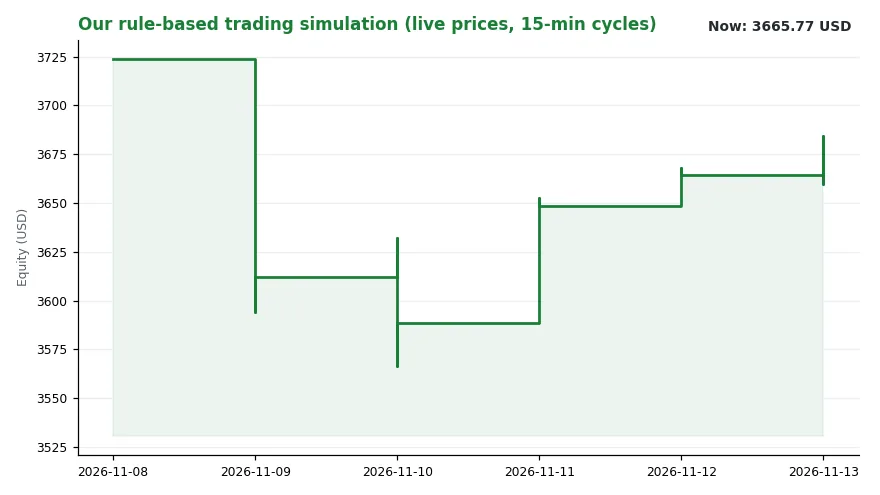
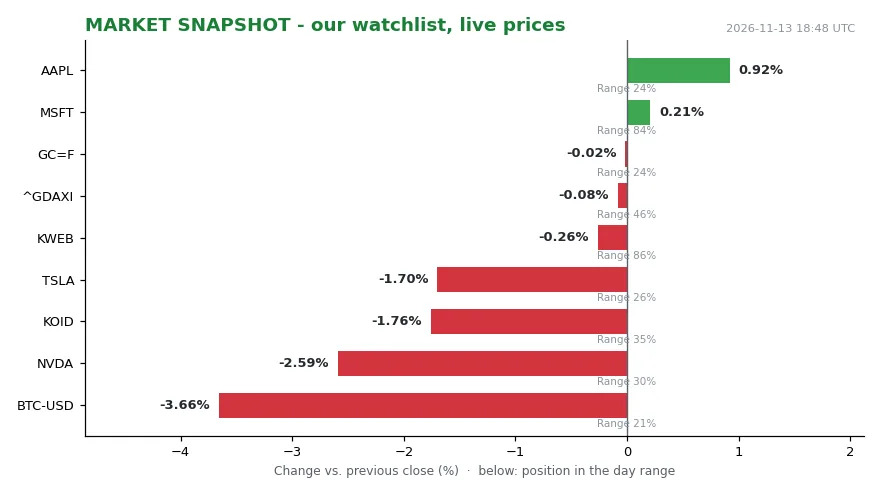
At 18:43 UTC on 13 November, our watchlist showed NVDA at 162.10. That was 2.46 % below the previous close and 32 % of the way up its daily range (percentage of range: where the price sits between the day’s low and high) — dead centre, no conviction in either direction. Apple printed 358.14, up 0.92 %, but pinned near its day lows at 24 % of the range. Microsoft held 523.88, up 0.17 %, near its day highs at 82 % of range. Tesla traded 390.48, down 1.75 %, mid-range at 25 %. Bitcoin showed 68,736.87, off 3.69 % and close to its low at 21 %. Gold stood at 3,884.40, effectively flat at minus 0.02 % and 24 % of range. The DAX was 26,749.95, minus 0.08 %, mid-range at 46 %. KWEB, our China internet proxy — an exchange-traded fund used as a stand-in for Chinese internet stocks — sat at 22.84, down 0.31 % but near its high at 82 % of range. Our rule-based simulated book — a model portfolio we run on paper, not with client money — read 3,665.77 USD, up 0.04 % against the same time yesterday, with 1,839.73 in cash. The last logged decision was WATCH KWEB at 0.00. Our signal layer — our internal feed of scheduled events by theme — had its busiest channel on 12 November as “central banks”, with two events. Our regime reading — our internal classification of the market’s direction and strength — was trend=falling, level=3.63.
A rotation, not a flight. Two names in that snapshot sat at 82 % of range: MSFT and KWEB. Two sat near their lows: BTC at 21 % and gold at 24 %. NVDA, TSLA and KOID clustered in the middle at 32 %, 25 % and 33 %.
That is not the silhouette of broad liquidation. It looks more like money changing seats inside a downtrend. Our regime flag confirms the direction. The busiest signal channel carried central-bank events, not semiconductor news.
Nvidia announced Jensen Huang’s resignation on Thursday [1]. Huang, 63, was one of AI’s most visible champions. He fuelled the boom with advanced chips and financing deals across the supply chain. Nvidia invested in customers and suppliers. That helped cloud providers and AI labs build out the infrastructure running on its silicon. Colette Kress, finance chief since 2013, has taken over as interim CEO — a temporary chief executive until a permanent one is appointed — while the board looks for a permanent successor. The price reaction was severe. Weekend reports of Huang’s infidelity preceded it. Share price losses wiped out $900 billion of the chipmaker’s market value between the previous Friday’s close and Thursday’s intraday low. In total, about $1.8tn (€1.6tn) of market value has gone since the record close on 6 October, when shares ended at $239.24. [2] On Thursday the stock fell 4.3 % to $166.19, near its 52-week low — the lowest price the share reached in the past twelve months — [1]. Our 18:43 reading of 162.10 sits below that close.
The Multiple Was Pricing a Person At $166.19, Nvidia traded at 13.7 times expected earnings. Rival AMD traded at 38.9 times, according to Koyfin data cited by
The Information [1]. On the surface, that gap looks like a discount, because demand for Nvidia’s products remains high. But a multiple is a price for a story as much as for a cash flow. Kunjan Sobhani, a senior semiconductor analyst at Bloomberg Intelligence, pointed to longer-term risks around succession, dealmaking and scrutiny over China as investors reassess the “Jensen premium” [1] The price targets — analysts’ forecasts of the share price in about twelve months — trace the same repricing. Before the resignation, analysts at Yorkville Ives, led by Dan Ives, estimated Nvidia was worth $225 a share without Huang as CEO — 25 % below their $300 estimate with him at the helm [1]. [1] Several brokerages landed near that figure. Bernstein and Baird cut their targets to $200. Citi lowered its target to $225 from $285. Baird reaffirmed its target after the resignation. Goldman Sachs stood by its buy rating — an analyst’s recommendation to purchase the share — and $220 target, citing Nvidia’s order backlog — orders already booked but not yet delivered and billed — and product plans [1].
The Deal Machine Needs a
Hand on the Valve Huang’s role was not confined to product strategy. He also ran the financing side.
That is a self-reinforcing loop — a cycle in which each step feeds the next — and loops need a hand on the valve. The open question for investors is whether Kress can keep up the pace of dealmaking that helped Huang drive the AI boom [1]. Dan Coatsworth, head of markets at AJ Bell, frames the succession risk this way [2]:. [2] The AI industry is moving at an incredible pace and staying abreast of technology developments and spotting ‘tomorrow’s world’ opportunities is not easy.”
The actors. Kress is the incumbent operator: a familiar face, finance chief since 2013, now holding the interim title while the board searches.
The customers are the cloud providers and AI labs whose spending plans underwrite the revenue line. The suppliers are the other half of the same financing loop. Governments, with China scrutiny named explicitly, form a third constituency that Huang handled personally [1]. Rival AMD functions as the valuation yardstick rather than as a direct cause of the move. On the losing side of the ledger sit holders who paid for the “Jensen premium” and are now being asked what they will pay for the same earnings under a different signature. Nvidia reports on Tuesday, 17 November, after the US market closes; revenue more than doubled to $96.2bn (€86.8bn) in the quarter to 26 July, with data centres accounting for more than 90% of sales, and the company forecasts about $108bn (€97.5bn) for the quarter it is about to report against $109.3bn (€98.6bn) expected by analysts polled by Visible Alpha [2].
Coatsworth separates the two horizons cleanly:
“While the shares have been knocked for six on the spy scandal and Huang’s subsequent departure from the company, no CEO is irreplaceable, and Nvidia’s day-to-day business will keep ticking along. It’s the long-term vision that could come under question.” [2].”
Sources